
Zoho co-founder and Chief Scientist Sridhar Vembu has warned that artificial intelligence (AI) is creating growing risks for people whose jobs primarily involve working on computers. On October 29, 2026, Vembu said that one skilled person using AI could perform work that previously required a team of 10 people.
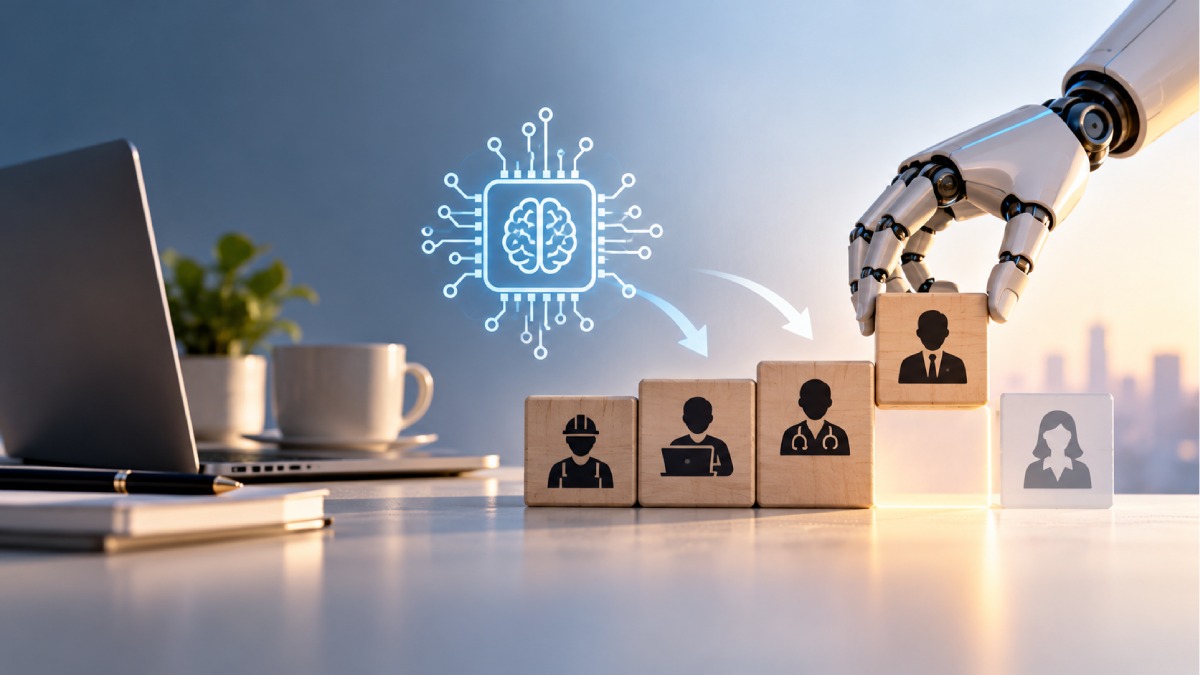
His remarks highlight the growing debate about how AI-powered tools could change productivity, hiring practices and employment opportunities across industries. AI can help workers complete certain tasks faster, but its increasing capabilities could also force businesses and employees to adapt to a changing job market.
Vembu warned people not to interpret his comment as a prediction that 90% of computer-based workers would lose their jobs. But rather he framed the potential impact as a broader economic shift that could be difficult to cope with for workers and businesses in the transition.
Why Sridhar Vembu believes AI will transform Computer-Based Jobs?
Vembu also highlighted how AI tools are beginning to help people do things that once required several employees.
His warning applies to work done on computers where AI can assist with writing code, analysis of information, writing content, and automating repetitive tasks. Depending on the work, these capabilities can help businesses to operate on fewer resources or increase the number of employees that are doing the work.
The implications could be for software development, digital marketing, research, customer support, and other knowledge-based professions.
But productivity gains do not necessarily translate to the elimination of entire occupations. The impact will depend on the nature of the work, how businesses implement AI, the quality of its output and the need for human judgement, oversight and accountability.
Why AI will not directly eliminate 90% of jobs?
Vembu specifically emphasized that his warning should not be interpreted to mean that 90% of people working on computers will become unemployed.
It is clear that AI could make professional services more affordable for businesses that didn’t have the personnel to hire specialized employees before and for those businesses without them, he added.
And a small business that is not well-equipped to pay a software engineer could be able to develop or maintain digital products with AI-supported tools, for example. Businesses that have previously considered digital marketing to be too expensive would also be able to access the information they need to reach customers and grow.
This could create more demand for some skills and services as AI changes how much work is required to deliver them.
So the outcome might be job displacement, new responsibilities, new opportunities, job growth and demand in different sectors. The degree of these changes will be dependent on how quickly companies adopt AI and if new business activity creates enough opportunities to offset jobs lost to automation.
AI may very well trigger a painful economic rebalancing.
Vembu described the transition as an economic rebalancing that may be painful at times. Workers whose jobs are easier to automate may need to adjust to new expectations, acquire new skill sets or take on more complex jobs that rely on human interaction.
Businesses might also have to re-examine their staffing needs, investment priorities and operating models as AI tools take on more responsibility in their workplace.
For employees, the change is difficult if they no longer possess skills that employers need. Smaller businesses might benefit from low expenditure technology and specialist skills that are beyond their budgets in the future.
Vembu’s message was that workers and businesses should acknowledge the changes taking place and prepare for their consequences as opposed to thinking that the existing working conditions will stay the same.
What has Vembu said about Zoho and AI-related costs?
Vembu’s comments come at a time of broader change in the software industry with companies integrating AI into operations.
In earlier remarks reported in October 2026, he discussed increasing infrastructure costs, such as higher server prices and increased expenses associated with AI usage. Zoho had also reduced its marketing budget and would not provide its usual annual salary increases to employees that year.
These comments reflect the financial pressures that can accompany technological change. While AI can improve productivity, developing, deploying and operating AI-enabled systems can require significant computing resources and investment.
So companies should weigh the savings in efficiency against infrastructure costs and business priorities and workforce needs.
What workers have to do to prepare for AI?
Vembu’s warning is a reminder to adapt to changing workplace expectations. No one skill can ensure job security, but we can do things to be competitive.
- To use AI tools: Learn how AI can support what you do in your profession and to identify where AI is not good for your job and where limitations need to be found by a human.
- Strengthen basic skills: Communication, analytical thinking, problem solving, and domain knowledge remain important when interpreting AI-generated work.
- Building practical experience: We need to be able to build real experiences: Put AI in practice: Use AI to support real projects in a practical manner and measure results in real work, rather than rely solely on theoretical knowledge.
- Develop adaptable skills: Be prepared to learn new tools and take on responsibilities as job requirements evolve.
- And then, judgement and quality: A way to verify information, make decisions and understand business needs can complement AI-assisted productivity.
The value of these steps will vary by profession and workers should assess which capabilities are most relevant for their particular roles.
What is the future of work in the AI era?
Sridhar Vembu’s warning is an indication that AI will change the relationship between productivity and employment significantly. A single worker may do more with AI, but the impact on jobs will be based on how companies, industries and economies respond.
AI could reduce demand for some tasks; yet, that would also open up new services to other people. The transition is not necessarily easy for people who are already doing things that automation has already made so much work for them.
For now, Vembu’s main message is that AI-driven change is becoming increasingly difficult to ignore. And with continuous learning, practical AI skills and adaptability, workers will be able to cope with a changing job market.






Comments