One engineer has made headlines with an invention that looks like it has emerged from a futuristic science fiction movie - an umbrella that can be launched on a drone to hover above a person. Instead of the user holding an ordinary umbrella, the prototype is moved by aerial propulsion and the umbrella is launched over the person. It’s a hybrid of everyday weather protection with drone technology that shows how familiar objects can be redesigned with modern engineering.
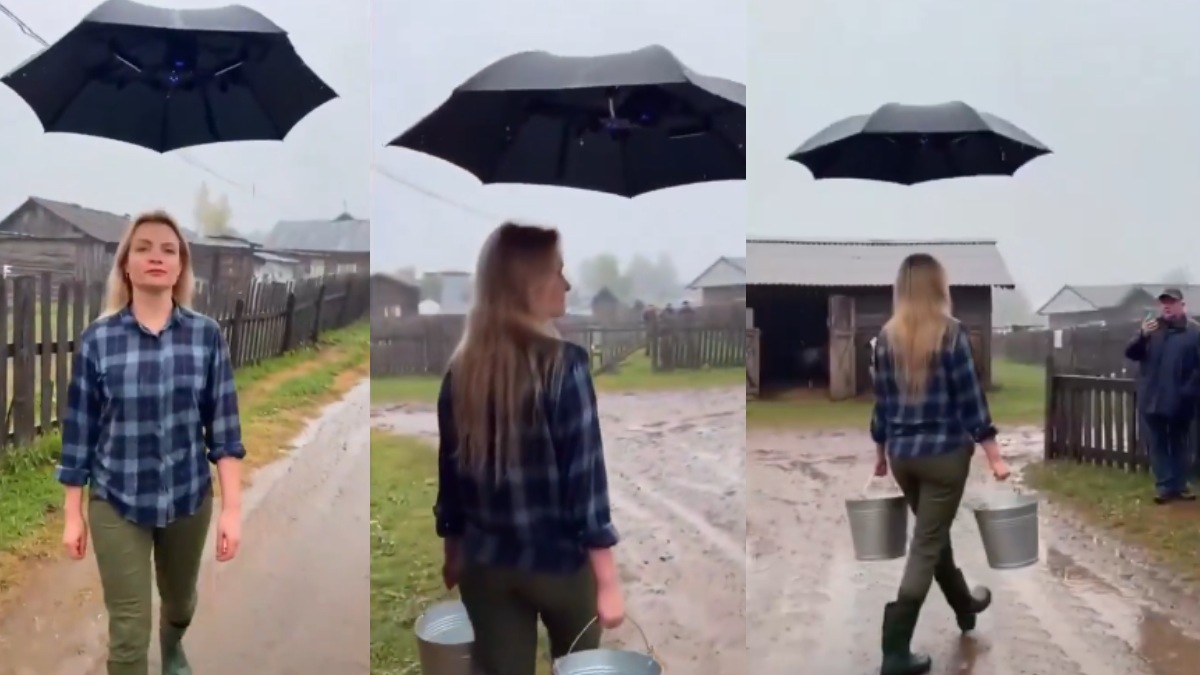
Traditional umbrellas have remained largely unchanged for generations. While manufacturers have made progress with automatic opening mechanisms, more robust frames and compact structures, the basic concept is that a person will still hold the umbrella. The drone-powered approach aims to do away with that by keeping the canopy out of the user’s hands and letting it fly above them.
At the core of the solution is drone technology. Small unmanned aerial vehicles can maintain their position in the air by continuously changing the speed of their rotors. The engineer has used this ability and an umbrella-like canopy to create a system to hover above the user's head. The drone is used to lift and position the umbrella and protect the canopy against rain.
I think it would be ideal for people who need to have both hands free to walk out into a field with one hand held at the same time (hand free of course). A conventional umbrella can be cumbersome to carry things like bags, use certain equipment or do other things. A hovering umbrella might then be able to compensate for this by following or standing above the user and not require them to hold the handle (e.g., the user might be the one who is holding a handle on the umbrella).
But keeping an aerial device safely above a person's head is very challenging from engineering points of view. A drone must always be in a position that will adjust to wind, movement and change in the surrounding environment. An umbrella canopy can also be different from a traditional drone in that it can absorb wind. Gusts might push the drone away from the intended position and stability is crucial.
Another challenge is that the drone is not too close to the person beneath it. Rotating propellers are a danger and, therefore, any practical version of such a device would have to be designed with very strict protective systems in mind. Engineers might also investigate enclosed rotors, protective cages, automatic emergency landing mechanisms and obstacle detection technology to help make it safer.
Battery life would also be an important factor. While the usual umbrella is able to remain open indefinitely without any energy, a flying umbrella would need continuous power to keep the motors running. Then a practical consumer version would need an efficient battery system to provide enough flight time and still keep the weight down.
The invention also raises questions of autonomous navigation. A more advanced version might use sensors, cameras or positioning systems to detect how the user moves and automatically adjust its location. A system would have to be able to differentiate the person who is carrying and wearing the device from other people around it. Artificial intelligence and computer vision may be a very close ally of how the technology will be able to be more responsive.
The concept shows how drone technology is being taken beyond photography, surveying and delivery through the development of drone technology in ways that are not just conventional applications. Engineers and inventors throughout the world have used drones for entertainment, agriculture, emergency response and transport. The hovering umbrella puts the technology in a much more everyday category by trying to solve a simple problem with aerial automation.
Hence, it is not yet clear to us whether such an invention will be commercially available. The price, safety, battery performance, noise and regulations will affect its future. Drone use is in many countries governed by aviation and safety laws especially when devices are manned or in public places. A consumer product would need to meet these rules before commercial use.
Despite all these difficulties, the flying umbrella has great novelty value. It demonstrates how engineers can rethink ordinary objects by combining them with technologies that were once associated primarily with specialised industries. A simple umbrella can become a flying device with sensors, motors, batteries and autonomous control systems.
The idea also is a fascinating example of experimental engineering. Not every futuristic invention is a mass-market product, but prototypes are the first to show us what is technically possible and encourage further development. Better battery power, fast motors and autonomous navigation might eventually make even exotic concepts like hovering personal devices possible.
Bu mühendis, drone teknolojisini kullanarak başının üzerinde havada duran bir şemsiye geliştirdi. pic.twitter.com/KSYALTMYf6
— Mühendislik Harikası (@muhendisIiktr) August 21, 2026
So far, the drone-powered umbrella is still a very striking example of innovation and creative engineering. Because it allows an umbrella to hang above the user rather than being held by hands (as we often do in a rainy day), it turns an everyday item that is used to keep one’s umbrella into an aerial gadget that is now a futuristic aerial object. And although much work will be required to make such technology safe, reliable and affordable, the invention can be used to make even the simplest everyday things into experiments in technology at once.