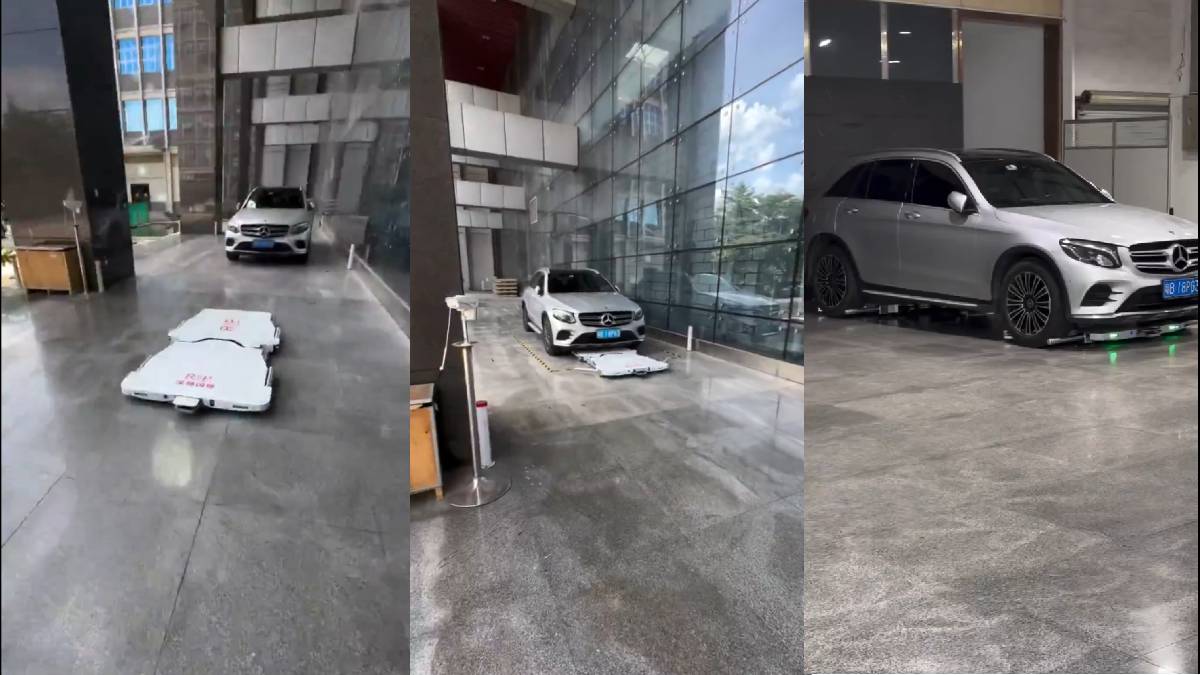
A new generation of fully autonomous valet robots is showing how technology could change the way people park and retrieve their vehicles. These robots can take on tasks that human drivers can’t do to move vehicles out of an empty space, navigate tight spaces, and actually place vehicles in parking spaces.
Parking is one of the most frustrating parts of driving, especially in crowded cities where space is tight. Drivers often spend several minutes looking for a parking spot before trying to manoeuvre their vehicle into a narrow space. Tight corners, pillars, other vehicles and limited visibility can make the process even more difficult.
Autonomous valet robots are designed to solve many of these problems by taking over the parking task.
Instead of requiring a driver to remain behind the wheel, the vehicle is parked in a drop-off area. The autonomous system can then take control of the parking process and move the car to a spot and navigate areas where it is difficult for a human driver to navigate.
One of the most successful aspects of the technology is that it can operate in tight spaces. Parking facilities are often designed around maximum space utilisation, so manoeuvring room can be limited. Sensors and navigation technology could help an autonomous robot detect the surrounding obstacles and calculate an appropriate route.
Once the vehicle is parked, the system might be able to track it and retrieve it when the owner is ready to go away. This would eliminate the need to walk through large parking facilities to find a vehicle.
Fully autonomous valet robot that parks, retrieves, and navigates tight spaces with ease. pic.twitter.com/qPQeDf5ENL
— Massimo (@Rainmaker1973) August 17, 2026
The technology will be most useful at airports, shopping malls, hotels, hospitals, large commercial parking sites, and high-density commercial parking sites, in particular. Parking spaces can take up a lot of space, and it can be hard to get a vehicle in there during busy times.
Automated parking might even improve the efficiency of current parking infrastructure. If cars could be more precisely positioned, parking operators might be able to take advantage of the amount of available space in place; parking operators can better use it. Autonomous systems could even move cars closer together and keep safety margins for movement and retrieval.
Another potential benefit is less congestion in parking lots. Drivers searching for a particular parking spot often create unnecessary traffic as they travel through the parking lots. A robotic valet system could coordinate vehicle movements and direct cars to the spots they need and, theoretically, make the whole process more organised.
But safety is still very much a major consideration. Autonomous parking systems need to detect pedestrians, other vehicles, walls, pillars and unexpected obstacles. Real-world robots have high-performance sensors, cameras and mapping systems, but they need to be able to work reliably in unpredictable situations.
The technology also raises questions about how parking will be redesigned in the future. If autonomous systems become widespread, parking structures may in fact be based on robotic vehicle movements instead of human driving patterns.
In the end, the biggest attraction to consumers might be convenience. Instead of searching for a parking spot, squeezing into a narrow space and then trying to remember where the car was, drivers could simply hand over the parking to an autonomous system.
The concept is also part of the wider development of smart mobility. Autonomous driving, connected vehicles, artificial intelligence and robotic systems are converging to automate everyday transportation tasks.
Fully autonomous valet robots might eventually play a central role in future mobility infrastructure. While widespread adoption will depend on safety standards, reliability, cost and compatibility with different vehicle models, the technology shows how parking itself could become increasingly automated.
The classic valet service has always been about convenience—handing a vehicle over to another person and parking it. Autonomous valet robots are taking that to a higher level by replacing the human driver with a robotic system to take the driving and parking of vehicles independently.
With cities getting even more crowded and parking spaces getting more valuable, new technology that can make parking so much faster, smarter, and more efficient is going to attract more and more attention. The autonomous valet robot is an example of a future where finding and parking a car may not be a headache for drivers, and they won’t have to worry about it.