
In an unexpected political development, the Bharatiya Janata Party (BJP) suffered setbacks in the recent Legislative Council elections in Varanasi, Prime Minister Narendra Modi’s parliamentary constituency, and Nagpur, the hometown of Maharashtra Chief Minister Devendra Fadnavis and Union Minister Nitin Gadkari.
In Uttar Pradesh, the Samajwadi Party (SP) won both the Varanasi Teachers’ and Graduates’ constituencies, dealing a symbolic blow to the BJP in a region closely associated with the Prime Minister. Meanwhile, in Maharashtra, Congress candidate and sitting MLC Abhijeet Wanjari retained the Nagpur Division Graduates’ constituency, defeating BJP candidate Sudhakar Kohale by 3,271 votes. The results have prompted questions about the BJP’s performance among these electorates, even as the party retained an overall lead in the Uttar Pradesh MLC elections.
Om Prakash Rajbhar’s Response
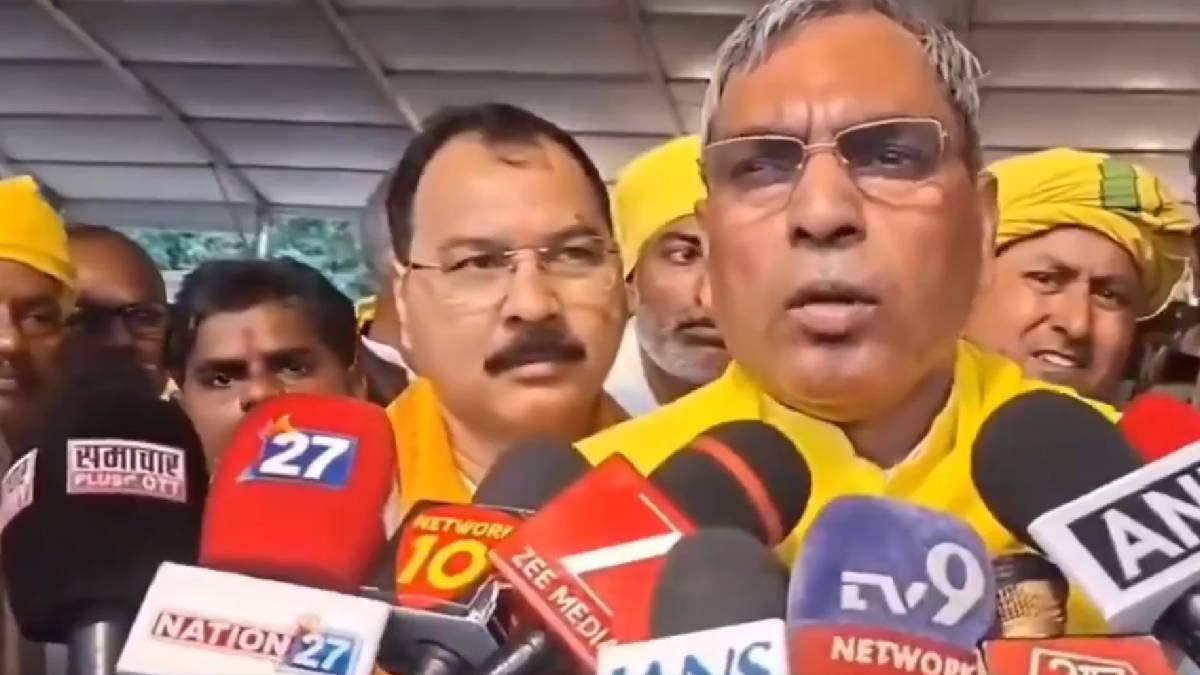
When asked about the BJP’s defeat in Banaras, Uttar Pradesh Panchayati Raj Minister and Suheldev Bharatiya Samaj Party (SBSP) president Om Prakash Rajbhar said the result reflected the mandate of educated voters rather than that of the general public.
“The mandate is that of educated people. These are the votes of educated people, not the general public,” Rajbhar said, according to media reports. He also argued that the MLC elections should not be treated as a rehearsal for the 2027 Uttar Pradesh Assembly elections, pointing out that the electorate and voting patterns differ between the two types of elections.
His remarks have attracted scrutiny and become a subject of mockery and debate on social media. Some have interpreted the statement as suggesting that the BJP’s wider voter base is less educated, although Rajbhar’s comments were also made in the context of the different electorates involved in MLC and Assembly elections.
Reporter: The Samajwadi Party has won MLC seats in Varanasi. What do you make of it? NDA Minister: “Ye padhe likhe logo ka vote hai, aam janta ka vote nahi hai.” Is he calling his own voters uneducated, or implying that educated people don’t vote for the BJP? 😭😭 https://t.co/hLGaXnu9Gx
— Anukram (@AnukramWrites) October 29, 2026
Is the BJP Unpopular Among Educated Voters?
The available results cannot establish that the BJP is unpopular among educated people as a whole. MLC elections involve specific groups of registered voters, including graduates and teachers, and their results cannot automatically be extended to the entire electorate. A person’s educational background, by itself, does not determine their political beliefs, priorities or voting choices.
While the jokes about Rajbhar’s remarks continue, the debate also points to a broader problem in political discourse: the tendency to treat large sections of the population as a single, undifferentiated group.
The Problem With Stereotyping Ordinary Voters
The assumption that educated, urban or politically vocal groups possess a greater understanding of political and social issues can be misleading. People with formal education and those without it are equally capable of evaluating political parties, questioning authority and making decisions based on their experiences and priorities.
India’s political history also offers examples of ordinary citizens participating in major movements, including the struggle against British colonial rule and protests against the Emergency. Many people who have faced social and economic disadvantages have nevertheless played significant roles in shaping the country’s political direction.
At the same time, educated and urban communities are not politically uniform. They can support different parties and ideologies, just as voters in rural and economically disadvantaged communities can. Reducing either group to a stereotype does little to explain how people actually make political choices.
Modi’s Support Among the Indian Diaspora
The group that usually only comments on culture and stolen art, they rarely gets ridiculed for their extensive support or is generalised as all Modi bhakts
A 2024 Indian American Attitudes Survey published by the Carnegie Endowment for International Peace found that 47% of Indian American respondents approved of Modi’s performance as Prime Minister, while 34% disapproved and 19% expressed no opinion. The findings show that support exists alongside substantial criticism and differing political views within the diaspora.
The growth of Indian-origin political and cultural organisations abroad, including Hindu nationalist groups, has also drawn public attention. Does it mean we can classify the diaspora as all Modi supporters?
Welfare Schemes and the Dignity of Voters
It is also important to scrutinise welfare schemes, subsidies and other benefits offered by the central government and state administrations, particularly used in seeking electoral support. However, voters who depend on these schemes should not automatically be blamed or ridiculed for accepting assistance.
For people facing financial insecurity, access to food, housing, healthcare, education or direct financial support can be a matter of everyday survival. It is easy to dismiss such decisions from a position of relative comfort, where politics may be discussed as an academic interest rather than an issue tied directly to a household’s future.
Political parties should be held accountable for how welfare programmes are designed, funded and implemented. But voters who use legitimately available benefits should not be dehumanised or portrayed as incapable of making informed choices.
Ultimately, such comments from liberal or leftist spaces just villainise poor and uneducated people. Which begs the question. Are you a leftist if you don't even support the weakest in your society? Because the left was all about providing an alternate route for those who can't have it.



Comments