A futuristic desk concept is attracting attention for its unusual approach to interacting with digital content. Instead of a touchscreen, keyboard or mouse, it appears to use simple hand gestures to manipulate holographic visuals above the desk. The technology offers a glimpse of what future workspaces could look like if physical screens gradually become more immersive and contactless interfaces.
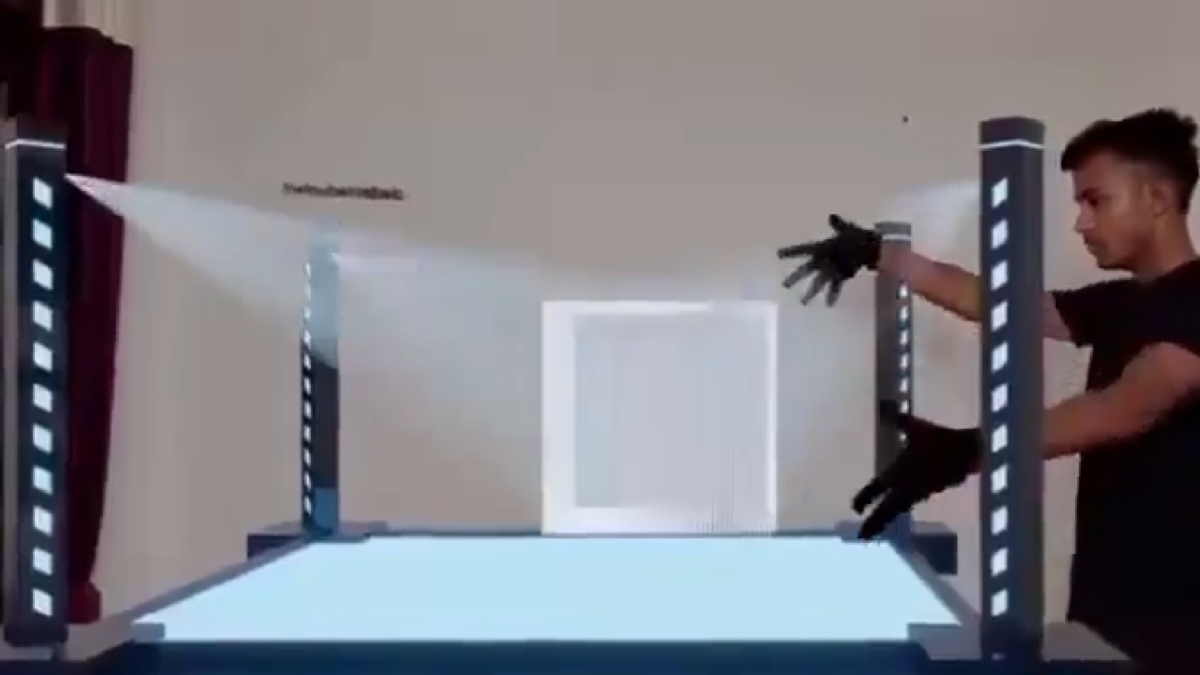
The images show a person standing beside a very beautiful desk with vertical structures shining out of it all over its surface. A bright, three-dimensional-looking visual seems to float over the tabletop and users use their hands to interact with the visual. In another, the displayed visual is projected across the workspace which gives the impression of a large interactive display without a monitor.
At the heart of the concept is gesture-based interaction. Instead of feeling a screen on their hands to control digital objects, users could move their hands through the air to move it. A wave could move an object, a pointing gesture could select something, and other predefined movements could be used to zoom, rotate or navigate through digital information.
The idea combines several technologies that are already being explored independently, including computer vision, motion tracking, projection systems, spatial interfaces and three-dimensional visualization. Combining these technologies would make digital interaction feel much more natural and immersive.
Imagine an architect manipulating a 3D building model above a desk, a designer rotating a virtual product prototype with their hands, or an engineer looking at a digital machine without having to switch between physical screens all the time. Such a model would also be useful in presentations, education, gaming and creative applications.
A holographic interface could also come with more flexibility than a fixed monitor. Digital content might be displayed in various sizes and positions as the user needs it. Many virtual objects could be displayed at once so that users are able to move from one information source to the other and not be restricted to the size of a traditional screen.
But making a practical holographic workspace is much more difficult than showing a futuristic visual effect. A commercial system would need accurate hand tracking, low-latency processing and reliable projection or display technology. It would also need to differentiate intentional gestures from ordinary hand movements so that users do not accidentally trigger commands.
Visibility is also an issue. Holographic and projection-based systems must work well in different lighting conditions and from different viewing angles. The system designed for everyday use would also need to provide comfortable visuals without causing eye strain during long sessions.
There is also the matter of physical interaction. Gesture controls are certainly nice, but keyboards, mice and touchscreens are already very efficient in order to perform a lot of tasks. Typing a long document, editing large spreadsheets or performing precise operations could be easier on the usual input devices. Future smart desks may have many interfaces rather than eliminate all of them.
Privacy and security will be just as important. A smart desk that can track hand movements could use cameras or sensors to see where things are. For offices and homes, users would need clear information about what data is collected, where it is processed and whether recordings are stored.
Next-Gen Desk Turns Simple Gestures into Interactive Holographic Displays
— Ronald van Loon (@Ronald_vanLoon) August 28, 2026
by @tweetciiiim
#Innovation #EmergingTech #Tech #Technology pic.twitter.com/mDMaAG4yzY
As hard as it is, the idea holds great promise for human-computer interaction. The desk is not just a piece of furniture with built-in technology; it is being considered as an interactive computing environment. The surface might be a place where digital information appears, moves and responds to the user’s physical actions.
The images in the literature around this concept should be seen as a demonstration of or futuristic technology concept rather than proof that a fully commercial holographic desk is already widely available. But the idea underlying it is part of a larger trend toward spatial computing and touchless interfaces.
As display technology, artificial intelligence, sensors and computer vision continue to advance, the way people interact with computers would change a lot. People might not sit in front of a rectangular screen, but instead work with digital information directly within their physical surroundings.
For now, the gesture-controlled holographic desk is still an intriguing vision of the future. But if the technology is affordable, accurate and practical, desks could turn from passive work surfaces into fully interactive digital environments—a simple hand movement into a new way to control the digital world.