
Artificial intelligence (AI) is revolutionizing the global economy and the US, China and India are leading the way in creating and adopting AI technologies. From advanced language models and automated business systems to AI-based healthcare and manufacturing, the technology is creating new opportunities and even making the sector have to deal with employment issues.
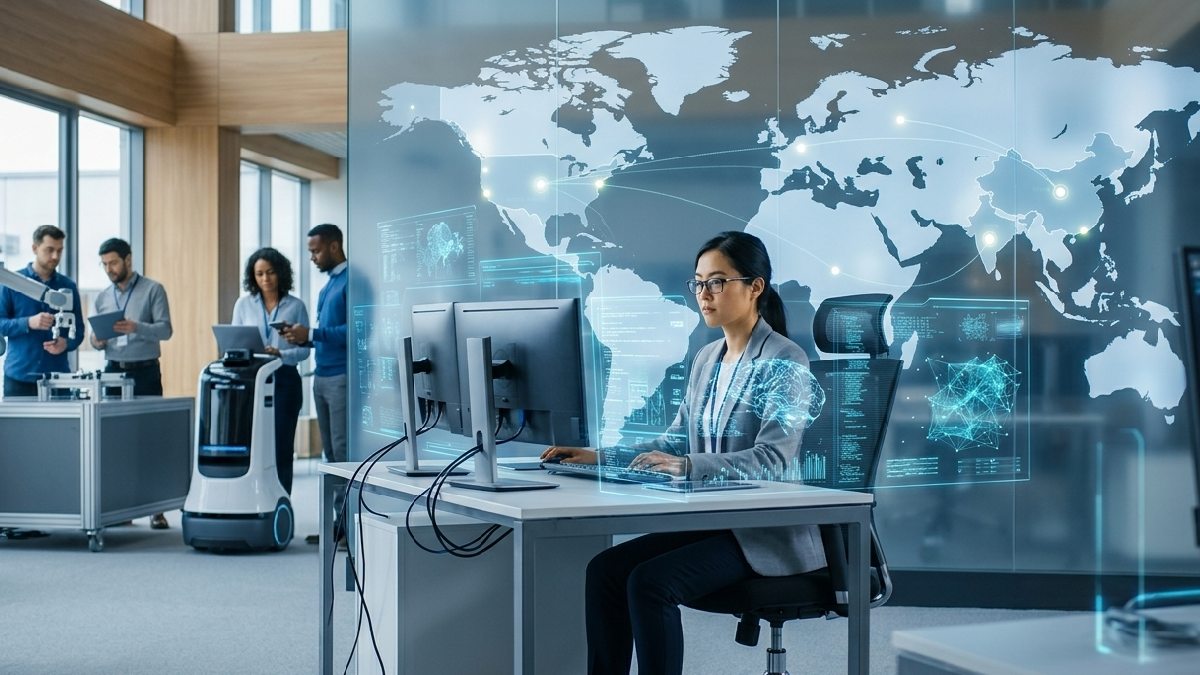
As the International Monetary Fund (IMF) has shown that 40% of jobs could be affected by AI, so governments, businesses, and workers need to prepare for changes in the workforce.
AI is a key issue that policymakers and industry leaders must address. AI is a big part of the decision-making process that companies across sectors are taking for AI tools to increase productivity and to reduce repetitive work.
Meanwhile, workers are wondering how automation will impact their jobs, what skills will be most in demand, and how quickly new jobs will be created and how to counter the impact.
The US, China and India are emerging as the major AI players
The US has an outsized role in the global AI industry due to the presence of the world's leading technology companies as well as research institutions with venture capital funding and advanced computing infrastructure.
American companies have developed large-scale AI models, cloud platforms, and specialized chips that help train and deploy AI systems. Private sector and government-funded research has kept the US at the forefront in AI development.
China is also investing heavily in AI research, digital infrastructure, and industrial applications. AI companies are developing AI models and integrating automation into sectors like manufacturing, logistics, financial services, and consumer technology.
China’s huge digital market and manufacturing ecosystem present opportunities for AI to be leveraged across a wide range of applications.
India’s position on the AI landscape is the result of its large technology workforce, growing startup ecosystem, digital public infrastructure, and growing demand for technology services. AI applications are being explored for customer support, software development, agriculture, education, healthcare, and financial services by Indian companies. The country has opportunities to make AI solutions available to local languages and region-specific needs, to increase access to digital services.
Leadership in AI, however, is more than developing software or developing models. Access to computing power, investment, quality data, skilled professionals, and reliable digital infrastructure also determines how a country can build and use AI at scale.
The IMF’s warning that 40% of jobs worldwide could be affected by AI highlights the scale of the transformation taking place. The figure refers to jobs that are affected by AI’s influence, not to the fact that the same proportion of workers will automatically lose their jobs.
AI can affect several different occupation-specific tasks in different ways. Some tasks will be automated while other tasks could be automated faster or more efficiently with AI assistance. In many fields, the technology could impact the way employees work and not eradicate human workers entirely.
Advanced economies may be more exposed as a larger share of their workforce is employed in jobs involving cognitive and information processing tasks. In emerging and developing economies, the immediate impact may differ depending on digital infrastructure, the composition of employment, and how well firms adopt AI.
The final result is going to depend on how companies use the technology, its speed of adoption, and whether new roles and industries come with automation. Productivity gains would boost the growth in the economy, but the benefits might not equally fall on workers, businesses, and countries.
Which jobs could see the biggest change?
Roles that are typically repetitive administrative duties, routine data processing, basic document preparation, and standardized customer interactions are especially likely to be affected by AI-driven changes. AI tools can already help with drafting, summarizing, translating, analyzing, and responding to common customer questions.
Some other professional jobs may also change dramatically. Software developers, financial analysts, marketing professionals, researchers, and other knowledge workers could use AI to complete things more quickly. In these disciplines, demand could shift toward work that is able to judge AI-generated output, solve difficult problems, and integrate technical tools with professional judgment.
At the same time, jobs requiring physical dexterity, in-person care, interpersonal trust, or complex real-world decision-making may be affected differently. Healthcare workers, teachers, skilled tradespeople, and service professionals could use AI to support their work, but the extent of adoption will vary by occupation and workplace.
It is important to distinguish between exposure and replacement. A job may involve tasks that AI can do without the whole occupation becoming superfluous. A lot of jobs have technical, social, and practical requirements that are hard to automate.
Why Skills and Reskilling Will Matter
As AI becomes more common, workers may need to update their skills throughout their careers. Digital literacy, critical thinking, communication, adaptability, and working with AI tools could be increasingly valuable across industries. Technical professionals may also need specialized knowledge in data analysis, AI development, cybersecurity, and responsible technology use.
Governments, educational institutions, and employers all need to prepare workers for these changes. Training programs, vocational education, and industry-related courses can take people into new roles. Businesses could also help employees to learn new tools and not just rely on workforce reduction.
India’s challenge, for example, is how to prepare highly skilled professionals and workers in sectors where access to formal training may be limited. AI could help improve productivity and expand services, but unequal access to technology and education could leave some groups less prepared for the transition.
The Road Ahead for the Global Workforce
AI has economic and employment opportunities. The United States, China, and India are all key players in the global AI landscape, but their success long term will depend on the way in which they develop technology, deploy it responsibly, and train people for the changes in the workplace.
The IMF’s warning is a reminder that AI will influence beyond the technology sector. Businesses need to reconsider workflows, governments will need to tackle potential labor market disruption, and workers will need to be given relevant training for their job and the job-market impact.
The question is not how many jobs AI can take up, but how economies can manage the transition and how much of the productivity boost should be spread out among workers.
AI will change the nature of work in the coming years. Whether that change leads to broad-based economic gains or more inequality will depend on investment in skills, responsible adoption, and policies that help workers adapt.







Comments