Scientists are exploring some of the most bizarre and potentially life-saving technologies that could revolutionize how emergency workers go about searching through disaster zones.
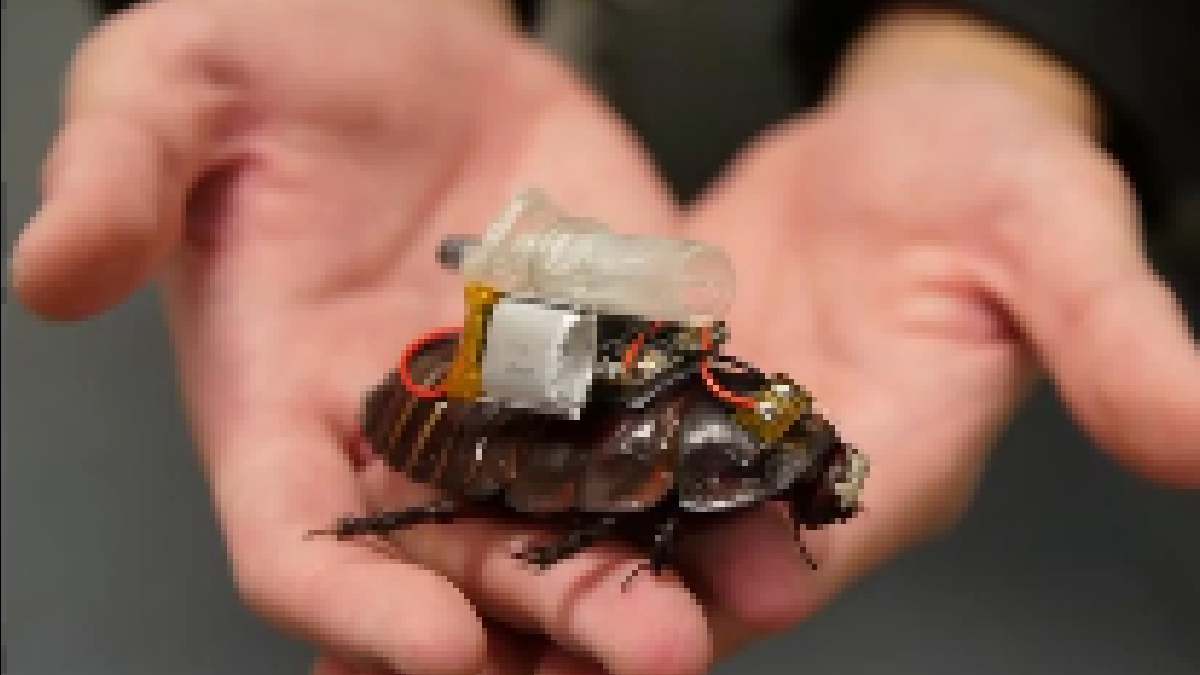
Scientists have developed so-called paraborgs, living cockroaches with little electronic systems that can remotely guide humans and robots into areas that can be too dangerous or even too hard to enter by human hands.
The idea combines biology with robotics. Instead of building a small robot from scratch, researchers utilize the natural traits of cockroaches such as their relatively small bodies, the ability to squeeze through narrow gaps and the ability to move along rough surfaces.
The insects are attached to electronic devices, which give a hybrid system that researchers can control.
The technology could be particularly useful in earthquakes, building collapses and other disasters where survivors may be trapped beneath rubble.
Conventional rescue robots can struggle to navigate piles of broken concrete, twisted metal and narrow spaces. But a small biological machine, if feasible, could be able to move through gaps that larger machines cannot.
The "paraborg" concept is based on using electronic stimulation to influence the cockroach’s movement. Scientists can send signals to the insect's nervous system to encourage it to move in particular directions. Sensors and miniature electronic equipment can also potentially provide information about the surrounding environment.
The technology is still experimental. Cockroaches are not afraid to survive in difficult environments and move across uneven surfaces.
Their biological design gives researchers the ability that is difficult to replicate with conventional miniature robots.
🔬 Baratas ciborgues ao resgate! 🪳
— Saber Atualizado (@AtualizadoSaber) August 27, 2026
Baratas ciborgues equipadas com câmeras e injetores de medicamentos em miniatura podem em um futuro próximo prestar atendimento de emergência supervisionado a pessoas presas em prédios desabados, cavernas ou outros locais muito perigosos ou de… pic.twitter.com/wxxnO3iaM9
There’s still experimental work on the technology, and there are still significant challenges before it’s a practical emergency response tool. Control systems, battery life, communication reliability and the ability to work the insects in a complex environment need to be further improved by researchers.
The ethical implications of using living creatures in technology are also well-known.
But in the face of such challenges the concept illustrates a new category of biohybrid robotics that is very much developing today.
Scientists are looking for ways to combine living organisms with electronics to produce systems that can handle tasks that machines find hard to accomplish.
In a future disaster scenario, a swarm of remotely controlled “paraborgs” could be deployed around collapsed structures to search for survivors or gather information about hazardous zones. With their small size they could explore spaces before rescuers enter.
The technology is far from replacing trained rescue teams, but it demonstrates how unusual biological abilities can inspire new engineering solutions.
What seems like an ordinary cockroach could be an unlikely search-and-rescue system, with miniature electronics.
As research continues, paraborgs may offer scientists a new approach to one of the most intractable challenges in disaster response getting to places where humans or robots can’t travel safely.