Toyota has studied a novel idea in mobility: a four-legged chair that can move over uneven surfaces and climb stairs. Instead of wheels, motors in each of its four limbs lift and place the chair as it moves.
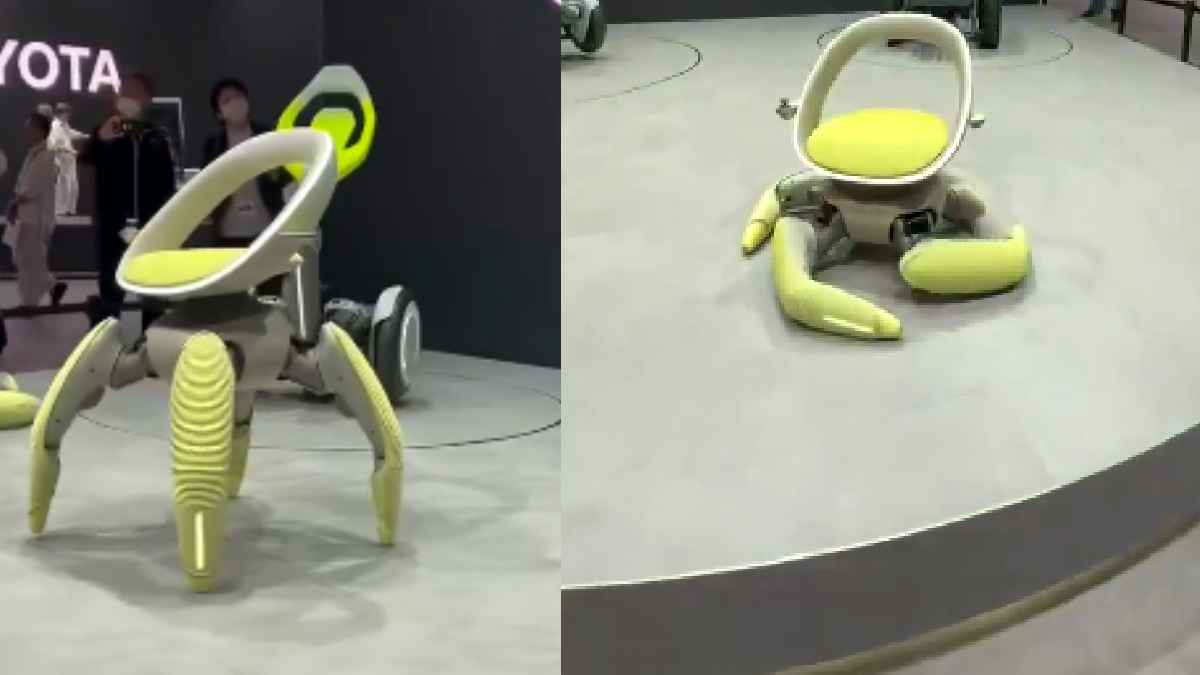
The idea addresses one of the biggest limitations of wheeled mobility stairs. Wheelchairs and other conventional wheeled devices generally need ramps, lifts or alternative routes when faced with steps.
Toyota’s walking-chair concept takes a completely different approach by attempting to make the chair itself capable of negotiating changes in elevation.
At the heart of the concept are powered legs that work in partnership to support and move the seat. Each limb can be manipulated to help a chair move upward, creating a walking motion and not a rolling motion. It could allow the chair to function in places where wheels have failed.
Another great feature is that the seat is relatively level while the legs are reacting to a change in the ground.

Keeping the seating area stable is important for comfort and safety, especially when the device is moving across uneven terrain or climbing a staircase.
Toyota’s experiment is part of a longer history of the automaker exploring mobility outside of cars. Robotics and mobility technology used to help people move in different environments are the company's core focus.
Concepts such as this show how engineering used to build vehicles can be applied to other forms of transportation and accessibility.
The walking chair also points to another future mobility technology to be developed. Robots could eventually be built to help overcome obstacles, and instead of making the staircases accessible to people, they would be built to do the job.
Toyota already built a chair with 4 legs that can walk upstairs
— P1eSenb (@P1eSenb) September 1, 2026
Motors in each limb. A seat that stays level when the floor does not.
⁰Wheelchairs stop at the first step. This one is meant to keep going.
They are not only making cars now. They are making the stairs stop being… pic.twitter.com/WJGMQaGz3C
Such technology might be useful in homes, public places and other locations where ramps or elevators are not necessarily available.
But a product such as this still faces significant hurdles before it becomes a daily mobility solution.
A practical version would need reliable balance control, strong motors, long battery life and safety systems to prevent falls.
It would also have to be affordable, easy to operate and suitable for different users.
The concept is therefore better understood as an experiment in mobility technology rather than as a replacement for modern wheelchairs now.
Its importance lies in the question it raises: what if mobility devices could adapt to the environment instead of forcing the environment to adapt to them
Toyota’s walking chair shows that the future of mobility may not always involve four wheels. Sometimes, the next step could literally mean using four legs.