A technological milestone in robotics was outlined at the World Artificial Intelligence Conference (WAIC) 2026 when Chinese robotics company UniAI launched the world's first quadruped robot that could perform a 720-degree continuous backflip.
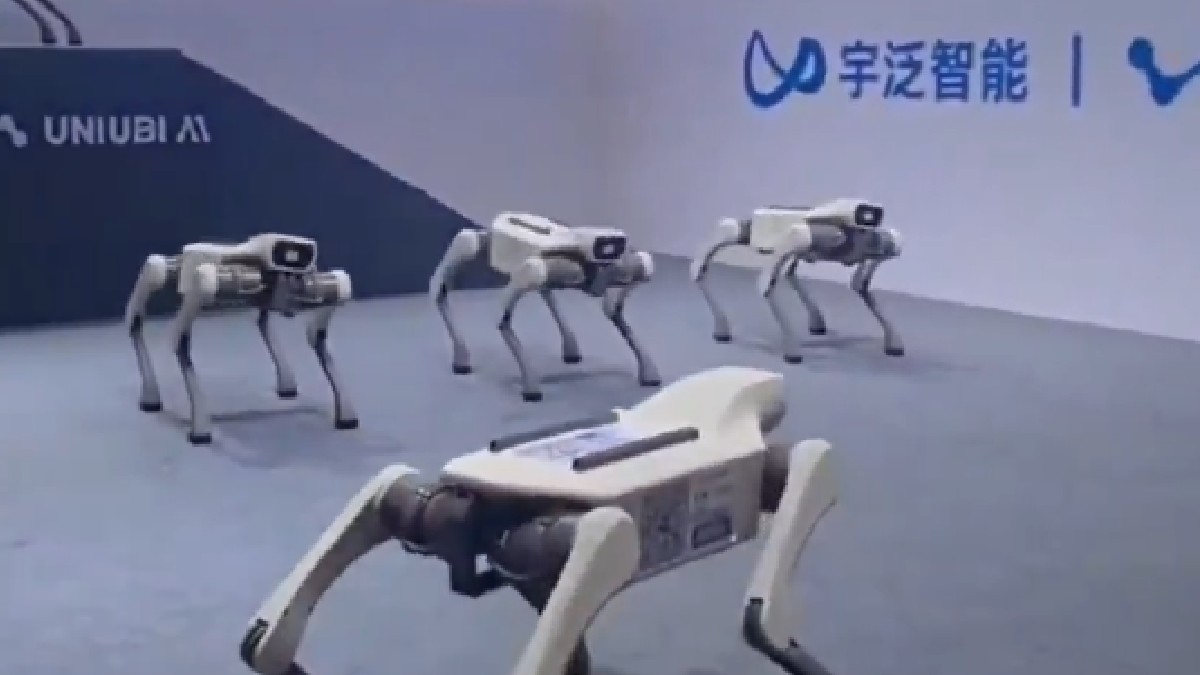
The demonstration was witnessed by technology advocates and robotics researchers alike. The robot did two full backward rotations in one continuous move, and landed well, demonstrating the robotics agility and precision.
While the backflip is visually impressive, experts say it is much more than a stunt. It is a game changer in dynamic balance, motion planning, real-time control systems and mechanical coordination critical skills for autonomous robots.
Unlike industrial robots that are generally working in a controlled environment, agile quadruped robots are meant to deal with unpredictable terrain and changing surroundings. To perform a continuous 720-degree backflip, this robot needs to figure out body position, weight distribution, joint movements and stability within milliseconds.
These technological advancements have applications beyond the exhibition halls in every field of practical use.
Researchers envision that these same control systems will help robots navigate rocky landscapes, climb uneven terrain, recover quickly after falls, and maintain balance in a situation where wheeled machines cannot move in that terrain.
One of the most promising applications is disaster response. Agile quadruped robots could go into collapsed buildings, pass through earthquake debris or search hazardous zones that are too dangerous for human rescuers to reach.
The industrial sector could also benefit. Robots with advanced mobility could perform inspections at construction sites, power plants, oil refineries, mines and other high-risk facilities without human workers needing to enter hazardous areas.
A quadruped robot just completed a 720° continuous backflip. 🤖
— CTO ROBOTICS Media (@ctorobotics) August 6, 2026
Chinese robotics company UniAI unveiled what it describes as the world's first quadruped robot capable of performing a 720° continuous backflip during WAIC 2026.
While the demonstration showcases impressive… pic.twitter.com/rMJC2iUMcE
With autonomous exploration with these robots, these robots could be used to map caves, forests, mountains and even extraterrestrial environments where rough terrain makes conventional vehicles ineffective.
Military, security, agriculture, and infrastructure maintenance are other fields that will benefit from the increasingly capable quadruped platforms.
In the last few years robotic locomotion has advanced dramatically with machines capable of running, jumping, climbing stairs and recovering from unexpected disturbances. UniAI’s latest demonstration shows the gap between laboratory research and real-world deployment is narrowing.
Artificial intelligence working with more sophisticated sensors, more effective actuators and faster onboard computing, quadruped robots are becoming more adaptable and can operate independently in complex environments.
The 720-degree backflip is an eye-catching engineering work, but the technology is the real focus of it. Balance, perception and motion control have been improved and robots need to be better developed and better technology to be used to make robots useful in emergency response, industrial operations, scientific research and public safety.
The question is no longer whether agile quadruped robots will find applications but which industry will first adopt them on a large scale.