
Goshamahal MLA T. Raja Singh of Telangana has triggered a political storm by saying that every Hindu household in India should have a licensed gun if the government does not implement a two-child policy nationwide.
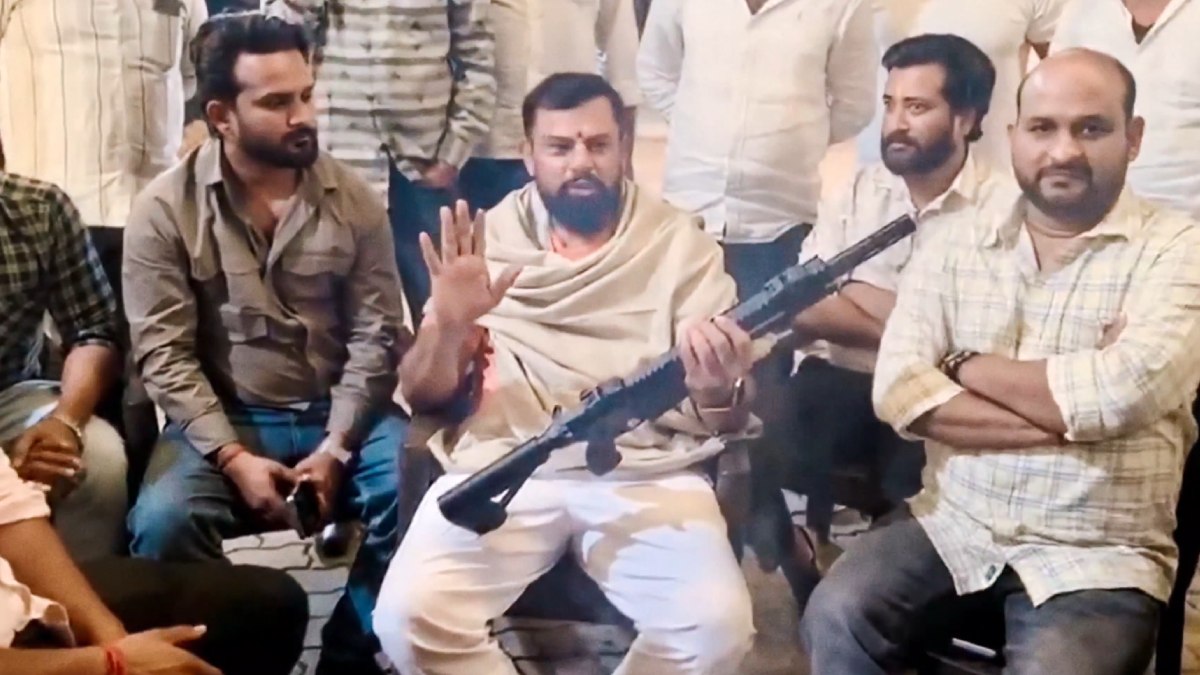
In a video message, he said that Hindu families should be prepared to protect themselves, their property and their loved ones and added that only those who own a licensed gun will be able to do so because “we are scared about demographic change happening in this country”.
His comments have created a furore because of sensitive issues related to religious identity, population growth, personal safety and firearm ownership in India.
In the video released, MLA T. Raja Singh is sitting among people holding a gun in his hand. Talking about the issue, he said Hindu families without guns could not protect their property and sisters and daughters too (Hum Do Hamare Do) were not safe anywhere in the country, so if the two-child policy was not implemented across the country, then Hindu households should get licensed firearms.
His statement has reignited debate on whether personal ownership of firearms should be encouraged as a means of protecting families or not, since in India one needs to satisfy certain legal conditions before applying for a licence.
T. Raja Singh Raises Concerns Over Muslim Population Growth. “The reason why I said this is because of a newspaper report that India’s Muslim population will triple in 15 to 20 years,” Goshamahal MLA said. He felt that if such a demographic change happens, then the security of Hindu communities would be affected in future.
He also compared it with Pakistan, saying religious conversions, violence and atrocities against Hindus there could happen in India too. And he used those concerns to say that Hindu families should prepare themselves for protection.
However, the statement does not cite any of the demographic research that is available to support the claim that India’s Muslim population will triple in 15 to 20 years. Population projections are based on fertility rates, mortality, age distribution and migration patterns, among others.
Reliable demographic studies generally show that growth rates and fertility change over time, so claims about a dramatic increase in a particular community’s population need to be tested against credible statistical evidence rather than accepted without verification. Demography should also not be used to portray an entire religious community as a security threat.
MLA Praises Uttar Pradesh’s Gun Culture. In his remarks, T Raja Singh also spoke about what he called the gun culture in Uttar Pradesh. He said licensed firearms were present in almost every household of the state and Hindu families in India should follow suit too. It seemed like he was calling for more awareness among Hindu households on personal security and ownership of guns.
He also had confidence in PM Narendra Modi’s leadership, saying that Modi became Prime Minister with the blessings of Hindus across the country. Raja Singh said several measures could be taken under the PM’s leadership. He linked demand for a two-child policy and licensed gun ownership to larger issues of population and community security.
मुस्लिम आबादी को लेकर..", BJP विधायक T. Raja Singh की हिंदुओं से लाइसेंसी हथियार रखने की अपील https://t.co/iOSHw8NXuA
— Dinesh Kumar (@DineshRedBull) November 21, 2026
The statement also raised questions about the responsibilities of gun ownership. People may want protection for themselves and their families, but encouraging gun ownership on a large scale adds other concerns (public safety, accidental injuries, misuse, illegal possession). Guns need to be trained properly, stored securely and strictly adhered to licensing conditions. A firearm licence does not grant permission to use a weapon in every situation.
What Are India's Rules for Owning a Licensed Gun?
Possession of a firearm is governed by the Arms Act, 1959 and Arms Rules, 2016 in India. Unlike some countries, India does not give an automatic or unrestricted right to own a gun. Anyone who wants to buy and possess firearms must get a licence from the licensing authority. The application is scrutinised on the basis of the applicant’s background check (police verification), reasons given for seeking a firearm licence, etc.
Authorities check whether an applicant has a valid reason for possessing a weapon and whether the person meets legal eligibility criteria (personal safety may be considered as a reason in certain circumstances, but approval is not automatic); the licensing authority can look at the circumstances of each application before making a decision. Applicants must also comply with conditions relating to possession, storage, use and renewal of firearms.
However, Indian firearms legislation does not have a system whereby every household belonging to a particular religion automatically gets a gun licence; rules apply regardless of religion and applications are evaluated according to the requirements of law. If someone has a gun without authorisation or violates licensing conditions, they can be prosecuted.
T. Raja Singh has thus put two different issues before the public: one is the demand for a nationwide two-child policy, and the other is that Hindu families should have licensed firearms to protect themselves. Both are bigger issues about public policy and personal security, but firearm ownership in India is governed by existing rules; anybody who wants to get a weapon must follow the Arms Act and rules applicable thereto, not on religious grounds or political appeals.


Comments