
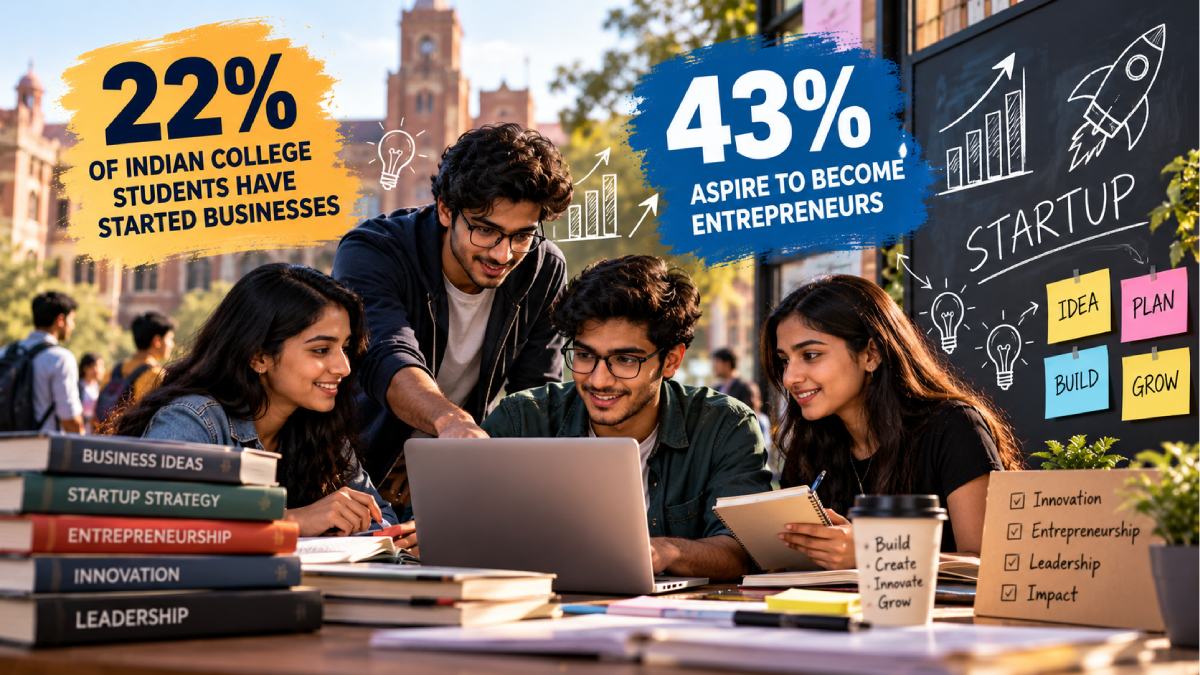
More than one in five college students in India have already started a business and 43 per cent want to become entrepreneurs, according to an Indian Institute of Technology (IIT) Mandi survey. These findings reflect the growing interest in entrepreneurship among young Indians, but also the fact that entrepreneurs are finding it difficult to convert their business ideas into successful ones.
The findings are part of the GUESSS India 2025 report, entitled How Do We Make Student Entrepreneurs? The study was conducted in partnership with Bengaluru-based REVA University and has been based on responses from 25,783 students from more than 1,200 higher education institutions in 34 states and Union Territories.
The survey found that 22% of Indian students had already started a business, whereas 23% globally. Meanwhile, 43% of students in India and the global survey said they aspired to become entrepreneurs.
India has many aspiring student founders, but more support should be provided to them to make their ambitions into sustainable businesses.
More students want to start businesses after graduation.
At the same time, the survey also reveals a change of career choices among Indian college students. And the proportion of students who want to start their own businesses immediately after completing their studies increased from 14% in 2023 to 16.2% in 2025.
But at the same time government jobs and employment at large companies declined.
The share of students who preferred government jobs immediately after graduation fell from 12.7% in 2023 to 10.1% in 2025. The proportion looking for jobs at large companies dropped from 31.3% to 27.4% in the same period.
According to these figures, entrepreneurship is becoming a more attractive career option for some students. But the survey doesn’t indicate that traditional work has fallen out of favor with students. It does indicate a gradual transition in the kind of career students are looking at.
Student businesses are generating sales.
According to the report, 35.5 percent of Indian student businesses had recorded regular sales, while 33 percent globally. This means that the majority of student-led ventures have gone beyond the idea phase and are earning revenue.
The survey also highlighted a recent increase in business creation. In 2025, 31% of Indian student businesses with regular sales were founded compared to 18% globally.
We found that students are establishing businesses while continuing to study. But for many early-stage entrepreneurs, consistent sales are not the easiest part.
Of these students still developing their business plans, only 10% had made their first sale, compared to 23% around the world. The gap highlights the difficulties in translating a business idea into a product or service customers are willing to pay for.
Access to entrepreneurs can make a difference.
In fact, access to entrepreneurial role models seems to be an important factor in whether students start businesses.
According to the report, students who know entrepreneurs among their relatives, friends, classmates or teachers are three times more likely to start a venture. But about half of Indian students said they did not know an entrepreneur beyond their parents.
When the founders have very limited exposure to companies, how they do business, how they find mentors and how they start up a business at the early stages can be difficult.
Therefore the report calls for better connections to students and existing entrepreneurs. Universities, incubators and other institutions might help to provide mentoring opportunities, practical guidance and access to people with experience in building businesses.
Young founders are learning from business setbacks.
The survey also found that student entrepreneurship involves experimentation and, in some cases, repeated attempts at starting a business.
Of student founders who have businesses experiencing regular sales, 41% had previously closed an earlier venture before starting again. And 42% were running two or more businesses.
As a result, they suggest that some student entrepreneurs open new businesses after a failed venture and try again (and seek out two or three business opportunities). They also point out the need for the entrepreneur to learn from failure and become business experts to learn from it and grow business ideas.
Information technology, artificial intelligence, and digital services were also popular areas for students who wanted to start businesses. Yet only about one in 10 student-run businesses was digital, indicating a difference between students' intended business sectors and the ventures they are now running.
What the findings mean for colleges and universities?
The GUESSS India report emphasizes the need for universities to focus on actual business creation rather than entrepreneurship courses, business plan competitions and startup events.
Students might benefit from prototypes, registering ventures, making their first sales and meeting experienced founders. Campus incubators and mentoring programs can also provide students with access to market demand, control finances and sustainable business models.
Dr Puran Singh, Associate Professor at IIT Mandi's School of Management and Country Delegate for GUESSS India, led the report. Indian students were very ambitious and some already set up businesses that employed people, he said.
As a whole, the findings of the survey are that entrepreneurial interest among Indian students is more similar to global ones. Now it is up to more students to go from wanting to start a business to starting businesses that can attract customers, make regular sales, and grow over time.





Comments
Leave a Comment