
A political poster introducing the “Makkhi Janta Party” (MJP) has turned heads online as protests and public debate erupt in Delhi, a political poster depicting a fly that tells us about democracy and citizens’ rights and the duties of elected representatives. The poster’s bold colour and pointed Hindi language have made it a talking point on social media and the political concept of an insect-based political party has been very much a conversation piece.
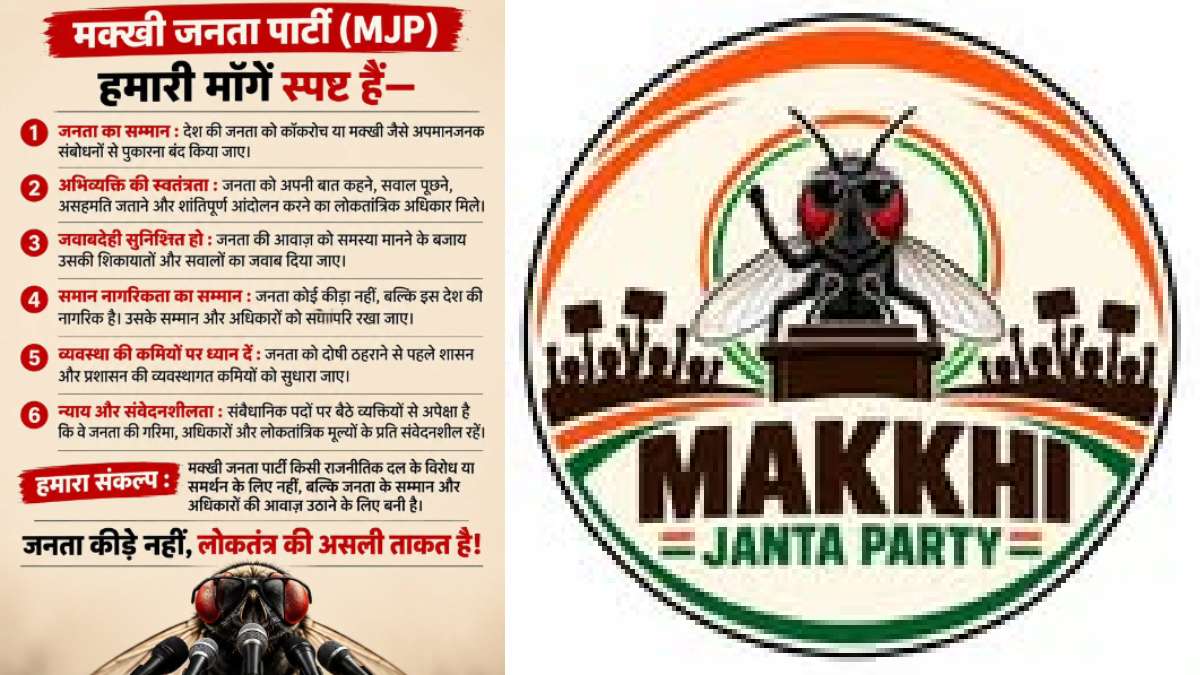
The poster portrays the Makkhi Janta Party as a symbolic voice for ordinary citizens, and six key demands centred on respect for the public, freedom of expression, government accountability, equal citizenship, administrative reform and sensitivity among those in power. Its final slogan declares that the public is not an insect but the real strength of democracy, and uses humour and satire to question how citizens are treated by institutions.
The concept is in line with a wider trend of protest messaging in which everyday items, animals or insects become symbols for political criticism. Rather than just party flags and speeches, such visuals employ irony, memorable slogans and unusual imagery to communicate a message quickly. But even the poster alone does not prove whether Makkhi Janta Party is a formally registered political party, an organised protest group or simply a satirical campaign.
What Is The Makkhi Janta Party?
The Makkhi Janta Party, abbreviated MJP, is depicted in the viral poster as a very people-oriented political platform. The Hindi text contains a list of demands that seem to be meant to push back against the treatment of citizens and call for greater accountability from those holding public office.
The poster is dominated by a giant picture of a fly in front of microphones that looks very much like the press conference room of a politician. The small insect against the microphones gives the image its satirical look. And even a creature that would be considered a nuisance can be used to raise questions about public dignity, democratic representation and the actions of government.
The name also has a direct connection to political party branding. With the familiar initials MJP and the bold red-and-black design, the poster mimics the visual language of political campaigning while also presenting a purposefully unorthodox identity.
It is not just the humour to send a message. The graphic’s six demands address issues that frequently come up in democratic debates - how citizens are heard, how well and when officials respond to complaints and whether people can ask those in charge questions without being dismissed.
Six Demands Listed In The Viral Poster
The poster lays out six demands in the name of the Makkhi Janta Party. The first is to respect the people of the country, and the second is that insulting or humiliating comparisons of citizens should stop. The message frames dignity as a basic expectation in the relationship between the government and the people it serves.
The second demand is freedom of expression. It wants citizens to be free to talk and to ask questions, to challenge authority and to express themselves with no fear. There is a public criticism and the right to question authority at the center of the poster’s message.
Third demand is accountability. Instead of only listening to citizens’ voices, the poster suggests that authorities should hear complaints and respond to them. In a practical sense, that means more transparent communication and better response from public institutions.
The fourth point is equal citizenship. Citizens should not be treated differently nor be degraded and their dignity should not be diminished, it says. Equal rights and respect are under the democratic system.
The fifth demand is to see in governance and administration the weaknesses. The poster argues that authorities should not blame citizens for the problems but rather to make administrative systems better. This means that we need to look at public services and institutional performance when complaints are made.
Justice and sensitivity are the sixth demand. It calls upon constitutional actors to act in a manner honourable and respectful of democracy. The six points speak to the MJP poster as a satirical call to a more respectful and accountable governance.
Why The Poster Is Attracting Attention
Political messaging often competes for attention in a crowded digital space. Popular slogans on posters may be easily overlooked, but a brand new image or funny name can prompt people to stop, read and share the content.
The fly at the centre of the MJP graphic serves that purpose. The image is unusual enough to spark curiosity and the demands serve to give us a political message to interpret. The satire and civic language make the poster accessible to people who may not otherwise engage with a long political statement.
The fly reference seems to be part of the poster’s critique of language that diminishes or insults ordinary citizens. By adopting the insect as its own symbol, the graphic turns the insult into a protest. Its last line reinforces that reversal by declaring that people are not insects and that democracy derives its strength from the public.
But the poster should be understood as political messaging, not as evidence of the claims or events that led to it. The connection between the graphic and particular Delhi protests would need confirmation from the organisers or reliable reporting.
From Cockroach References To Fly-Themed Political Satire
The headline linking the Makkhi Janta Party with previous cockroach-related political references points to a wider mode of protest humour where insects are used to challenge political language and public attitudes. Such comparisons can become powerful symbols because they reduce complicated political arguments to a single, memorable image.
In protest settings, satire can allow people to express frustration without resorting to traditional political talk. It is also possible that a deliberately exaggerated party name will also make the point that citizens feel respected, represented and heard by those in power.
At the same time, such imagery has its own meaning. Without any information about who created the MJP poster, when it was circulated and what particular comments and incidents it reacts to, it would be premature to attribute it to a particular organisation or political group.
What The MJP Message Says About Democracy
Besides the strange branding, the poster also raises questions of citizens and public institutions. Dignity, free speech and accountability are core concepts of democratic governance and are what it is all about.
Citizens engage with governments through elections, public meetings, complaints, petitions and peaceful protests. These channels are meant to give people a voice and make their concerns known to elected representatives and officials. When people are feeling like their voices are being ignored, symbolic campaigns and satirical messaging can bring attention to that frustration.
The poster also makes a distinction between blaming citizens for problems and examining whether administrative systems are functioning well. That distinction is relevant to discussions about public services, grievance redressal and institutional transparency. But the graphic only presents demands, not evidence of a particular authority's performance. Its statements are the message promoted by the poster and should not be taken as verified findings about the circumstances surrounding the Delhi protests.
Will The Makkhi Janta Party Become More Than A Viral Poster?
Whether the Makkhi Janta Party becomes an organised campaign is unclear. A viral graphic can generate attention, but turning a satirical identity into a sustained public movement generally requires identifiable organisers, consistent messaging and activities beyond social media circulation.
For now, the poster’s significance is to use an unusual symbol to make a familiar democratic argument. Its six demands are centered on citizens having the right to question authority and to be given a legitimate response when they do not feel listened to.
The Makkhi Janta Party poster shows that political satire is not just a joke; it is a way of making serious questions about governance visible. It can stick to a viral image or be a part of a much wider protest campaign, but its main message is clear: citizens shouldn’t be overlooked or humiliated, and democratic institutions need to listen to the people they represent.



Comments