Artificial intelligence (AI) adoption in many fields is already transforming the traditional structure of work and how the careers of the future will be. AI, according to Kevin Sneader, who heads Goldman Sachs' Asia-Pacific business, has the potential to transform how employees progress from one line of management to the next, reduce the significance of the hierarchy, and create entirely new jobs for workers.

For decades, the corporate world has been in this very same pattern. Employees start in entry-level jobs, gain experience by performing standard work, and then work up the ladder to become managers responsible for supervising teams. But the use of AI-powered tools and autonomous AI agents, and the advent of AI-powered robots in the workplace, could change the way the model is done.
Sneader believes that future employees won't have to wait years before taking on managerial responsibilities. They could start their careers by working with AI agents from the very first day on the job. In this new workplace model, a single employee might be responsible for managing multiple AI systems that do job-related work traditionally done by junior staff members.
The concept is a reflection of the growing capabilities of AI technologies, which are now being used across areas such as banking and finance to healthcare, customer service, software development, and logistics. Data analysis, report preparation, information gathering, document processing, and routine administrative tasks are being done by AI systems faster than humans.
Traditionally, junior employees have carried out much of the analytical and preparatory work that supports business operations. As they gained experience, they would move to supervisory roles and then to manage teams. But if AI can effectively do a lot of this routine work, then businesses might rethink how career progression works.
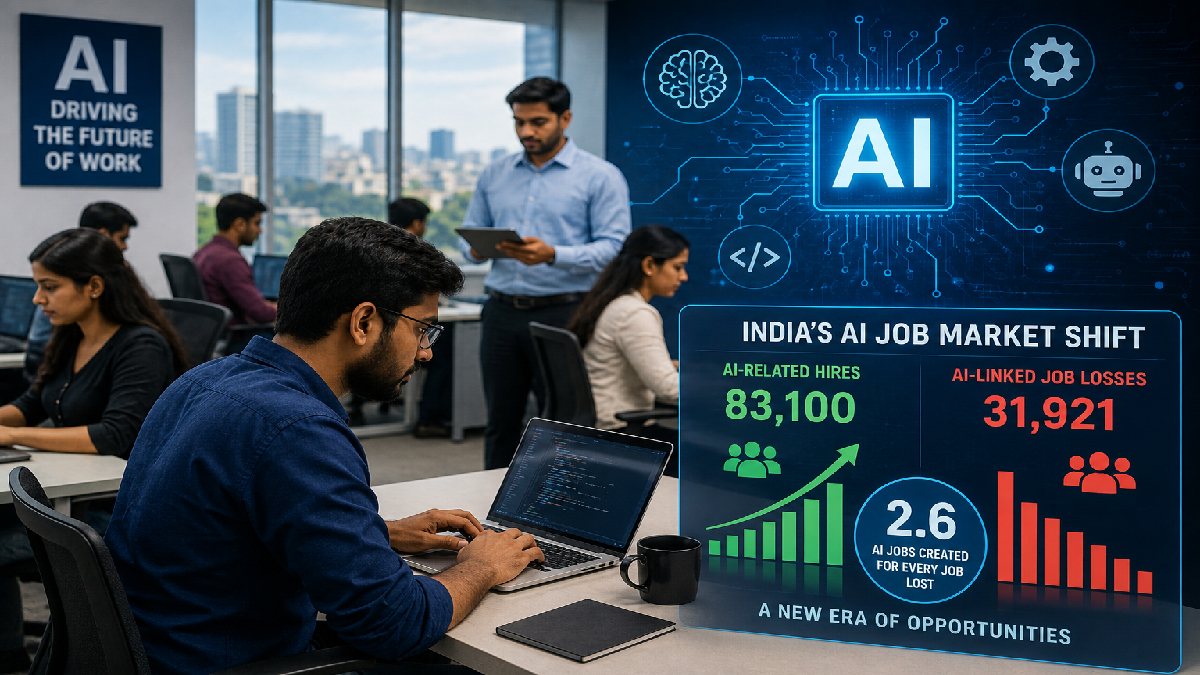
This change has profound implications for middle managers. In many organisations, middle managers are critical in terms of organising teams, monitoring performance, and ensuring that work flows smoothly from junior staff to senior leadership. But if AI agents are assigned a significant percentage of operational work, some of these responsibilities could fall directly to frontline employees who oversee AI-driven processes.
As a result, the traditional corporate ladder might not be as clear. Employees might need to make less of a decision about who is to be supervised and more of a decision to direct, evaluate, and optimize the performance of AI systems. That would demand skills in a different way from those commonly associated with management roles.
The impact might also be felt in entry-level hiring. Financial institutions and other large companies have long recruited graduates to work in analytical and repetitive roles. Companies may not require the same number of entry-level workers to do these tasks as AI is capable of doing, and this has led to concern for the future in terms of jobs that involve routine information processing.
But experts caution against seeing AI as a job-replacement technology. Many analysts say AI can enhance human productivity rather than eliminate workers. AI will allow people to focus on strategic thinking, decision-making, creativity, client relations, and problem-solving because it will automate repetitive tasks.
As Goldman Sachs has noted before, although AI may automate some tasks, it is also likely to create new types of jobs. Positions focusing on AI supervision, AI training, prompt engineering, data governance, compliance monitoring, and human-AI collaboration are expected to grow as organisations integrate advanced technologies into their operations.
In this new world, the most valuable skills may well be those that AI can’t easily replicate. As such, critical thinking, leadership, emotional intelligence, communication, adaptability, and complex decision-making will be increasingly important. Employees who can work alongside AI tools and maximise their capabilities will have a competitive edge in the labour market.
Educational institutions and employers will also be expected to adapt by promoting digital literacy and AI-based competencies. Future graduates will have to be comfortable with AI systems just as previous generations learned to use computers and enterprise software.
AI does not, in the end, mean the end of jobs; it means an overall reorganisation of the way work is done and what is done. The trick for workers is to learn to adopt new technologies and build skills that can work with AI, not against it.
As AI continues to progress, the workplace of the future might look very different from today’s. Employees might not have to work for years to climb up the career ladder before they become managers. Instead, they might have the opportunity to lead teams of AI agents, marking a fundamental change in how organisations work and how careers are built.