
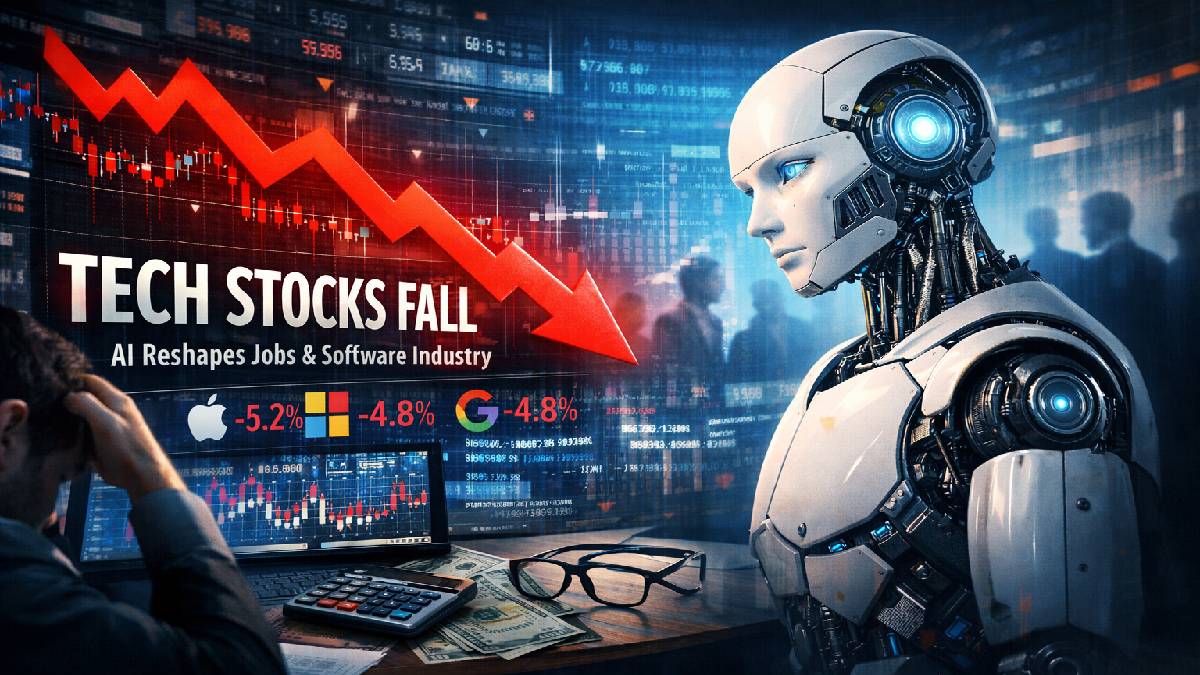
The world tech sector is entering one of its most turbulent periods in decades. India's IT conglomerates TCS, Infosys and HCL Tech were hit hard with stock dropping 5–7% on Tuesday. The sell-off was precipitated by fears of software ecosystem disruption after Anthropic, an AI company, unveiled 11 new plug-ins for its Claude co-work agent. Those plug-ins automate legal, sales, marketing, data analysis jobs, raising fears that many older tasks could soon be replaced by artificial intelligence. And though advances in AI hold out optimism of efficiency and saving costs, the bigger question for companies and workers is what happens to jobs.
The Trigger: Anthropic’s Plug-ins
Anthropic’s new plug-ins are a huge step forward in automation driven by artificial intelligence in the workplace. By letting Claude take on complex tasks in areas as diverse as legal documentation, sales planning, marketing events, and data analytics, it has indicated to everyone that AI is ready for jobs that were thought to be untouchable by the mere sight of automation.
This announcement had investors nervous, prompting a sell-off in U.S. tech stocks. Fast forward to India, where IT services companies rely heavily on global clients and the spread became apparent. If AI tools do these tasks faster and cheaper, investors fear, the demand for outsourcing services will shrink, hurting the revenues of Indian IT firms.


Job Cuts Across the Industry
There is more to anxiety than that. Cuts are already underway all across the technology industry. Indian IT services behemoth TCS, India’s largest IT services firm, has now laid off an estimated more than 30,000 people in the last six months to cut jobs. Increased costs of growth, declining profits and restructuring forced by AI adoption has made the company re-organize and rationalize its staff. Many TCS employees have been laid off.
Internationally, it is also the same. Amazon plans to cut 16,000 corporate roles globally for efficiency and restructuring reasons. Meta, Facebook’s parent company, also plans to cut its Reality Labs division, which develops virtual reality and metaverse projects, by 10 percent. Even though companies are paying for these layoffs, it illustrates how much disruption AI is causing in different sectors of the technical industry.
Broader Concern: The Future of Work
The major issue at stake is not only collapsing stock prices, but the future of employment in technology employment as well. IT services companies have profited for decades after providing them with the right skills to code, test, manage data or provide customer support. As AI tools stand to perform much of this, this model of outsourcing is in danger.


Employees fear job loss, companies are scrambling to balance profits with social responsibility. The task is to reskill workers required to take on new roles that AI does not readily adapt. AI development, advanced analytics, cybersecurity, human-centered design skills are increasingly essential but not an easy, expedient transfer.
The Silver Lining: GCCs in India
Even with the gloom, we have a silver lining. In India, Global Capability Centers (GCC) or captive centers are growing faster. Multinational corporations create these centers to operate more specialized functions, including product development, research, and even advanced analytics. GCCs, unlike traditional outsourcing, concentrate on innovation and high-value work.
This growth presents new opportunities for Indian professionals, but the skill sets required vary sharply. GCC employees will necessarily have to possess a knowledge of AI, machine learning, cloud computing, and domain-specific expertise. The move signifies the pressing need for retraining and upskilling efforts to prepare the workforce for next-generation situations.
Technology shares have tanked, reflecting a broader fear about how AI could affect jobs (and more broadly the software industry). The new plug-ins Anthropic has provided a glimpse into how rapidly automation is going to spread across critical business functions, sparking concerns over diminished demand for outsourcing and layoffs for workers, Anthropic’s new plug-ins have confirmed.
Although corporate giants such as TCS, Amazon and Meta are all laying off people, the popularity of GCCs in India offer new opportunities if the GCCs rise to prominence in India. But these will also need the workforce with expertise in advanced skill set. The coming years will be a litmus test of organizational adaptability for the new landscape. AI will not depart — its impact will only proliferate. The trick is to ensure that technology transforms itself into a tool for growth or at least not a threat to our livelihoods.
Telling that story, of falling stocks, is only the start of a broader reshaping of how we work, live, innovate.











Comments