Every year, India celebrates National Farmers Day, also known as Kisan Diwas, on December 23 to honor the invaluable contribution of farmers — the backbone of the nation’s economy. The day recognizes the tireless efforts of millions of farmers who feed the nation, drive rural prosperity, and ensure food security for over 1.4 billion people.
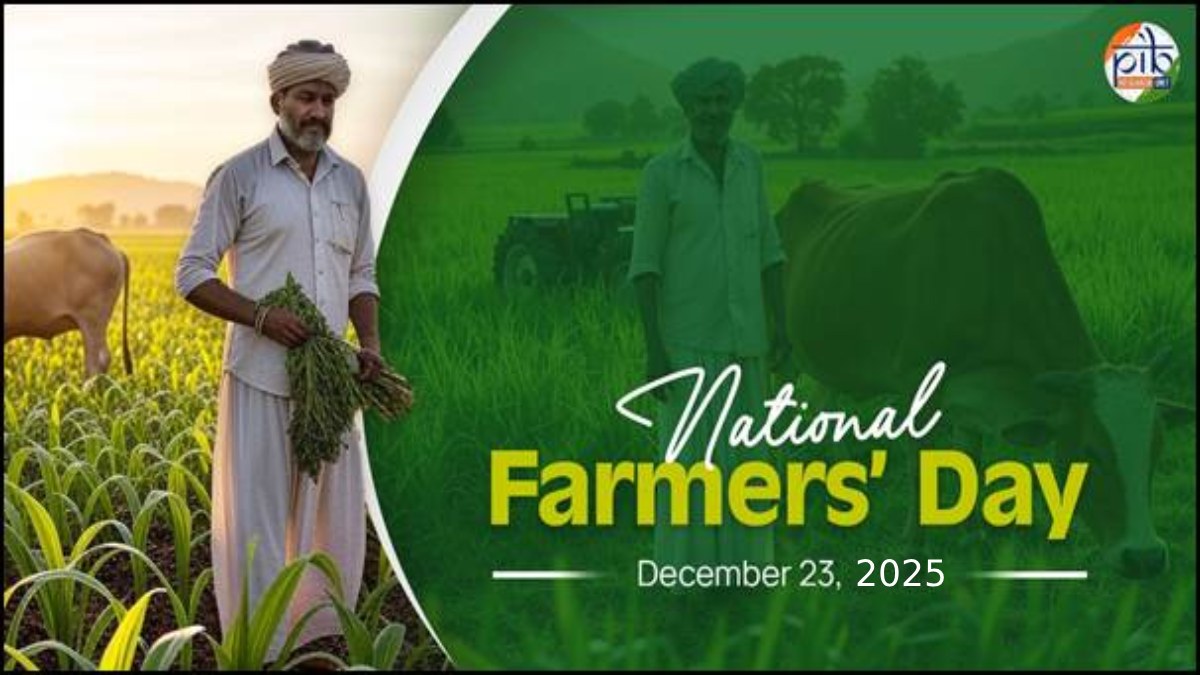
National Farmers Day is not just a tribute but also a reminder of the need to empower the agricultural community through sustainable practices, fair pricing, modern technology, and government support.
National Farmers Day 2025: Date and Overview
- Date: December 23, 2025 (Tuesday)
- Observed as: Kisan Diwas (किसान दिवस)
- Observed in: India
- Significance: Honoring Indian farmers and promoting awareness about the agricultural sector.
- Commemorates: The birth anniversary of Chaudhary Charan Singh, the 5th Prime Minister of India.
History of National Farmers Day
National Farmers Day is celebrated on December 23 every year to mark the birth anniversary of Chaudhary Charan Singh (1902–1987), who is often called the “Champion of India’s Farmers.”
Chaudhary Charan Singh was a visionary leader and strong advocate for rural and agricultural reforms. He introduced several policies that improved the lives of farmers and reformed India’s agricultural system.
Key Contributions of Chaudhary Charan Singh:
- Land Reforms: As the architect of land reform laws in Uttar Pradesh, he worked towards abolishing the zamindari system.
- Agricultural Policies: He emphasized equitable land distribution and fair pricing for agricultural produce.
- Focus on Rural Development: During his tenure as Prime Minister (1979–1980), he implemented measures to boost rural credit and farming cooperatives.
- Author and Advocate: He wrote extensively on farmer-centric issues, including “India’s Poverty and Its Solution” and “Abolition of Zamindari.”
In 2001, the Government of India officially declared December 23 as National Farmers Day in his honor.
Significance of National Farmers Day
Farmers are the lifeline of the Indian economy — contributing nearly 18–20% of India’s GDP and providing livelihood to more than 50% of the population.
National Farmers Day holds immense importance as it:
- Recognizes the hard work, resilience, and sacrifices of farmers.
- Highlights agricultural challenges such as climate change, water scarcity, and fluctuating crop prices.
- Promotes awareness of government welfare schemes aimed at improving farmers’ income.
- Encourages youth participation and innovation in agriculture through technology and agri-entrepreneurship.
Celebrations and Events
National Farmers Day is celebrated with great respect and enthusiasm across India, especially in rural and agricultural regions.
Common Activities & Events:
- Farmer fairs (Kisan Melas): Exhibitions showcasing new farming technologies, seeds, and sustainable practices.
- Government programs: Awards and recognition for innovative farmers.
- Awareness campaigns: Programs on soil health, irrigation, crop insurance, and organic farming.
- Workshops & seminars: Organized by Krishi Vigyan Kendras (KVKs), state agricultural universities, and NGOs.
- Social media initiatives: Campaigns promoting #KisanDiwas, #NationalFarmersDay, and #JaiKisan.
In Delhi and Uttar Pradesh, special tributes and memorial events are held at Kisan Ghat, the samadhi (memorial) of Chaudhary Charan Singh.
India’s Agricultural Landscape – Facts & Figures
- Total cultivable land: About 140 million hectares.
- Top producing states: Uttar Pradesh, Punjab, Haryana, Madhya Pradesh, Maharashtra, and Andhra Pradesh.
- Major crops: Rice, wheat, maize, sugarcane, cotton, pulses, and oilseeds.
- India’s global ranking: Among the top 3 producers of food grains, fruits, and vegetables worldwide.
- Agricultural exports: Over USD 50 billion (2024–25).
Despite the growth, challenges such as climate change, soil degradation, rural debt, and market instability still affect many farmers. National Farmers Day brings these issues into national discussion.
Government Initiatives for Farmers’ Welfare
The Government of India has introduced several schemes and programs to improve productivity, income, and rural livelihoods:
Key Schemes:
- PM-KISAN (Pradhan Mantri Kisan Samman Nidhi):
Direct income support of ₹6,000 annually to small and marginal farmers. - PM Fasal Bima Yojana:
Crop insurance to protect farmers against yield losses due to natural calamities. - Soil Health Card Scheme:
Helps farmers understand soil quality and nutrient requirements. - Kisan Credit Card (KCC):
Easy access to low-interest credit for agricultural inputs and expenses. - PM Krishi Sinchayee Yojana:
Focus on “Har Khet Ko Pani” (water for every field) for better irrigation coverage. - eNAM (National Agriculture Market):
A digital trading platform connecting farmers directly with buyers for fair prices. - AtmaNirbhar Krishi Initiatives:
Encouraging agri-startups, drone technology, and precision farming.
These programs aim to double farmers’ income, promote sustainability, and make agriculture resilient to modern challenges.
Role of Technology in Modern Farming
Modern agriculture in India is undergoing rapid transformation through digital innovation:
- Drones and IoT devices for crop monitoring.
- AI-based weather forecasting for timely sowing and harvesting.
- Mobile apps for market prices, crop management, and soil testing.
- Agri-startups offering digital marketplaces and logistics solutions.
By embracing technology, farmers can increase productivity, reduce risks, and ensure better profits.
Famous Quotes on Farmers
- “The farmer is the only man in our economy who buys everything at retail, sells everything at wholesale, and pays the freight both ways.” — John F. Kennedy
- “If agriculture goes wrong, nothing else will have a chance to go right.” — M. S. Swaminathan
- “The ultimate goal of farming is not the growing of crops, but the cultivation and perfection of human beings.” — Masanobu Fukuoka
How You Can Celebrate National Farmers Day
- Support local farmers’ markets and buy local produce.
- Promote awareness through social media campaigns and educational activities.
- Volunteer with agriculture NGOs or rural development projects.
- Encourage youth to explore agri-entrepreneurship and sustainable farming.
- Share stories of farmers’ innovations and struggles to inspire others.
India’s Vision for Farmers – 2047 and Beyond
India’s vision is to create a prosperous, self-reliant, and sustainable agricultural sector by 2047 — the centenary of independence.
Key focus areas include:
- Sustainable farming practices.
- Agri-export growth and food processing.
- Farmer welfare and income diversification.
- Climate-resilient agriculture.
The future of Indian agriculture lies in innovation, inclusion, and respect for the people who nurture the land.