We observe National Panchayati Raj Day once every year on April 24 in India to mark and reinforce the foundations of grassroots democracy with respect to the Panchayati Raj system. Such day emphasizes both local self-government in the rural regions and the role of PRIs (Panchayati Raj Institutions) in the empowerment and inclusion of villages. The day dates back to 2010 when India's former Prime Minister, Manmohan Singh, took office.
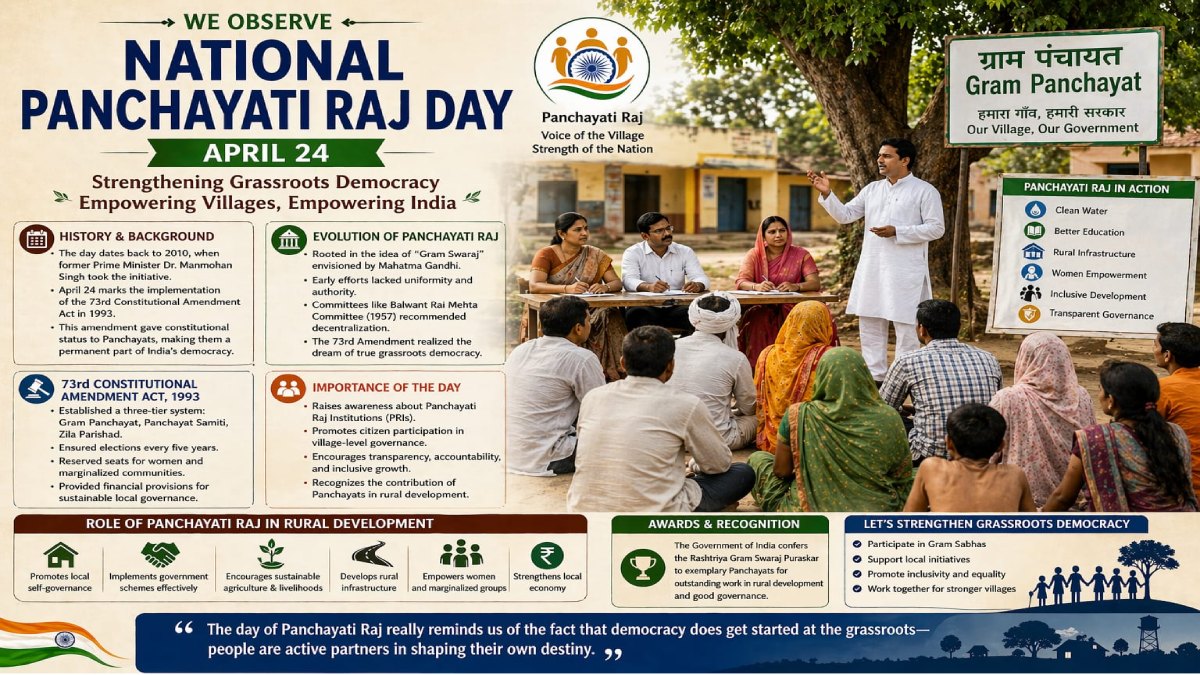
The date was selected for the historic implementation of the 73rd Constitutional Amendment Act on April 24, 1993. Panchayats were given constitutional status due to this amendment; therefore, they became a permanent and mandatory part of India’s democratic framework.
Local self-government is rooted deeply in India. After independence, for example, leaders like Mahatma Gandhi stressed the idea of “Gram Swaraj” village self-rule as the basis for democracy. In contrast, early Panchayat systems were not uniform and did not have authority in the village.
Committees such as the Balwant Rai Mehta Committee (1957), as well as their representatives, suggested decentralization and by this gradually evolved Panchayati Raj. The 73rd Amendment finally brought that vision about, giving a clear three-tier system Gram Panchayat (village level), Panchayat Samiti (block level), and Zila Parishad (district level).
The amendment also ensured regular elections every five years, reservation of seats for women and marginalized communities, and financial provisions to sustain local governance. The aim of these measures was to bring decision-making closer to society and bring better implementation into rural areas of development. We initiated National Panchayati Raj Day to give importance and awareness of these institutions to citizens to help create a sense of inclusion in governance at the level of the citizen base in public life and at the village level. National Panchayati Raj Day on April 24 is a day for this purpose.
It is an occasion to review how well Panchayats are performing and to demand and encourage transparency, accountability, and inclusive growth. And as an appreciation for people for Panchayat’s contribution to development of rural governance, the ruling government even announces awards like the Rashtriya Gram Swaraj Puraskar for excellent Panchayats who work in rural development and governance.
In our time, the Panchayati Raj Institutions are playing an important role in governance schemes that can be carried out by government to develop rural infrastructure and development takes place in every part of the land.
“The day of Panchayati Raj really reminds us of the fact that democracy does get started at the grassroots people are active partners in shaping their own destiny.