In Part 1 we covered Nikola Tesla’s remarkable journey from a village in Europe to the United States and how he had led a generation of technological revolutionists, and how he was so determined.
His belief in alternating current (AC) defied conventional thinking and was the one behind the famous “War of Currents”.
In this second part, we look at the inventions that took Tesla from a promising engineer into one of the greatest scientific visionaries of the world.
The Trial of Alternating Current
Tesla’s belief in alternating current was not only a theory but a practical solution to one of the biggest problems of the nineteenth century.
While direct current (DC) lost a lot of energy over long distances, alternating current could be transmitted efficiently across cities and countries. Tesla improved the AC system and proved its superiority with industrialist George Westinghouse.
One of the most defining moments in 1893 was when the World Columbian Exposition in Chicago was lit by Tesla's AC system. Millions of visitors saw the magnitude of alternating current, and it was safe, efficient and able to supply electricity on a massive scale.
A few years later, Tesla’s technology was able to harness the mighty Niagara Falls, one of the world’s biggest natural sources of hydroelectric power. The successful power station transmitted electricity over long distances and was a turning point in world electrical engineering.
Today the same basic principles of alternating current still power homes, industries, hospitals, schools and businesses around the world.
The Tesla Coil A Symbol of Innovation
Among Tesla's most famous inventions is the Tesla Coil, patented in 1891.
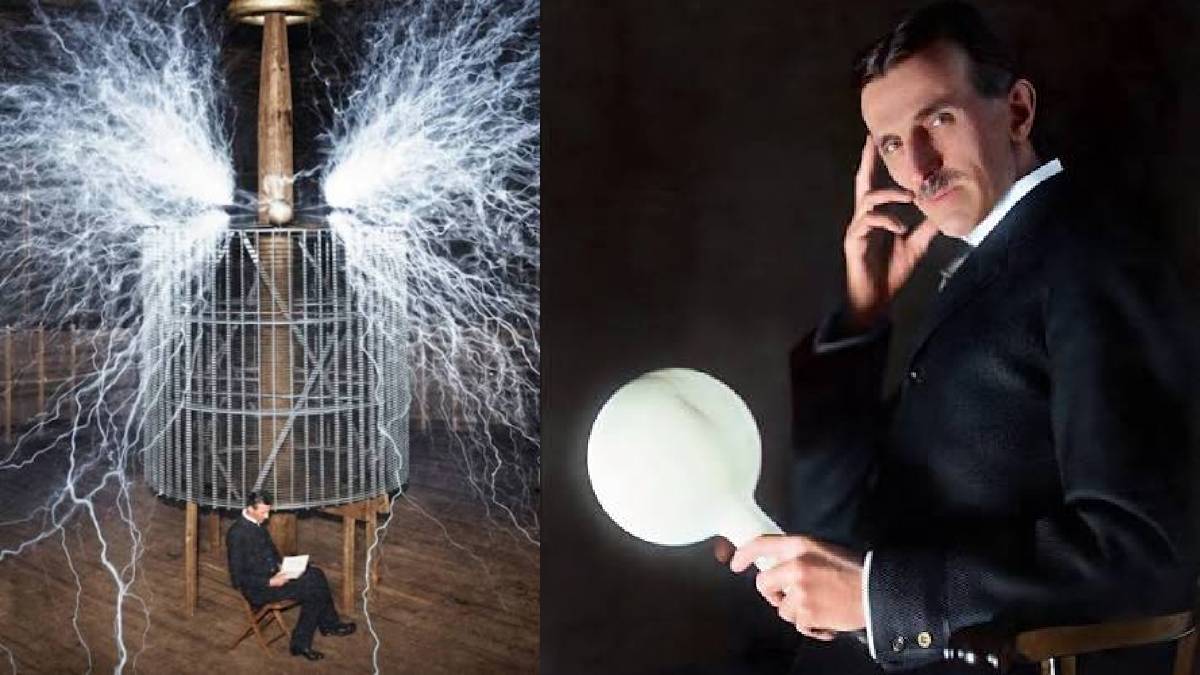
This remarkable device provides high voltage, high frequency electricity and demonstrated the possibility of sending electrical energy wirelessly. During demonstrations of such a device, Tesla impressed the public by lighting lamps without wires, and then he would cause a great electrical discharge to appear almost magical.
Even though the Tesla Coil is still perceived as a spectacular lightning display, it has played a crucial role in the development of radio technology, medical equipment, electronics, and science. And yet it is still a symbol of Tesla's creativity and his willingness to pursue ideas far beyond science.
The Induction Motor That Changed Industry
Tesla brought the alternating current induction motor into the manufacturing and transportation field.
And Tesla’s design was more efficient, reliable and less maintenance-intensive than earlier electric motors. It formed the basis of a lot of industrial machines and household appliances.
Many modern factories, elevators, pumps, washing machines, air-conditioning systems and many electric vehicles still rely on principles developed through Tesla’s pioneering work.
Few inventions have had such an impact on everyday life.
A Vision Beyond His Time
Tesla’s imagination extended far beyond the technologies of his time.
He envisioned a world where information was being transmitted instantly around the world, and people could send messages even when they were far away. At the time telephones were still relatively new, Tesla suggested portable communication devices that could bring people together around the world, which is very much true today with smartphones.
He also demonstrated one of the first radio-controlled devices in 1898 and unveiled a small boat that traveled entirely through wireless signals. Many of his audience thought it was controlled by magic but Tesla told them this was the future of automation.
Today, drones, remote-controlled systems, robotics, and autonomous technologies all reflect concepts Tesla introduced more than a century ago.
The Dream of Wireless Electricity
Perhaps no project better represented Tesla's ambition than the Wardenclyffe Tower.
The massive tower was built on Long Island, New York, to communicate information and electricity without wires. Tesla hoped that electricity would be transmitted worldwide and communication would be easier and energy would be available to all.
Due to the funding crises that hit the project before it could be completed, investors questioned its commercial viability and the tower was dismantled.
Although his dream of global wireless electricity was never realized, the current wireless charging technologies as well as ongoing research about energy transmission show that Tesla's ideas were far ahead of their time.
The Final Years
Despite all he achieved, Tesla spent most of his later life in financial peril.
He devoted almost all of his time to research and often neglected his own comfort and financial security. Unlike most inventors who made money from their inventions, Tesla was not interested in money but in science.
There were other bold ideas that he would keep in mind about renewable energy, advanced communication systems and power generation techniques too. But many of these ideas, however, were not realized because there was little or no funding.
Nikola Tesla died in a hotel room in New York City on January 7, 1943, at the age of 86. His death was scarcely noticed in the beginning, though in all the decades that followed it became very much appreciated.
A Legacy That Continues to Inspire
Nikola Tesla is one of the greatest inventors and electrical engineers of all time.
We name the international unit of magnetic flux density, the tesla, after him, in honor of his contributions to electromagnetism. Museums, universities, and scientific institutions all over the world thank him for his wonderful work.
His impact goes far beyond engineering. Entrepreneurs, researchers, and innovators can still draw inspiration from his fearless pursuit of knowledge and his willingness to imagine technologies that seemed impossible in his own lifetime.
With renewable energy, electric mobility, wireless communication and smart technologies in vogue, Tesla’s ideas are more relevant than ever.
Conclusion
Nikola Tesla wasn’t just a visionary, he was a visionary whose ideas changed civilization. He developed alternating current technology that produced the electricity grid we have today and the Tesla Coil and induction motor that made the industrial world possible.
Even if many of his ambitions were too far ahead of the technology of his age, history has shown that his imagination was decades ahead. Today, every city is lit up with electricity, every factory runs on electric motors and every wireless communication is a tribute to Tesla’s genius.
His story is a reminder that true innovation always starts with the courage to challenge established ideas. Even now more than a century later, Nikola Tesla continues to inspire scientists, engineers, students and dreamers to push the boundaries of what is possible.
Missed Part 1?
Start from the beginning of Nikola Tesla's incredible journey. Discover his early life, his move to America, his time working with Thomas Edison, and the dramatic "War of Currents" that paved the way for one of history's greatest scientific revolutions.
Read Part 1: Nikola Tesla: The Forgotten Genius Who Changed the World Forever (Part 1) - https://www.saptashwatv.com/lifestyle/nikola-tesla-forgotten-genius-part-1-16439.html