In a culture that has long romanticized "adjusting" and "sacrificing" for a partner, a quiet revolution is taking place in Indian households. From Mumbai’s high-rises to Bengaluru’s tech hubs, "sleep divorce" the practice of couples choosing to sleep in separate beds or rooms is no longer a sign of a failing marriage. Instead, for many, it is the secret to saving one.
The Numbers Behind the Trend
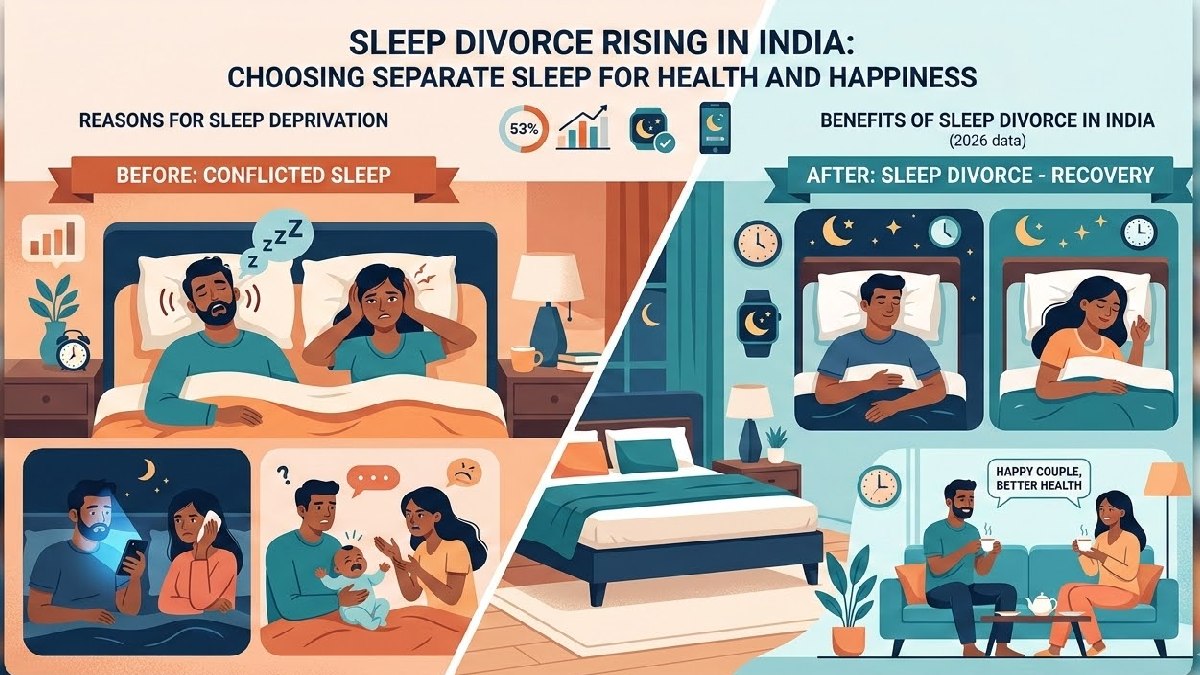
Recent data from the 2026 Global Sleep Survey suggests that nearly 53% of Indian couples now sleep separately at least one night a week. Even more striking, 46% of Indians report that their partner disrupts their sleep at least once a week, leading to a "survival mode" mentality that prioritizes health over heritage.
Why Indian Couples are Opting Out of Shared Beds
Experts point to a cocktail of modern stressors and physiological disruptions as the primary drivers:
- The "Snorer vs. Light Sleeper" Battle: Snoring or loud breathing remains the top disruptor for 27% of couples. In the past, the "quiet" partner would simply suffer in silence; today, they are moving to the guest room.
- Digital Distraction: With 28% of partners admitting to using phones or tablets in bed until late at night, the blue light and scrolling habits of one partner often rob the other of precious rest.
- The Rise of the "Night Owl" and "Early Bird": Mismatched work schedulesdriven by global remote work and erratic shifts mean that one partner may be starting their day just as the other is finally falling into a deep sleep.
- The "Parenting Pivot": Many urban couples with young children choose separate rooms to ensure at least one parent is well-rested enough to handle the next day’s work and childcare demands.
Breaking the Stigma
Traditionally, in India, sleeping in separate rooms was seen as a precursor to a legal divorce or a sign of a massive fight. However, clinical psychologists note that the 2026 perspective is far more practical.
"Separate beds are not about emotional distance; they are about physical recovery," says Dr. Munia Bhattacharya, a Senior Consultant in Clinical Psychology. "When you remove the resentment that comes from a night of broken sleep, you actually find that couples are more patient, empathetic, and connected during their waking hours."
Maintaining Intimacy
The "sleep divorce" doesn't mean the end of romance. Many Indian couples practicing this trend have established "intentional intimacy" rituals spending dedicated time together for cuddling or conversation before retreating to their respective sleep sanctuaries.As India continues to lead global charts in sleep deprivation, the move toward separate beds may just be the most "pro-relationship" move a modern couple can make.