
The air quality in Delhi is deteriorating quickly in October, with the Air Quality Index (AQI) more than doubling in just three days as the national capital is heading toward winter. The city’s AQI rose from 90 on Friday to 159 on Saturday and 187 on Sunday, according to CPCB data.
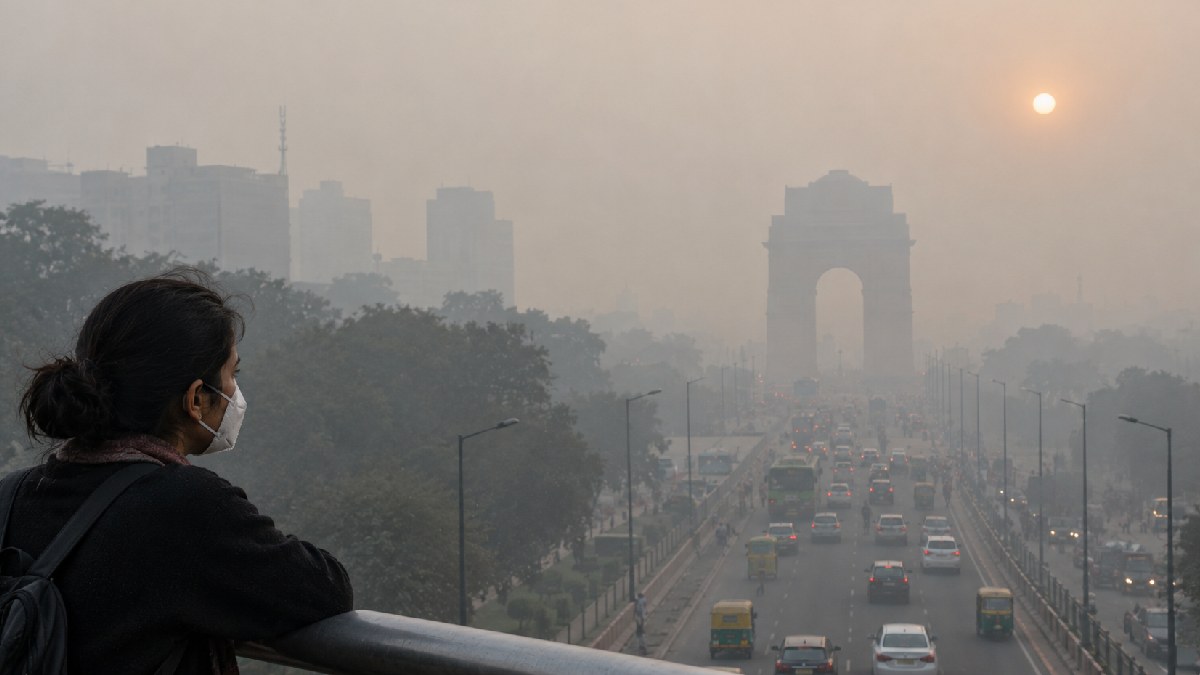
The deterioration is occurring even before winter, a time when Delhi usually has a tough time cleaning up air pollution. With rainfall not expected over the next week, the lack of natural pollutant-clearing conditions could add to the pressure on the city’s air quality.
The minimum temperature in Delhi was 17.1 degrees Celsius on Sunday, 1.3 degrees below the seasonal norm. The falling temperature following the disappearance of the monsoon is also important when the capital moves into the season of cooler weather.
Delhi AQI Rises Sharply in Three Days
The increase in Delhi’s AQI has been particularly noticeable over the three days. The reading of 90 on Friday indicated good air quality under CPCB classification, but the index rose to 159 on Saturday and 187 on Sunday, indicating the city is moderate in the category.
The AQI was expected to enter the poor category on Monday, which would be the first such reading for Delhi during the season, the report says. This shows how quickly air quality can change when emissions continue and weather conditions become less favourable for dispersing pollutants.
Several monitoring stations in the capital reported heavy pollution levels. Twenty-two stations recorded poor air quality on Sunday, according to the data reported. ITO had an AQI of 430, which is in the severe category, one of the most alarming readings for the city according to the report.
Other monitoring locations also recorded high pollution levels during the period. Anand Vihar had an AQI of 348 on Saturday, Mundka 227 and Jahangirpuri 212. Chandni Chowk recorded 188, Vivek Vihar and Rohini 187.
Punjabi Bagh recorded an AQI of 171, Narela at 165, CRRI Mathura Road at 158, and Dwarka Sector 8 at 155. The readings of the pollution levels indicate that in some neighborhoods pollution levels were higher than others, and in some places pollution levels were worse.
Air Pollution Worsens During October
The recent deterioration follows a wider rise in pollution readings during October. Data from Oct 1 showed that the ITO monitoring station recorded an AQI of 132 at 5 p.m., Jahangirpuri 216 and Punjabi Bagh 178. Anand Vihar, by comparison, reported an AQI of 96 at that time.
The readings show that pollution levels have varied in the city in the first part of the month. The uptick in pollution after Friday’s relatively cleaner reading has fueled fears of how Delhi’s air quality would be as the weather changes.
According to CPCB classification, AQI readings from 0 to 50 are good, 51 to 100 satisfactory, 101 to 200 moderate, 201 to 300 poor, 301 to 400 very poor and 401 to 500 severe. The classification is useful so that residents are aware of the extent of pollution and the health effects from different levels.
As readings approach or enter the poor category, people who are particularly sensitive to air pollution may need to pay closer attention to local advisories and limit prolonged outdoor exertion when conditions are unfavourable.
Dry Weather and Weak Winds May Add to Pollution
The lack of rainfall and slow wind speed is among the reasons for concerns about Delhi’s deteriorating air quality. Rain can remove some pollution from the atmosphere, and stronger winds can disperse emissions. When these conditions are absent, pollution from vehicles, road dust and construction activities can remain concentrated near ground level.
Seasonal changes can make it more difficult. As temperatures decrease, lower atmospheric mixing heights and stagnant wind conditions may reduce the movement of polluted air. Emissions can accumulate closer to the surface, especially in highly populated urban areas with heavy traffic and ongoing construction.
Delhi’s pollution levels are influenced by local emissions, weather conditions and pollution transported from surrounding areas. The relative impact of these can change from day to day, and monitoring and responding is of critical importance.
Since there is no rain expected the following week in the forecast, the weather may not help to disperse pollutants. However, the exact trajectory of the AQI will be influenced by wind patterns, temperatures, emissions and any further weather developments.
Delhi Government Highlights Annual Air Quality Improvement
Despite such recent deterioration, Delhi Environment Minister Manjinder Singh Sirsa said the capital recorded 211 days of good, satisfactory and moderate air quality so far in 2026. He described this as the city’s best performance since 2016, excluding the COVID-affected year 2020.
According to figures given by the minister, Delhi had 200 days of good-to-moderate air quality in 2025, 209 in 2024, 206 in 2023, 159 in 2018 and 110 in 2016. As more than two months were remaining in the year at the time of the statement, the total had already surpassed the numbers for several previous years.
Sirsa also said the number of days with poor, very poor and severe air quality had fallen to 79 in 2026, compared with 168 during the corresponding period in 2016.
These figures provide a broader picture of the city’s air quality record but they do not eradicate short-term pollution spikes. Daily AQI readings can vary considerably and local monitoring stations may report substantially different conditions within the same city.
What Delhi Residents Should Watch as Winter Approaches
The elevated AQI in Delhi makes it all the more critical to monitor pollution updates daily with temperatures falling. Residents can check official CPCB readings and local advisories to get a sense of the situation with pollution in their neighbourhood, particularly when pollution levels are poor or high.
People who are sensitive to polluted air should stop strenuous outdoor activity when AQI readings are high and follow public-health guidelines. Longer term, improving air quality will be a matter of continuing to pay attention to emissions from transport, dust, construction and other pollution sources as well as changing weather conditions.
Although Delhi has been able to record a relatively high number of good-to-moderate air quality days this year, the sharp increase over the past three days shows that there can be changes quickly. But with dry conditions and winter on the way, the capital’s air quality is still going to be a very important concern in the coming months.







Comments
Leave a Comment