
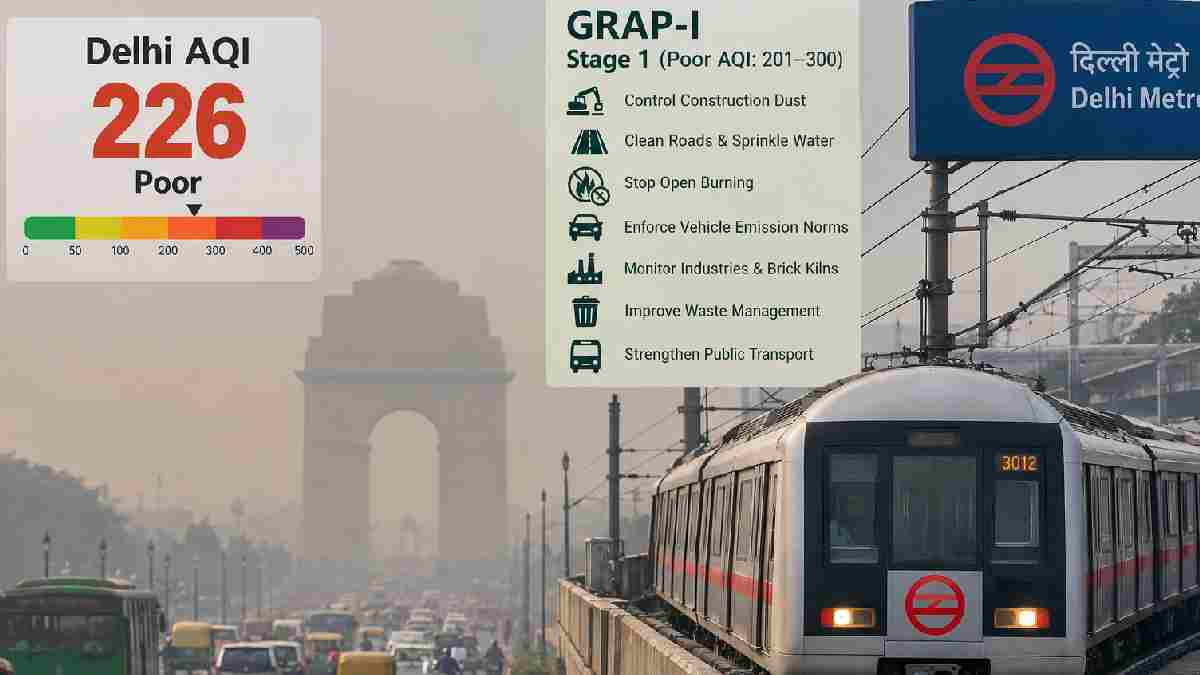
Delhi's air pollution remained in the ‘poor’ category on Thursday morning, with the city’s pollution control measures intensified throughout the National Capital Region (NCR). Its Air Quality Index (AQI) of 226 at 7 am prompted the city to elevate to Stage I of the Graded Response Action Plan (GRAP) across the region.
The Delhi Metro Rail Corporation (DMRC) has announced 20 additional train trips on weekdays from October 22 to improve air quality and encourage commuters in the city to use public transportation instead of private vehicles, to decrease congestion and vehicle emissions.
The move comes as Delhi enters the winter pollution season, when weather conditions change, road dust, vehicle emissions, and other pollution sources can contribute to deteriorating air quality.
Delhi AQI Today: Some Places Record Poor Air Quality
According to the latest available readings cited in the October 22 report, Delhi’s overall AQI was 226 in the morning. Several monitoring stations across the capital also recorded elevated pollution levels.
The AQI near AIIMS was 276, while readings around Akshardham and Anand Vihar were 237. India Gate had an AQI of 238, and the ITO area had 280. These readings placed the monitored locations in the ‘poor’ category.
Delhi’s air quality deteriorated sharply after October 20 when the AQI was recorded at 179, which is considered moderate. By 2 p.m. on October 21, the index had risen to 244, which is poor. The daily average had climbed to 245 at 4 p.m.
The deterioration led officials to activate the first stage of GRAP, a graded system that progressively increases the level of pollution with the introduction of tougher measures.
The India Meteorological Department (IMD) and Indian Institute of Tropical Meteorology (IITM) have indicated that air quality will remain ‘poor’ over the next few days, and continued enforcement of pollution control measures is crucial.
Delhi Metro adds 20 more train trips
The Delhi Metro’s decision to operate 20 extra weekday trips is among the immediate steps to address the worsening pollution situation.
The additional services started on Thursday, October 22, and will run daily from Monday to Friday. With services available to all, DMRC is optimistic that making public transportation more convenient for commuters will make it more easily available.
A higher proportion of Metro travel will reduce the number of private vehicles on the roads, helping to curb congestion and pollution from road transport. But the real environmental gain will depend on commuters’ responses and pollution control on a wider scale.
Besides the additional train trips, DMRC is also improving dust-suppression measures at construction sites and surrounding areas to reduce road dust and garbage from footpaths and road medians, and checking construction zones to ensure compliance with environmental standards.
Engineers will determine if construction materials are properly covered and if wheel wash facilities are functioning properly. These facilities prevent vehicles leaving construction sites from carrying dust onto public roads.
DMRC also installed more than 250 anti-smog and mist guns at construction sites, Metro stations, and office buildings. Its environmental department conducts regular inspections to monitor compliance with pollution-control requirements, the corporation said.
Around 31 kilometres of city roads are temporarily under DMRC’s control to facilitate Metro construction work. Most of these roads have been repaired to reduce dust pollution, the corporation states.
What is GRAP-I? Key Pollution Control Measures
Stage I of the Graded Response Action Plan is activated when Delhi’s AQI falls within the ‘poor’ range of 201 to 300. The CAQM took all Stage-I actions across the NCR on October 21, 2026, after reviewing the air quality and weather forecasts.
The first stage is to control pollution at its source and prevent conditions from worsening.
Key measures include:
Construction dust control: The authorities need to ensure that construction and demolition sites are subject to prescribed dust-mitigation measures and cover construction materials and waste properly.
- Road cleaning: Agencies need to increase mechanised sweeping and water sprinkling on dust-prone roads.
- Open burning: The open burning of municipal waste, leaves, and other biomass must be prevented.
- Vehicle inspections: Teams are going to check pollution control compliance and take action against visibly polluting vehicles.
- Industrial monitoring: Inspections of industries and brick kilns will be increased to ensure environmental compliance.
- Waste management: Authorities must improve garbage collection, prevent illegal dumping, and take control of fires at landfill sites.
- Public transport: Agencies should enhance public transport services to reduce dependence on private vehicles.
The GRAP framework allows authorities to escalate interventions if air quality worsens. Stage II applies to very poor air quality (AQI between 301 and 400), while Stages III and IV introduce tougher regulations as pollution rises to the ‘severe’ and ‘severe-plus’ categories.
Restrictions on Certain Buses and Other Pollution Sources
Under the applicable GRAP-I measures, inter-state and inter-city buses from certain neighbouring states and towns will be subject to fuel and emission requirements to operate in Delhi-NCR. The rules provide that such services can be operated using electricity, compressed natural gas (CNG), or diesel vehicles that meet BS-VI emission standards.
Authorities have also been instructed to enforce existing environmental regulations more firmly and respond promptly to pollution-generating activities.
The implementation needs coordination between the Delhi government, municipal bodies, transport authorities, pollution control agencies, and other departments in the NCR. Compliance will be monitored, and the effectiveness of such measures will be checked as conditions change.
What Delhi Residents Should Do?
In order to combat pollution, the Metro or other public transport system, which people can use when possible, is preferable, and they should manage to keep their vehicles in good order and avoid unnecessary private vehicle journeys.
People should also avoid burning household waste, leaves, or other materials in the open and report visible pollution violations through the appropriate civic or pollution-monitoring platforms. Construction contractors and businesses must follow applicable dust-control and waste-management rules.
People with asthma or other respiratory conditions, older adults, and children may need to take extra precautions when pollution levels are high. Checking current AQI readings before outdoor activity and restricting strenuous outdoor exercise during periods of poor air quality can help minimize exposure.
Delhi Pollution Outlook: Teams Step Up Vigilance
Delhi’s AQI of 226 on October 22 shows the challenge of controlling pollution as the winter season approaches. GRAP-I and DMRC’s new train services are early interventions to prevent air quality from worsening further.
But these measures will only succeed if there is regular enforcement, better dust management, responsible waste disposal, and a sustained shift towards public transportation. With forecasts that Delhi’s air quality could remain poor for a few days to come, residents and the authorities will need to continue monitoring conditions closely. If pollution levels rise into higher AQI categories, additional measures will need to be considered according to the prescribed guidelines under the GRAP framework.
Today, the immediate focus is on reducing avoidable emissions, improving dust control measures, and encouraging cleaner commuting choices across Delhi-NCR.




Comments
Leave a Comment