
The Leader of Opposition in Lok Sabha Rahul Gandhi on Monday attacked Prime Minister Narendra Modi ahead of a proposed INDIA bloc march to the Supreme Court, accusing the Modi government of protecting Chief Election Commissioner (CEC) Gyanesh Kumar. Gandhi said the march was designed to raise questions on the functioning of the Election Commission and allegations of electoral irregularities.
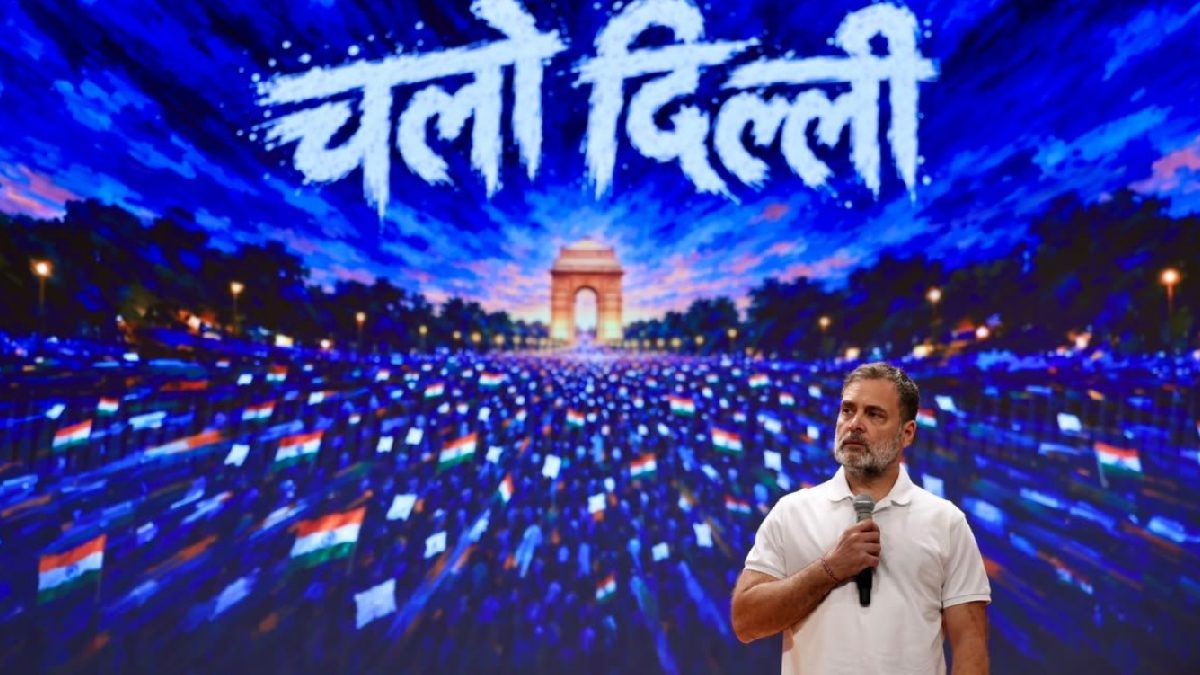
In a press conference at the All India Congress Committee (AICC) headquarters in New Delhi, Gandhi said protests against alleged vote theft and the Election Commission had taken root in the national capital over the past four to five days. He questioned the security arrangements across Delhi and asked why the city was effectively under siege.
“We want to show the country that the government, PM Narendra Modi, is protecting Gyanesh Kumar,” Gandhi said. He also asked, “Why is Delhi under siege?” His comments came as security was further tightened in the central city ahead of the opposition’s planned demonstration.
The Congress leader said he and party president Mallikarjun Kharge wrote to the Chief Justice of India (CJI) for concern about what they perceived as threats to democratic processes and electoral fairness. The CJI had responded to their letter and directed them to file a petition, he said.
“In fact today, INDIA bloc leaders and I will go to the Supreme Court together and file this petition,” Gandhi said, outlining the Opposition's plan to pursue the matter through the judicial process.
Rahul Gandhi Raises Questions About Election Commission
Gandhi accused the Chief Election Commissioner of facilitating alleged ‘vote chori’, a term used by Opposition leaders to refer to alleged electoral manipulation. These allegations formed a central part of Congress’s criticism of the Election Commission.
The Opposition has repeatedly raised questions about the electoral process and the functioning of the poll body. Gandhi said the proposed petition will take the issues of the INDIA bloc to the Supreme Court, for judicial consideration of the issues raised by the Opposition.
The allegations against the Election Commission and its chief are political leaders’ allegations but they are not reality and should be taken into account in parallel with the findings of a judicial process. Gandhi presented a legal action as part of the Opposition’s efforts to highlight its concerns about electoral fairness.
Gandhi also claimed that portions of the police and security forces supported the Opposition's agitation. He claimed that security restrictions were preventing people from reaching the capital and questioned the scale of the deployment across Delhi.
The government and security agencies’ response to the allegations would be crucial in the full investigation. The Congress said it would keep raising the issue through public protest and legal channels throughout.
Congress Calls for ‘Chalo Dilli’ March
The Congress had called for a ‘Chalo Dilli’ march from Connaught Place to the Supreme Court. The demonstration was meant to highlight the party's reservations about the Election Commission and alleged vote theft.
The planned march was a part of a broader political campaign by the INDIA bloc, an alliance of opposition parties. Gandhi said the participation of alliance leaders would demonstrate the collective nature of the Opposition’s concerns.
He also contrasted the Opposition’s approach with the security response in the capital and noted that the issue should be addressed through a public discussion and institutional process. His comment put the planned march in the context of the political accountability and the role of constitutional institutions in terms of both the electoral accountability of the government and the role of constitutional institutions in that process.
The Supreme Court petition mentioned by Gandhi would provide the Opposition a legal means of expressing its concerns. Any judgment on the allegations will depend on whether it is submitted and the subsequent proceedings.
Security was tightened across central Delhi ahead of the planned march. Barricades were put up on several places and a large number of Delhi Police, CRPF and Rapid Action Force (RAF) personnel were deployed.
The authorities also put restrictions on entry and exit of some metro stations until 4pm on October 12, according to the security arrangements outlined for the day. The measures were expected to affect movement around parts of the capital and also areas around the planned protest route and will affect people’s movement around the capital to protest.
The increased deployment and transport restrictions became a central area of Gandhi’s critique. He questioned why thousands of police personnel were stationed across the city and described Delhi as having been turned into a fortress.
Security arrangements around large demonstrations can affect public movement, traffic and access to transport services. Residents and commuters in central Delhi would therefore be frustrated when barricades and restrictions are in place.
INDIA Bloc Seeks to Take Its Concerns to the Supreme Court
The planned march and suggested petition showed the decision of the INDIA bloc to combine political protest and legal action over its allegations about the Election Commission.
Gandhi said the Opposition wanted to bring national attention to its concerns and hold the government accountable for its handling of the issue. The Congress also tried to portray the protest as a larger public movement rather than a political protest.
The next step depends on whether the petition is filed and then formally presented to the Supreme Court and if it is interpreted by the court. Details of the legal proceedings are of critical importance to the Opposition's allegations.
So far, the episode is a symptom of a political dispute over electoral systems, institutional accountability and security arrangements in the capital. Congress and the INDIA bloc have said they will continue to push their agenda through public mobilisation and judicial proceedings.




Comments
Leave a Comment