Beijing is the center of global attention in humanoid robotics with more than 2,000 robots from 666 teams competing in the World Robot Games. The event, held at the National Speed Skating Oval, brings together robots capable of performing a wide range of activities, from athletics and gymnastics to martial arts and practical emergency-response tasks.
The scale of this year’s competition is a reflection of the rapid growth of humanoid robotics. Robot entries have nearly quadrupled since last year, in a sign of increasing investment and interest in machines that can operate more independently. The teams are putting their new robotic systems through challenges — their movements, balance, coordination, speed and decision-making are all on display and the robotic systems are being tested.
The competition covers 51 events for sport and practical activities. Track races enable robots to move quickly and still maintain balance, gymnastics competitions test their flexibility, coordination and controlled movement
. Martial arts competitions add a new dimension of challenge, which is to respond to physical challenges in a way that robots can do and still remain stable.
Some events are more about real-world applications than about sport. Firefighting and other practical tasks are intended to demonstrate how humanoid robots could eventually assist people in dangerous or difficult environments. And these kinds of applications will only become more necessary in the years to come as robotics technology develops and machines become capable of working in situations where human intervention may be risky.
One of the biggest developments in the games this year was the increasing autonomy of the robots. Many robots are now able to make decisions independently rather than rely solely on remote human control.
This is a major step in the development of humanoid robots and researchers and companies are hopeful they will eventually be able to perform complex tasks in homes, factories, offices and public environments.
The competition has also provided a lot of fun moments. Robots are doing great jumping and synchronized dancing. But not everything has gone well; some robots have fallen behind in training and hit cushions at a training session.
These incidents serve as a reminder that it is still very difficult with the fast pace at which technology is developed and the technology will only be able to make robots more and more capable of control and natural movement (a basic requirement that has been proven).
The World Robot Games are taking place alongside the World Robot Conference, which is a great forum for companies, researchers and technology lovers to look at advancements in artificial intelligence and robotics. The conference is an opportunity to look at how humanoid robots are getting beyond experimental machines and to see them as potential products for the commercial world.
The growing commercial interest is also reflected in the price of increasingly lifelike humanoid robots. The most expensive are around $17,000, though manufacturers are starting to target a wider market.
These machines are still pricey compared to most consumer electronics (as compared to high-end computers), but falling production costs and technology advancements will eventually make them affordable.
China is now a major player in the humanoid robotics industry and the world market with heavy investment and manufacturing capacity and AI research going on. China's humanoid robot market is projected to total $15 billion by 2030. That rapid growth might generate more competition among technology companies and accelerate the development of more capable machines.
For all that, the Beijing games are more than a contest of robotic sporting skills. They also offer a glimpse of a future in which humanoid machines will take a bigger part of our daily life in a future in which they are all around us. From dangerous industrial work to supporting emergency services and maybe even helping people at home, the applications are huge.
As robots become faster, more coordinated and increasingly autonomous, competitions such as the World Robot Games give researchers a valuable environment to test their capabilities. There are successes—and sometimes crashes—on show in Beijing that demonstrate how fast the field is moving while also highlighting some of the technical difficulties that remain.
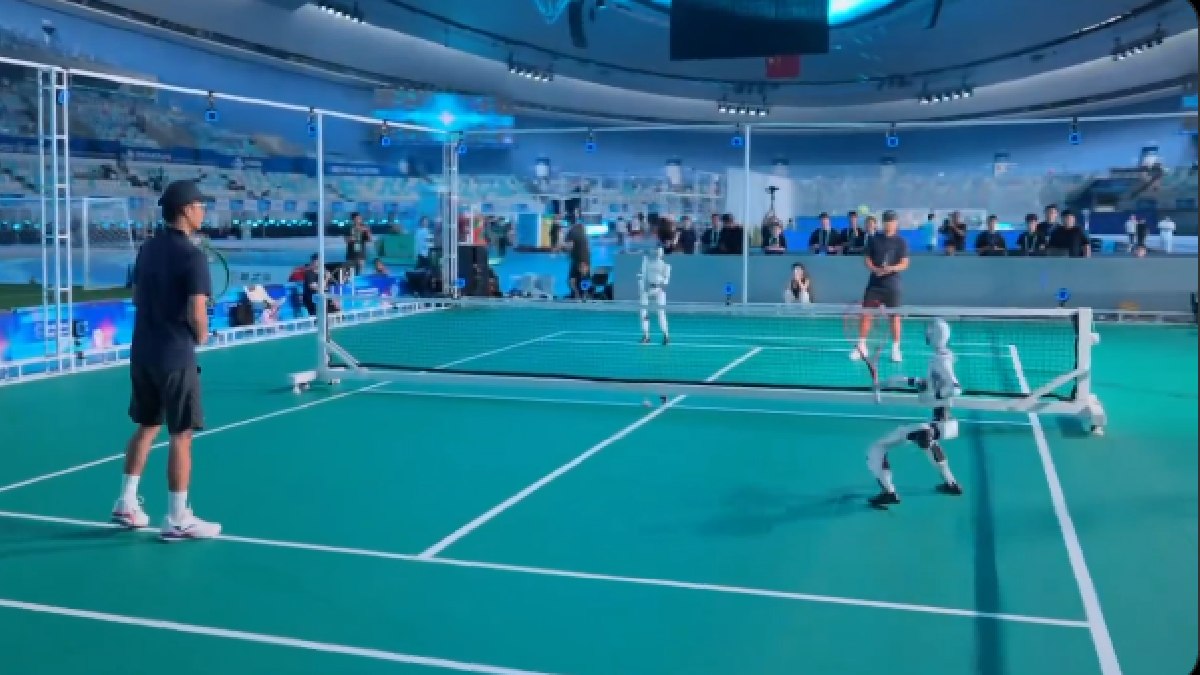
Humanoids will soon become great practice partners for tennis and other sports.
— The Humanoid Hub (@TheHumanoidHub) August 21, 2026
These robots, trained by Galbot, are preparing to play with celebrities at the World Humanoid Robot Games in Beijing. They're fully autonomous. pic.twitter.com/xtg5k6YYCZ
In a year of record participation, the event underlines the momentum of humanoid robotics. Beijing’s robot games are a showcase of what machines can do today but also how fast autonomous robotics are being pushed to the future.