A day at a wildlife sanctuary at an ordinary amount of risk of danger this week became dangerously dangerous when a leopard suddenly turned on a little, putting a weak parrot in the line of fire sight of the predator. The shocking incident was captured on internal security cameras and has gone viral: The cautionary tale of the fine line between harmony and danger in the animal kingdom.
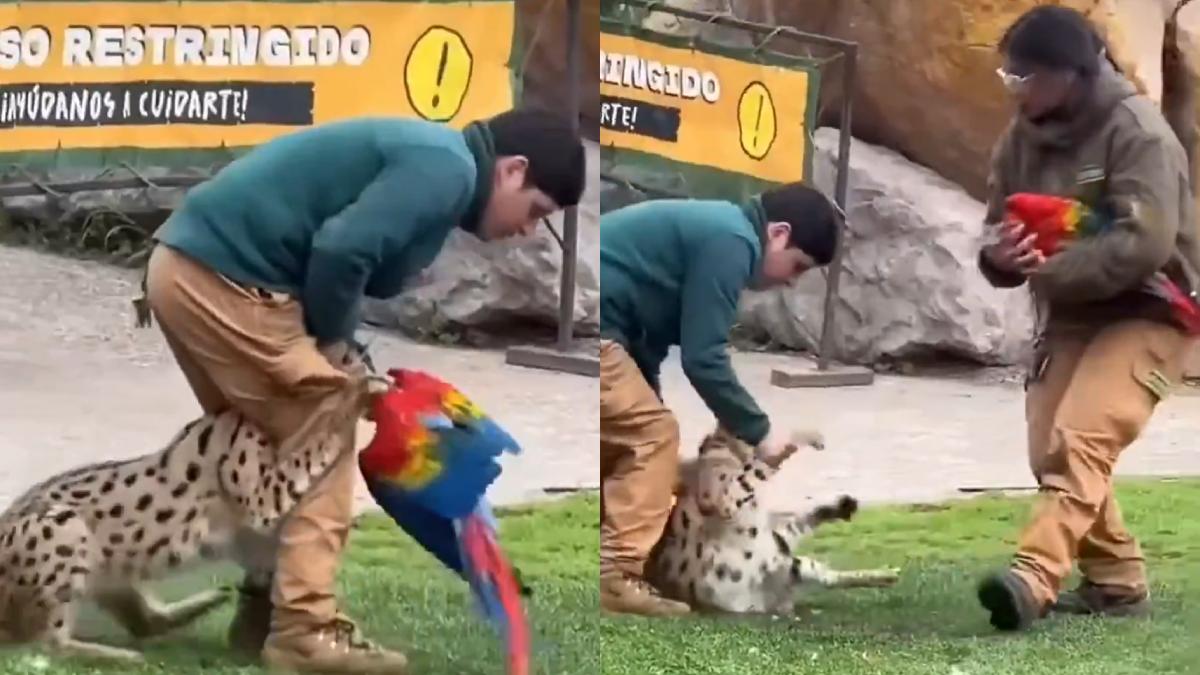
The Sudden Strike
The event began in an area of a communal enrichment center often visited by animals that are closely monitored. For reasons still being examined by behaviorists, the leopard, typically serene alongside the smaller animals, shifted suddenly to a hunting crouch. It emerged abruptly: a few feet from her, the big cat lunged after the parrot. The parrot, momentarily dazed by the predator’s shadow, could not take off. That would have been the story’s fate out in the wild. But human intervention changed that script.
A Heroic Intervention
The lunge, a longtime caretaker who’s supervised the facility’s leopards for more than a decade, stepped in front of a leopard and sped down its run. The caretaker used a combination of vocal and physical commands to distract the leopard as the leopard clawed towards the bird. And the split second choice left the parrot with plenty of time to fly to its next high safe rafter.
A leopard reacts… a parrot is in danger… and the caretaker has seconds to act.pic.twitter.com/nQkcBYEeS6
— Damn Nature You Scary (@AmazingSights) March 4, 2026

While the caretaker remained calm, the energy in that moment was palpable. “During those times, you don’t think; you just carry on,” the caretaker said later. “The leopard is not ‘evil’; it’s merely a leopard. But the parrot is family, and I have to keep every life that’s living here safe.”
The Unpredictability of Instinct
Although animals may be kept in captivity, experts say that in some wild animals, "hard-wired" predatory triggers persist. A sudden move, another sound, a flicker of light--even just a slight shift can turn on a switch in a large feline. That experience also shows us why we never quite 'tame' those animals, says Dr. Aris Mehta, an expert in feline behavior. The caretaker’s courage was commendable, but also highlights the near-constant vigilance necessary for a passage in mixed species areas.
Safety Protocol Review
After the emergency, the sanctuary suggested a complete review of its interaction protocols. The parrot was removed to another wing and any enrichment for the leopard will now be left in a separate area that keeps it under much tighter controls, in hopes of averting future “predatory drift”.