China’s recent flood rescue efforts in Guangxi have offered a new glimpse into how drones could transform emergency response. As floodwaters cut off villages and conventional rescue methods got more and more difficult, hundreds of drone pilots did show up with aircraft capable of bringing in essential supplies and in some of the most dramatic cases even stranded people themselves.
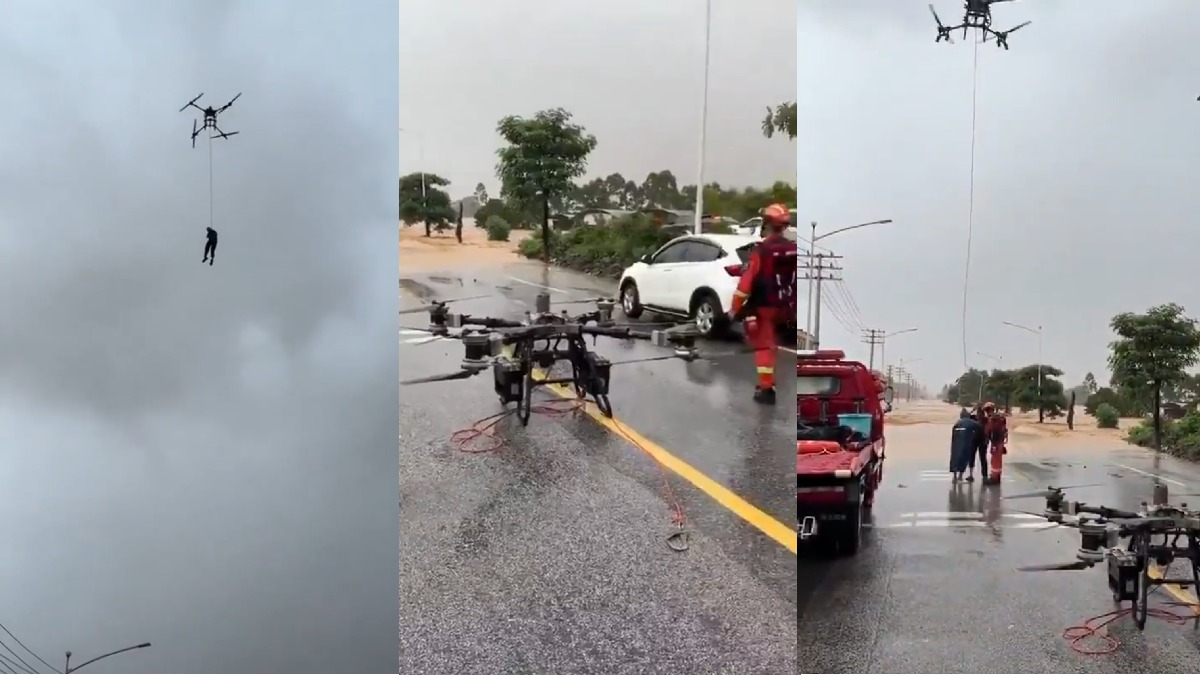
More than 400 drone pilots had participated in the rescue effort, with more than 300 aircraft deployed to areas of flooding. The drones were originally used to transport more basic goods like food, water and medicine to areas no longer reachable by road or boat and so on. Over the course of the time, some of the largest heavy-lift drones were also used to evacuate people from the area where people had been hurt.
One of those aircraft was DJI's FC200, a cargo drone designed for heavy loads of up to around 440 pounds. Unlike small consumer drones that drone owners have in common as a hobby, they are used for photography, the industrial aircraft are large and can be used in high-pressure environments. Their abilities made them especially valuable to rescue people that were caught in floodwater.
The rescue method was strikingly simple but required careful coordination. From the drone a cable and harness were lowered, and a stranded person was secured before the aircraft lifted them away from the danger zone. A human pilot operated the drone remotely, relying on live camera feeds to navigate the aircraft and avoid obstacles.
One rescue in Liulan village demonstrated just how challenging and potentially life-saving the technology could be. A man had been stranded on the roof of a building in floodwater rising around him. Rescuers had to use a heavy-lift drone to get him out if they were unable to open traditional access routes.
According to reports of the operation, the pilot replaced the drone's battery before the flight and kept another aircraft ready as a backup. The FC200 was then sent toward the stranded man. Once the man was secured with multiple wraps of the harness, the drone lifted him away from the flooded area.
The aircraft took him upwards of 150 feet above the ground and through the danger of power lines and treetops. It then traveled almost 3,000 feet through the flooded village before settling down for safe, dry land. The entire evacuation took about nine minutes and the drone’s battery level was at around 23 percent by the time it was completed.
The operation illustrates the shift in the way drones are viewed. For years drones have mostly been used for photography, surveying, mapping and military purposes. But in recent years heavy-lift commercial drones have also been tested for logistics, firefighting, infrastructure inspections and disaster response.
Floods represent an especially challenging situation for conventional rescue teams. Roads may disappear beneath water, bridges may fail and boats may struggle to reach narrow or dangerous areas. Helicopters can perform aerial evacuation, but they are expensive, require significant infrastructure and cannot always work in every situation. Large drones could fill that gap by providing a remotely operated alternative for specific rescue missions.
Drones to transport people raise an intriguing question about the future of urban transportation. If a drone can move a person through a flooded village safely via remotely controlled heavy-lift, could other futuristic technologies eventually be able to transport passengers in cities?
That possibility is already being explored by companies and aviation developers working on electric vertical takeoff and landing aircraft, known as eVTOLs. Unlike emergency cargo drones, passenger aircraft would need to meet far more demanding requirements involving redundancy, navigation, structural safety, communications, certification and passenger protection.
A future passenger drone would also need sophisticated autonomous systems and highly reliable flight controls. Flying a person around buildings, transmission lines, bridges and other aircraft is much more complicated than delivering a package. Urban air mobility would require dedicated rules, designated routes and systems capable of handling large numbers of aircraft sharing the same airspace.
so apparently people are getting flown out of floods by drones in China now
— Ole Lehmann (@itsolelehmann) August 28, 2026
like literally hanging beneath a giant DJI drone and getting flown to dry ground
it was during the recent floods in Guangxi, more than 400 drone pilots showed up with over 300 aircraft
> most of the… pic.twitter.com/Tb5L6KBnBg
But flood rescues like the one in Guangxi illustrate why the technology is getting attention. For those in Guangxi, an unmanned aircraft sent to a place too difficult or dangerous for a rescuer to do so can be an important advantage in a disaster.
As a consumer of technology, the idea of opening an app, asking someone to fly a drone and directly over traffic is a science fiction. But the technology is slowly evolving from demonstrations and into practical applications. What started as drones that carry food, water and medicine could become sophisticated aerial transportation systems.
But for now heavy-lift drones are proving their value where they may matter most: delivering critical supplies to isolated communities and helping rescue people when conventional transportation is no longer available. The notion of a future “drone Uber” is still some way off, but these flood rescue missions demonstrate that bringing people to the rescue by drone is no longer a futuristic idea.