A video of a woman interrogating a group of Hajj returnees about flowers found in an airport has touched on civic sense, public cleanliness and responsible behaviour in shared spaces.
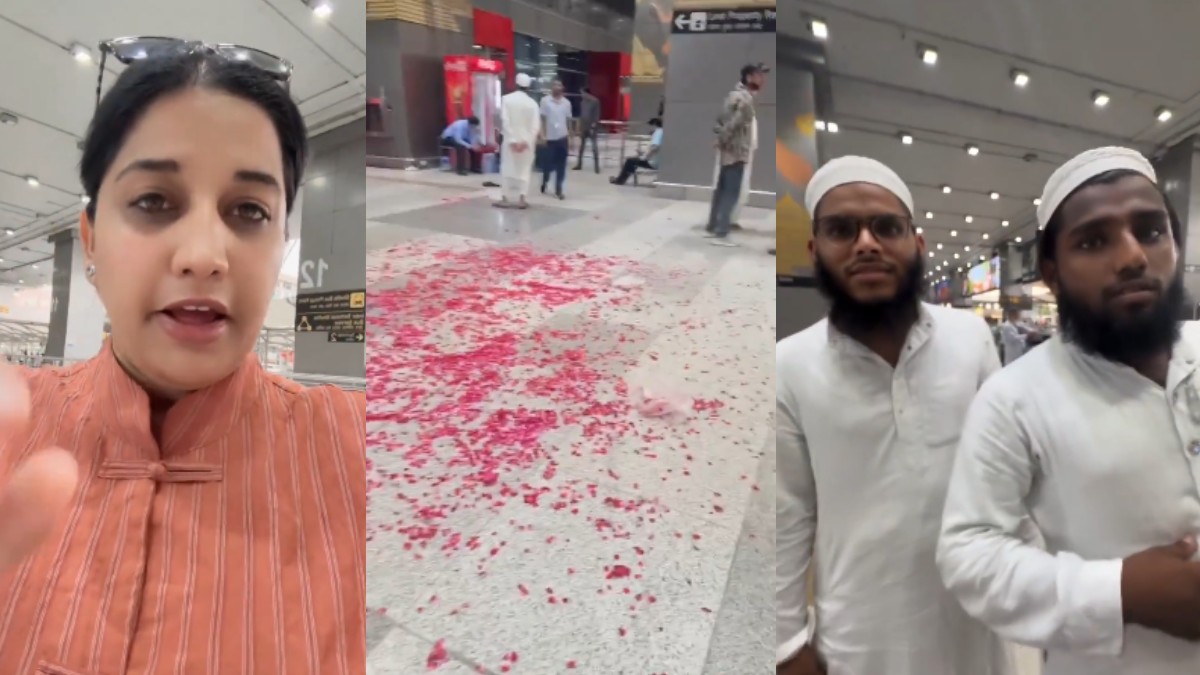
The encounter (recorded at an airport as pilgrims came back from Hajj) has made waves on social networking and has drawn fire from people who question the woman’s stance and the way the confrontation took place.
According to the video, the woman had questioned the reason flowers were thrown inside the airport when the group of men arrived after Hajj. One of the men said the flowers were offered because they were returning from the pilgrimage. She then questioned the practice from the point of view of airport cleanliness, asking who would take care of those flowers that were left on the floor.
The woman also compared the behaviour with standards of cleanliness in Dubai, asking whether the same conduct would be acceptable at an airport there. The men appeared to leave the spot without continuing the argument. That brief interaction has since been the talk of social media users.
The incident has raised a wider discussion about public spaces - especially airports, railway stations, religious places and other heavily used venues. Airports are shared spaces where thousands of passengers, employees and visitors arrive and leave every day. To keep clean in those places, everyone - passengers and people who arrive to receive arriving passengers - must be involved.
Flowers and other forms of welcome are common in many parts of India for religious, cultural and family occasions. Rejoicing for loved ones when they are returning from a major journey is a lot of emotions and flowers are associated with celebration and respect. But what happens when this video gets the waste thrown on a public site?
A civic sense generally involves knowing that public spaces belong to everyone and that individual actions affect other people. Clean up and safer spaces are just as much a result of simple behaviours like waste disposal, following airport guidelines and avoiding litter. The woman’s complaint is not confined to the group shown in the video and is a bigger problem.
At the same time, the context of the incident is rather limited. A brief video on social media will not tell us everything that happened before or after the interview. So we do not want to make conclusions about the people involved in this video based on a brief video. Cleanliness is most important and our focus is on that.
As well as criticism, the comparison with Dubai has also attracted attention online. Dubai is well-known for cleanliness standards and well-managed public infrastructure and the cleanliness culture is so strong that travellers are expected to be clean and have to do that at home. A person who is not in India or another country, people say, has to be clean. The basic principle of not leaving waste behind in public places is universal everywhere.
For airports especially, waste is an issue because of the huge passenger volumes. Cleaning teams work to maintain terminals, waiting areas, washrooms and other facilities. Additional waste left by passengers or visitors increases the workload for the cleaning staff and affects the overall look of the facility.
The incident has raised new questions about how public celebrations and civic responsibility are closely connected. Religiously and culturally rooted Indian traditions are not incompatible with responsible public behaviour. Someone returning from a pilgrimage does not need to lay things down on the floor and therefore does not need to do more work for sanitation personnel.
Social media has played a major role in amplifying the interaction. These kinds of short videos of public confrontations can get the ball rolling very quickly because they invite viewers to take sides. But in this case, the conversation has been so big as it combines religion, tradition, public behaviour and cleanliness - subjects that can generate strong reactions.
Some viewers have praised the woman for raising a concern about littering and asking who would clean the area. They say as citizens, public places are held accountable and citizens need not assume that sanitation workers will automatically take care of waste generated by individual celebrations as they do.
Others have advised people to avoid making a single incident into a broader observation of Hajj pilgrims or any religious community. The behaviour of individuals should not be used to make generalisations about an entire group. Civic responsibility is a universal expectation and applies equally to everyone, regardless of religion, profession or background.
The conversation also highlights the importance of finding respectful ways to deal with such conflicts. Public disputes can quickly turn into confrontational situations, especially in a space with cameras on. If I can gently remind the public of airport rules or point them to appropriate disposal facilities in that same room, there are times when the situation can be handled without further conflict.
Airport authorities can also play a part in that as well, by giving clear guidance on what is acceptable celebration and disposal of waste. For example, there should be designated areas where passengers can enter and who welcomes them, and bins and signage should be clearly marked so as not to misinterpret the situation and allow families and communities to celebrate the big things that happen.
Religious pilgrims who are returning to a destination airport (e.g. when flying back from religious pilgrimages) will also have a big celebration at a destination airport. Families will meet up with their loved ones and traditional customs may be part of the welcome. But there will be celebrations in shared facilities, and it’s good to take care of other passengers and airport staff as well.
So the viral video has opened a discussion that goes beyond the individuals featured in it. It’s a simple but intriguing question: How do we preserve cultural traditions while keeping public spaces clean? The answer is responsible behaviour, proper waste disposal and respect for the workers who maintain these facilities.
The incident also serves as a reminder that civic sense is not limited to following formal rules. It includes little everyday choices, such as placing flowers, wrappers or other waste in designated bins instead of leaving them on floors or public pathways. Such actions may appear minor individually, but they can make a significant difference when repeated by thousands of people.
The video will keep being shared and we can see the most constructive result of cleanliness and mutual respect in this way. Religious celebrations and cultural traditions can be celebrated with great enthusiasm and public spaces will also be taken care of properly.
A woman extremist named Alka Singh, targeted pilgrims returning from Umrah at the airport and spewed venom by dismissing rose petals as filth. pic.twitter.com/BHsF98kLMN
— The Muslim (@TheMuslim786) August 29, 2026
But the airport interaction discussion is not so much about one group but about a whole society’s responsibility to keep public spaces clean. And keeping things clean is a responsibility for us from a big airport in India, Dubai or anywhere else.
So the viral exchange brought that message back into view and opened up a dialogue about how each person plays an integral role in keeping public areas clean and in maintaining the dignity of public places.