China’s J-16 fighter jets participating in a joint military exercise with Egypt have attracted attention well beyond the two countries. The “Eagles of Civilisation 2026” exercise has involved Chinese J-16s in combat against Rafale fighter jets from France, along with Egypt’s MiG-29. For India, this exercise will provide an opportunity to assess the performance of a Chinese fighter platform that could become more salient in the region’s security environment too.
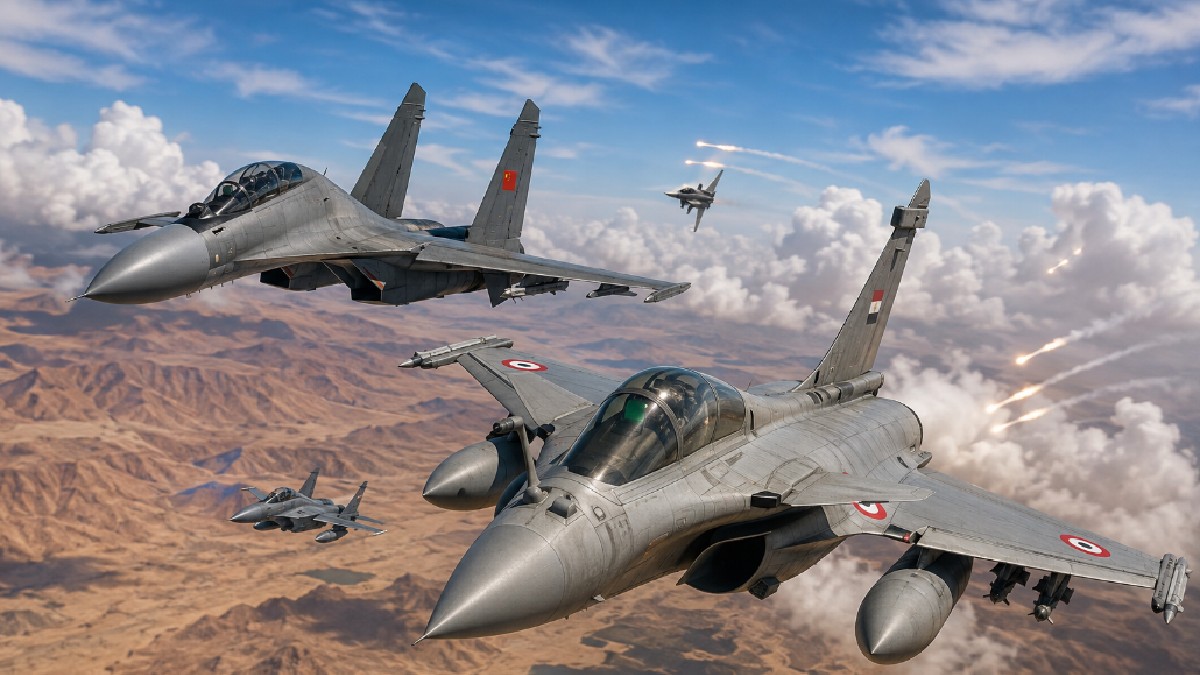
The J-16 and Rafale are simulated in the exercise. Such exercises are used to practice air combat scenarios, study tactics and assess how different aircraft function in the middle of a high-pressure fight. Also for observers, it is a great opportunity to see how China’s air force pilots its advanced multirole fighter with foreign forces.
The J-16 is a twin-engine, two-seat multirole fighter developed by China and based on the Su-30 family of fighter aircraft. It is generally considered a 4.5-generation fighter and is designed for a wide range of missions, including air-to-air and precision strikes. One of its key features is that it can carry a heavy weapons payload but also includes electronic warfare.
That electronic warfare component is particularly important from an Indian perspective. Modern air combat has become much more about sensors, electronic warfare systems, data links, missiles, and how to disrupt the systems of an opponent. The J-16’s reported electronic warfare capabilities therefore make its performance in exercises like the one in Egypt worth watching.
The presence of Rafales adds more interest to the exercise. Rafale fighters were purchased by India for the Indian Air Force and equipped with systems and configurations as per the Indian requirements. Therefore, analysts are cautious about comparing Rafales being used by Egypt and India. Aircraft performance can be very different depending on the radar systems, electronic warfare suites, weapons, software and mission-specific configurations.
India’s interest in the exercise is also connected to the military balance in the area. China is one of India’s top security issues and Pakistan has deep and long-standing defence ties to Beijing. Chinese-origin fighter aircraft are a major part of Pakistan’s combat aviation inventory, so the capabilities and operational doctrine associated with Chinese aircraft are of interest to Indian defence planning.
Pakistan is also interested in strengthening its air combat and electronic warfare capabilities. Should the number of Chinese fighter aircraft increase in Pakistan, it could be important to understand how platforms such as the J-16 perform in realistic training bases.
It's not just about which fighter jet is better technically. Modern aerial warfare involves a huge array of aircraft, missiles, radars, electronic warfare systems, airborne early-warning platforms and intelligence tools. The effectiveness of a fighter is all about the combination of all of these. Exercises like “Eagles of Civilisation” can also give useful pointers in terms of tactics and operational aspects and not a simple J-16-versus-Rafale comparison.
China's growing defence cooperation with neighbouring countries outside its traditional sphere of influence is another factor attracting attention. Joint exercises allow Beijing to expand its military-to-military partnership with other countries and to test its platforms in foreign settings and show its growing aerospace capabilities. Egypt is in line with a broader military procurement model incorporating equipment from many major defence suppliers.
For India, the development comes as the country is enhancing its own air power. The Indian Air Force is building and modernising its fighter fleet and Rafales are still an essential part of its combat capability. India is also looking for indigenous platforms and systems to reduce reliance on foreign suppliers and improve its ability to respond to modern threats.
The J-16's appearance in Egyptian skies should therefore be seen as a part of a much broader strategic picture. The exercise does not by itself prove that Chinese aircraft are superior to Rafales, nor does a simulated engagement replicate the conditions of an actual war. But it gives military planners another opportunity to study China’s fighter operations, tactics and electronic warfare approach.
As China enhances its air power and partnerships with defence partners, exercises involving its advanced fighters will be more and more studied by New Delhi. For India, understanding the J-16 is particularly important because it is a Chinese fighter platform but also a manifestation of a wider trend towards networked warfare, electronic warfare and rapidly developing air combat systems in the region.
The Egypt exercise is less about deciding the winner between the J-16 and Rafale and more about learning operational lessons. For Indian defence planners, those lessons could prove valuable as they assess the future capabilities of China and its regional partners and prepare for an increasingly technology-driven airpower environment.