Chinese motorcycle police units have attracted attention for their highly synchronized training drills in which officers demonstrate discipline, precision, balance and advanced motorcycle-handling skills. The exercises show how much preparation police officers are required to patrol busy urban areas with motorcycles, respond quickly to incidents and navigate challenging roads. The drills show how physically and skillfully motorcycle police officers move and work with such precision, and how they are able to achieve such a high level of precision.
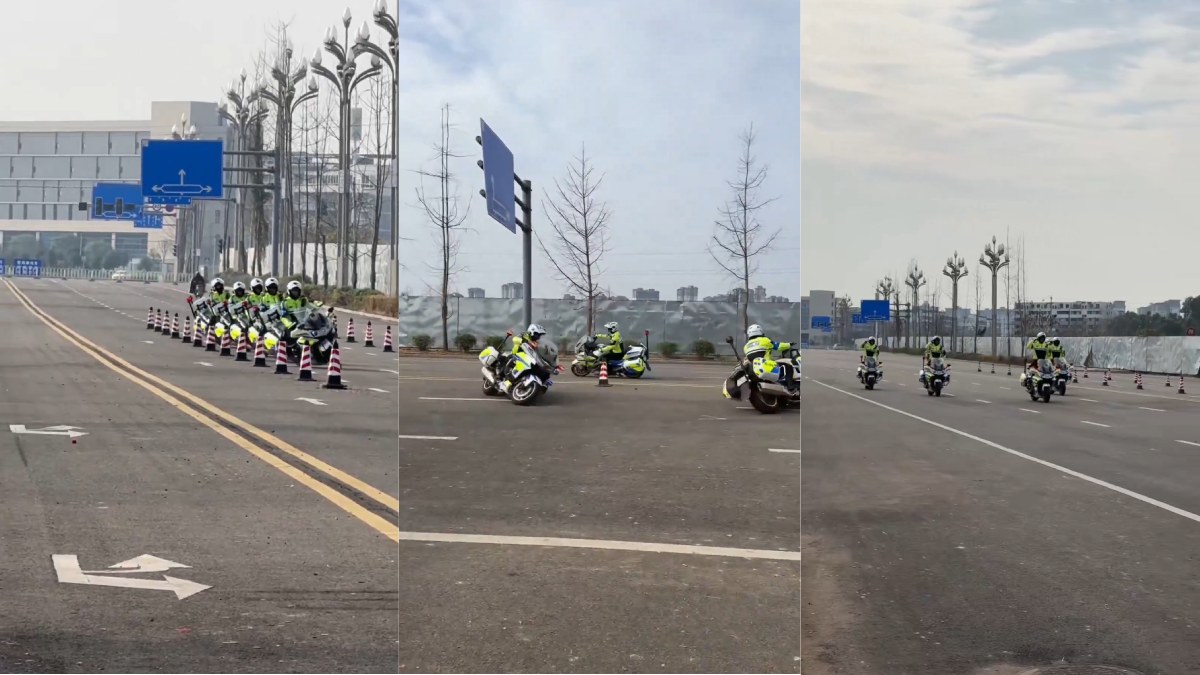
Motorcycle policing is a lot more than just learning to ride a two-wheeler. The police also need to have control of their motorcycles and keep up with traffic, pedestrians, road conditions and emergencies; officers should be aware of the motorcycle traffic, pedestrians and road conditions as well as emergencies. Training drills are meant to develop basic riding skills and to build confidence on the ground too, so that they are able to keep riding skills, ride well when under pressure.
Officers have to be able to control acceleration, braking, steering and body movement with precision while struggling to complete complicated courses in small spaces and have to learn how to do so very quickly and precisely in difficult situations to maneuver in tight spaces.
One of the most striking aspects of these demonstrations is that the officers are able to maintain their formation and synchronization. As many as five or six riders can move at the same time, but remain in a stable position so the formation is not disrupted.
Precision is another important aspect of police training for motorcycle users. Traffic officers may have to take narrow lanes, take sharp turns, weave through obstacles and stop at specific points. These maneuvers test balance and throttle control; they force the riders to anticipate their next move. Stability at low speeds is particularly difficult and slow-speed exercises are a part of all motorcycle training.
And the drills also stress fast turning and controlled braking. In real-world policing, motorcycle officers may need to react quickly when streets are congested and there is a surprise. Training in controlled situations allows officers to practice emergency responses constantly and to build muscle memory and become more calm in the middle of a crisis.
Another important aspect of the exercises is teamwork. Motorcycle police work in groups, so officers must be able to sense what their teammates are doing and communicate properly. Formation riding is essential for coordination and situational awareness training and group exercises encourage officers to anticipate changes in speed and direction. This coordination, especially at large public events, traffic management and organized patrols, will become more important when it comes to coordination and situational awareness.
Hence the visual appeal of these drills has also attracted police demonstrations. The motorcycles moving in a precise manner, riders making synchronized turns and officers in rigid positions makes for a very disciplined show. Yet behind the impressive show is training that requires patience, repetition and physical stamina.
Motorcycle police officers also need to be very conscious of their surroundings. And unlike the controlled demonstrations, on real roads that are not well-structured and controlled vehicles, the roads are unpredictable with uneven surfaces, sudden traffic movements and changing weather. Professional training can help riders make the judgment needed to learn how to modify their riding style along with riding and not lose control over their motorcycles.
As far as safety goes, in these exercises safety is the most important. Riders wear protective gear and practice in controlled spaces under supervision. Training is the way to develop their skills and not try very difficult things without prior knowledge. The control and method of riding is important and the method of advanced riding is technique and consistency not speed.
The drills also reflect the changing nature of motorcycles in modern policing. Motorcycles can provide mobility from crowded streets in which larger vehicles might struggle to move quickly. They can be useful for traffic patrols, quick response and visibility in busy areas. In this way, the specialized motorcycle units need officers who can merge traditional policing skills with a high degree of vehicle control.
Chinese motorcycle police drills showcasing discipline, precision, and advanced riding skills. pic.twitter.com/f53uDVDzoG
— Massimo (@Rainmaker1973) August 22, 2026
Chinese motorcycle police drills, as a whole, are a perfect combination of discipline, technical ability and teamwork. The highly scripted exercises might look easy to the experienced rider, but they are an exercise in training and detail. From low-speed balance and obstacle navigation to synchronized formations and emergency maneuvers throughout the course, each exercise is the basis for a good motorcycle officer.
These demonstrations are a reminder that professional motorcycle riding is more than speed or physical confidence. Precision, judgment, coordination and constant training are just as important as that. Thus the disciplined performance of Chinese motorcycle police is a good example of how specialized law-enforcement units train their personnel to ride motorcycles safely and effectively in demanding situations.