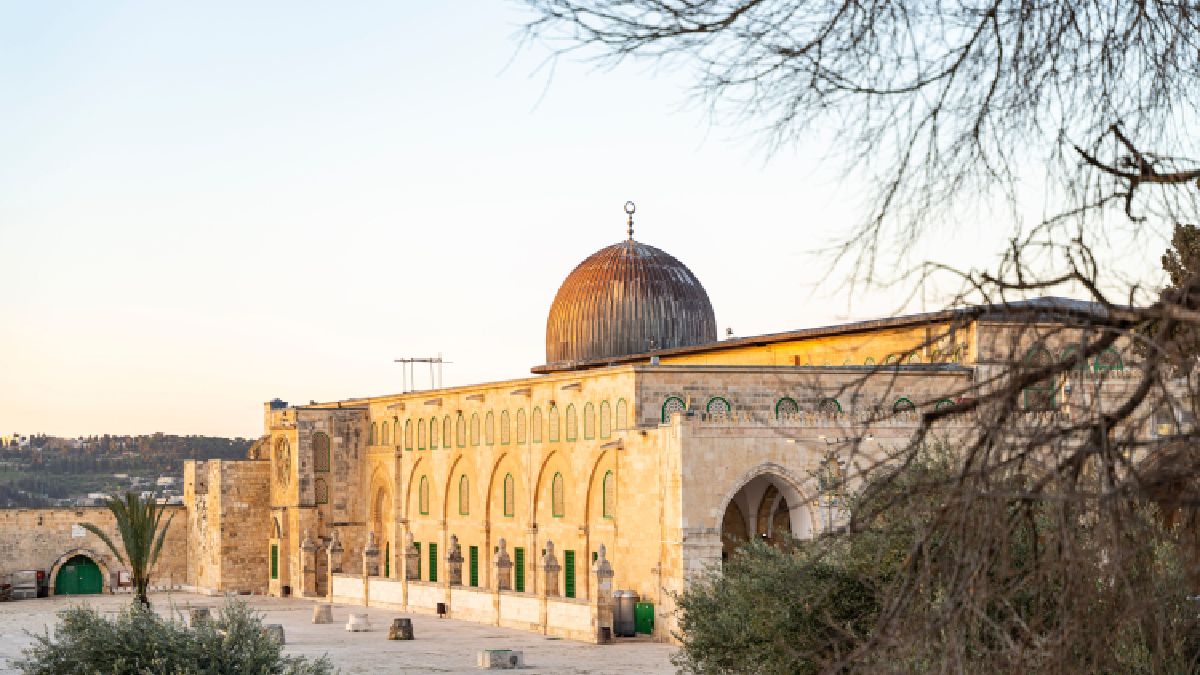
The foreign ministers of eight Muslim majority countries have jointly condemned Israeli actions at Jerusalem's Al-Aqsa Mosque compound, and accused Israel of breaching international law and undermining the long-standing ties that have kept one of Islam's holiest sites alive.
Türkiye, the United Arab Emirates, Indonesia, Qatar, Egypt, Pakistan, Saudi Arabia and Jordan issued a joint statement expressing concern over what they described as large-scale incursions by Israeli settlers into the compound of the Al-Aqsa Mosque. According to the statement, the groups were accompanied by extremist Israeli ministers and protected by Israeli security forces.
The coordinated diplomatic response came amid fresh tensions in occupied East Jerusalem after Israeli National Security Minister Itamar Ben Gvir visited the place again.
The eight foreign ministers condemned what they described as provocative actions inside the compound, including the alleged raising of the Israeli flag in the courtyard, the installation of two tents by Israeli police and continued visits by groups of Israeli settlers.
They claim that such actions are in violation of international law, United Nations resolutions and the historical and legal arrangements that are in place around the holy site. And the ministers warned that the development could stoke religious tensions and destroy potential for a political solution to the conflict to be reached by two states.
Ministers Accuse Israel of Threatening Al-Aqsa Status Quo
In their statement, the ministers accused Israel of seeking to alter the historical, legal and demographic character of occupied East Jerusalem. They also criticised what they described as extremist incitement and repeated calls from Israeli ministers and settler groups to visit the mosque compound.
And the eight countries argued that such actions threatened not only Muslim holy sites but also Christian religious sites across Jerusalem.
The ministers were also concerned about restrictions on access to Jerusalem's Old City and places of worship. They said restrictions on access to Muslim worshipers were inconsistent with international humanitarian law and part of a wider process of altering the legal and historical framework governing occupied East Jerusalem.
The statement also reiterated their position that Israel, as an occupying power, does not have sovereignty over Jerusalem’s Muslim and Christian holy sites.
Al-Aqsa at Centre of Long-Running Dispute
The foreign ministers confirmed that the entire 144-acre Al-Aqsa Mosque compound (known as Haram al-Sharif) is exclusively a Muslim place of worship.
They also reaffirmed the role of the Jerusalem Endowments and Al-Aqsa Affairs Directorate, which is located within Jordan’s Ministry of Endowments and Islamic Affairs. The countries said the directorate remains the only legal entity to administer the site and regulate access under the historical status quo.
The statement also reaffirmed support for the Hashemite custodianship of Jerusalem's Islamic and Christian holy sites as an important tool of preserving existing arrangements.
The ministers called on Israel to immediately lift restrictions on access to the Old City and allow Muslim worshippers unrestricted access to Al-Aqsa Mosque.
Ben Gvir Visit Draws Fresh Criticism
The joint statement followed another visit by Itamar Ben Gvir to the Al-Aqsa compound under police protection. He was accompanied by groups of Jewish visitors.
Ben Gvir, who belongs to Israel's far-right coalition government, has made several visits to the sensitive site over the past years. He has been criticized by Palestinian and regional governments and has been warned that such visits could fan the flames of unrest around the holy compound.
The eight countries also called on the international community to take a stronger position against what they described as continuing violations affecting Muslim and Christian holy sites in Jerusalem.
They called on international pressure to prevent any actions that could jeopardise the status quo at Al-Aqsa Mosque. Continued escalation around the site would further destabilise Jerusalem, one of the most sensitive flashpoints in the Israeli-Palestinian conflict, the ministers warned.
But the latest diplomatic statement is also indicative of growing concern among several Muslim-majority countries over developments at Al-Aqsa, and comes as tension around Jerusalem’s holy sites remains an important source of regional and international friction.