Former Pakistan Interior Minister Sheikh Rasheed Ahmed has drawn criticism for publicly celebrating the achievements of Hafiz Saeed, LeT chief and making hostile comments against India. Ahmed was the interior minister of Pakistan from 2020 to 2022 under former Prime Minister Imran Khan and voiced encouragement for them on a public platform to senior figures from the Pakistan Markazi Muslim League (PMML) party of Pakistan Markazi Muslims who are associated with the banned group.
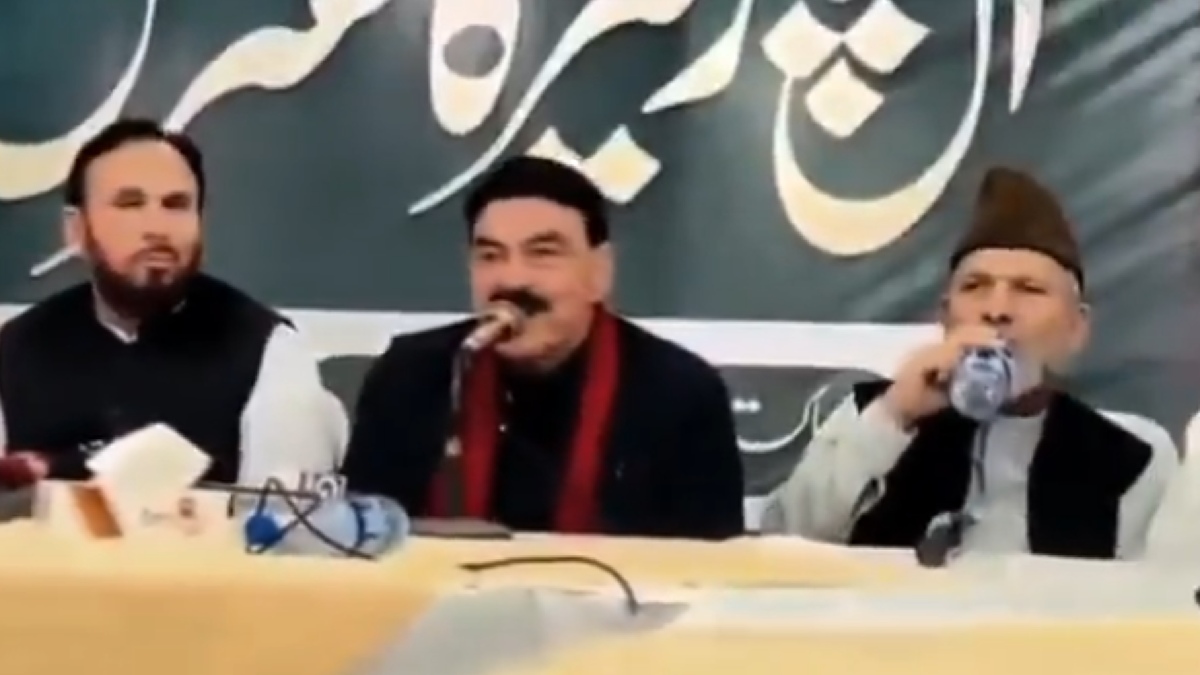
A video of the event has gone viral on social media and shows Rasheed on stage alongside Khalid Masood Sandhu, who is a senior LeT commander and president of the PMML, and Qari Muhammad Yaqoob Sheikh. Rasheed declared in his speech: “Main Hafiz sahab ka ghulam hu,” which means, “I am a slave of Hafiz Saeed.”
The statement has received a lot of attention as Saeed is a United Nations-listed terrorist and it is widely associated with Lashkar-e-Taiba, which is linked to the Mumbai attack in 2008.
Rasheed also raised questions about his alleged links with Saeed, claiming he was expelled from the United States after Saeed’s phone number was found on his mobile phone. The former minister then made threats against India, saying Pakistan would respond strongly to any perceived hostile action.
Rasheed invoked religion in his speech and even made a clear threat against India, saying that Allah would destroy the country if India looked at Pakistan. He also used provocative imagery, saying there would be no birds chirping in India and no temple bells ringing. Obviously, such comments could be seen as a threat to the relations between India and Pakistan as it is still very sensitive for there is a history of cross-border terrorism and militant activity in the region.
The appearance is even more significant in light of the political background of those present. The PMML has been associated with individuals and networks linked to Lashkar-e-Taiba, and LeT is a terrorist organization in several countries. Hafiz Saeed, the founder of the group has been identified by international authorities as a leader of the militant organization that is responsible for attacks on India.
Sheikh Rasheed Ahmed is a veteran Pakistani politician and founder of the Awami Muslim League. He served as the interior minister in Imran Khan’s government from 2020 to 2022 and has deep political links with Khan and his Pakistan Tehreek-e-Insaf (PTI) Party. So his comments are not only from the perspective of a politician but also from a position of his previous service in Pakistan’s government.
Rasheed has made controversial statements on terrorism and India before. In 2022, while he was interior minister, he claimed that former Pakistani Prime Minister Nawaz Sharif had provided Indian authorities with information about the Faridkot address that was associated with 26/11 Mumbai attack gunman Ajmal Kasab. Pakistan was in a political stalemate at that time and many people believed that foreign powers were trying to remove his government from power.
The recent episode has once again raised questions about Pakistan’s longstanding claims that militant organisations operating from its territory are independent “non-state actors.” Critics say public appearances by political figures together with proscribed militant organisations undermine those claims and raise questions about the relationship between political networks and extremist groups.
Hafiz Saeed and Lashkar-e-Taiba have been at the centre of India’s concerns over Pakistan-based terrorism for decades. Saeed was declared a terrorist by the United Nations, and Lashkar-e-Taiba has been designated as a terrorist organization by several governments and international bodies. The terrorist group has been linked to scores of attacks and the 2008 Mumbai attacks are probably one of the most visible examples of its alleged involvement in terrorism against India.
Rasheed’s comments come at a time of continuing tension between New Delhi and Islamabad. India has repeatedly demanded action against Pakistan-based terrorist organisations and individuals who are associated with terrorist groups, and those who are alleged to be behind the planning or facilitating attacks on Indian interests.
Pakistan exposed.#Pakistan Leader Sheikh Rasheed open claiming he was a “follower and servant” of Jihadi Terrorist Hafiz Saeed.
— Ravi Ranjan Singh 🇮🇳 (@RaviRanjanIn) August 13, 2026
In the video senior Lashkar leader Sandhu is reportedly seated on his right with senior commander Sheikh Yaqoob on his left.
For India. this is… pic.twitter.com/fgAs7CsMxG
Pakistan, on the other hand, has denied allegations that its state institutions sponsor terrorism although its handling of militants has long been at the forefront of international scrutiny in the past.
The former minister’s loyalty to Hafiz Saeed and his threats against India are likely to further galvanize criticism of Pakistan’s political establishment and its approach to militant groups. It also shows how inflammatory rhetoric from the top politicians in power has the potential to undermine the diplomatic dialogue between the two nuclear-armed neighbours.
Political statements are not always the official stance of the Pakistani government, but the remarks of a former interior minister praising a UN-proscribed terrorist will be of particular interest. The incident could prompt a new debate on the connection between Pakistan’s formal counterterrorism policies and the public activities of politicians and political groups associated with figures from the country’s militant ecosystem.