Government spending is the key to a country’s economy and is the basis of public services, infrastructure, health care, education, defense, and social welfare.
But spending levels vary from one country to another as economic priorities, population size, tax revenue and development objectives are far from the same.
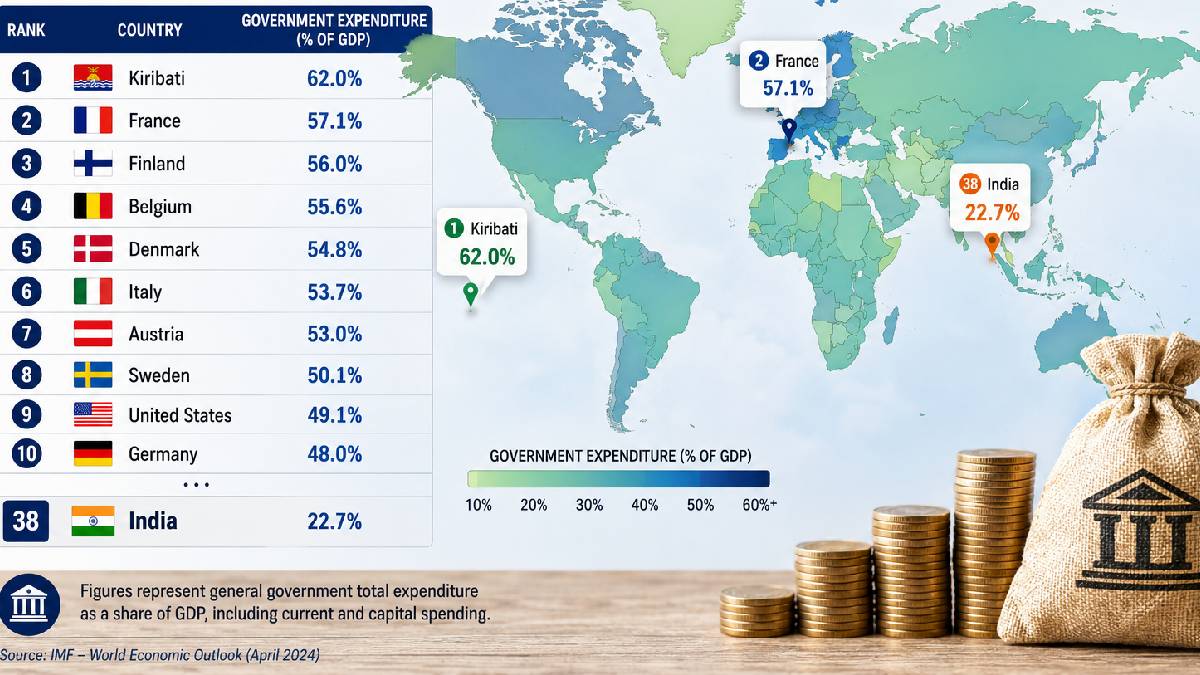
According to the latest global government expenditure data, Kiribati, a small island nation in the Pacific, has the highest government spending as a percentage of GDP; Kiribati is one of the largest public spending nations in the world.
Public services, climate adaptation, and development projects make up a large portion of the country’s budget (about 80 percent) and the country spends its GDP (2.5 percent) on public services, climate adaptation and development that is disproportionate to GDP and the budget.
France also ranks among the highest-spending countries. With a social welfare system, universal healthcare, pension schemes and public services, France has one of the largest government expenditure-to-GDP ratios in Europe.
And the high spending supports millions of citizens through healthcare, education, unemployment benefits, and retirement programs.
A number of European countries, including Finland, Belgium, Denmark, Italy and Austria, also feature high in global spending rankings.
They are very much social security and healthcare, education as well as public infrastructure investment based nations; their welfare system is very much about a universal welfare system.
Despite having the world's largest economy, the United States pays a smaller percentage of GDP than other European welfare states. But in dollars, U.S. government expenditure is still one of the highest in the world due to its huge economy and its vast defense budget.
India's Position
India is much lower in terms of government spending as a percentage of GDP than other developed countries. As the public expenditure in India has increased steadily over the years, the government does balance spending with fiscal discipline and efforts to reduce the fiscal deficit.
A large part of India’s budget goes into infrastructure development, welfare schemes, agriculture, defense, healthcare, education and digital transformation schemes.
Many flagship programs like PM Gati Shakti, Jal Jeevan Mission, Ayushman Bharat and various social welfare schemes have contributed to the higher public investment.
Experts say that India's fairly young population, fast-growing economy and capital expenditure drive its spending differently from countries with aging populations that spend large sums on pensions and healthcare.
Why Government Spending Matters
Higher government spending can create economic growth, upgrade the infrastructure, create jobs and improve public services. But excessive spending without sufficient revenue can increase fiscal deficits and public debt.
Countries must strike a balance between economic development and long-term fiscal sustainability. In developing countries, infrastructure and industrial growth are prioritized and in developed countries, healthcare, pensions and social protection are more heavily funded.
As global economies continue to struggle with inflation, climate change, aging populations and geopolitical uncertainty, the government spending patterns are going to evolve.
India's continued focus on infrastructure led growth and targeted welfare spending will define its place in the global expenditure rankings and economic growth in the future and help to keep it growing at a high level.