Google has launched Gemini 3.8 Live and Gemini 3.8 Live Extended Thinking, two new audio-to-audio models that make real-time conversations with artificial intelligence more natural, responsive, and capable. The models were generally released on September 15, 2026, via Google's Live API and are a significant addition to Google's real-time voice AI offerings.
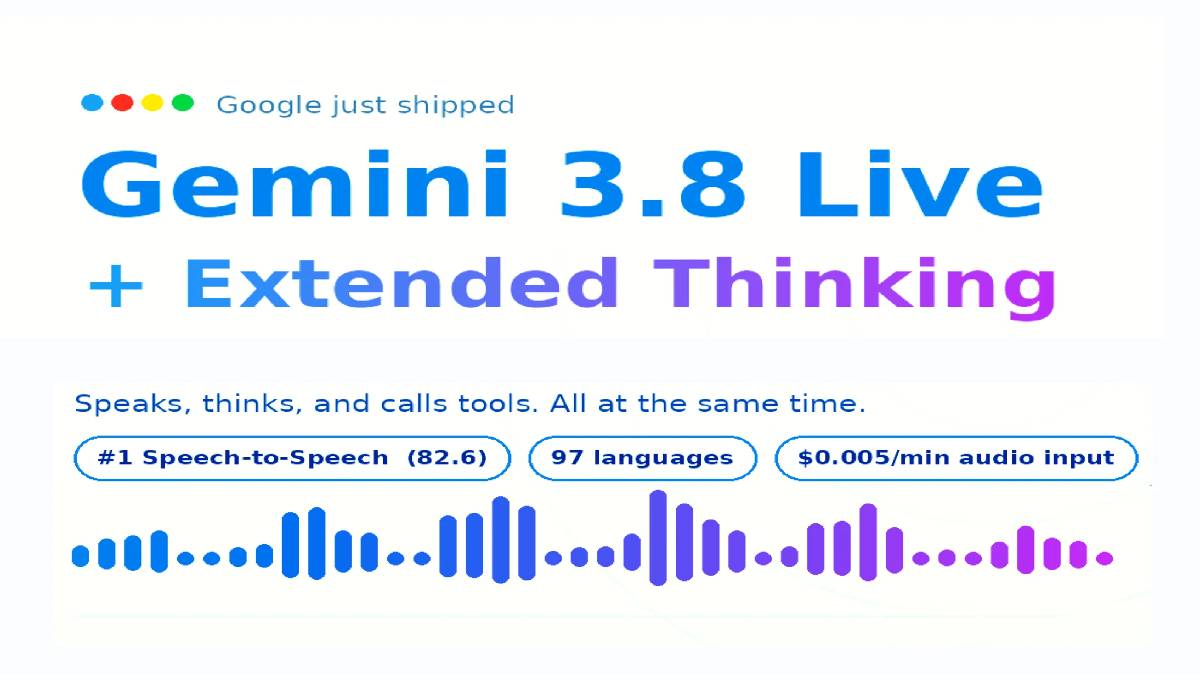
The new models are intended for different types of voice-based AI experiences. Gemini 3.8 Live is the default option for low-latency voice agents and real-time dialogue, while Gemini 3.8 Live Extended Thinking is designed for situations that require more complex reasoning and multi-step problem solving during a live conversation.
Gemini 3.8 Live is designed for fast conversational interactions in which users can expect AI to answer quickly, without any noticeable reasoning delay. Google says the model can support interleaved reasoning, asynchronous function calling, full session client-content updates, and built-in audio streaming. It can accept text, audio, images and video as input and produce text and audio outputs.
The more advanced Gemini 3.8 Live Extended Thinking model focuses on background reasoning. Rather than just responding right away to a complex request, the model can reason while maintaining a live voice interaction. Google says this architecture is for complicated tasks with multiple steps and external tools.
One of the main features of the model is that it can use conversational fillers when background processing takes place. For example, in the case that the AI voice agent needs a few seconds to retrieve information or complete an external task, it can give a spoken update instead of leaving the user in silence. Then the system can deliver the final response once the background task has been completed.
Google's documentation highlights some of the potential applications of the extended thinking model. These are technical support agents that need to look at multiple logs, travel assistants that coordinate information from different sources, and educational applications that work through complicated formulas or coding problems. The model can also be used for workflows where external tools take longer to return results.
The two models are also different in how developers manage the conversation lifecycle. With Gemini 3.8 Live, turnComplete can indicate that the model has finished its response and the session is ready for another interaction. With Extended Thinking, developers need to monitor an additional interaction_status signal because background reasoning and tool calls can continue even after an initial spoken response.
Gemini 3.8 Live Extended Thinking supports configurable reasoning levels of low, medium, and high. Google specifically notes that the standard Gemini 3.8 Live model does not expose a configurable thinking level. Instead, it uses interleaved reasoning within its low-latency conversational architecture.
The models are based on Gemini 3 Pro, according to Google's DeepMind model card. Both have a context window of up to 128K tokens and can handle audio, images, video, and text. Their outputs are audio and text and are suitable for applications that mix voice interaction with traditional AI.
Google is also making Gemini 3.8 Live available through the Gemini API, Gemini app, Google AI Studio, Google Cloud/Vertex AI and Google Search Live. The Extended Thinking version is also available through the Gemini API, Gemini app, Google AI Studio, Google Cloud/Vertex AI and certain Google Workspace experiences such as Gmail, Docs and Keep.
The launch also provides developers using older Live models with migration paths. Google suggests moving from the previous Gemini 3.1 Flash Live preview to Gemini 3.8 Live. And the new model should change the model identifier and remove unsupported thinking_level configuration from standard Gemini 3.8 Live sessions, said the company.
At the same time, Google has noted some limitations of the new models (e.g., hallucinations, slowness, or timeouts) as they may not apply to a foundation model. The company's model card also states that the knowledge cutoff for these models is January 2025, so applications requiring current knowledge might need appropriate grounding or external tools.
With Gemini 3.8 Live and Gemini 3.8 Live Extended Thinking, Google is expanding its focus from AI that talks to systems that can maintain a more continuous voice interaction, to reasoning and tool-based tasks in the background. The two-model approach allows developers to choose between low-latency conversation and more extensive reasoning for complex real-time voice applications.