Humanoid robots have taken over technology and competitive robotics by storm after setting record-breaking speed records at the second World Humanoid Robot Games in Beijing.
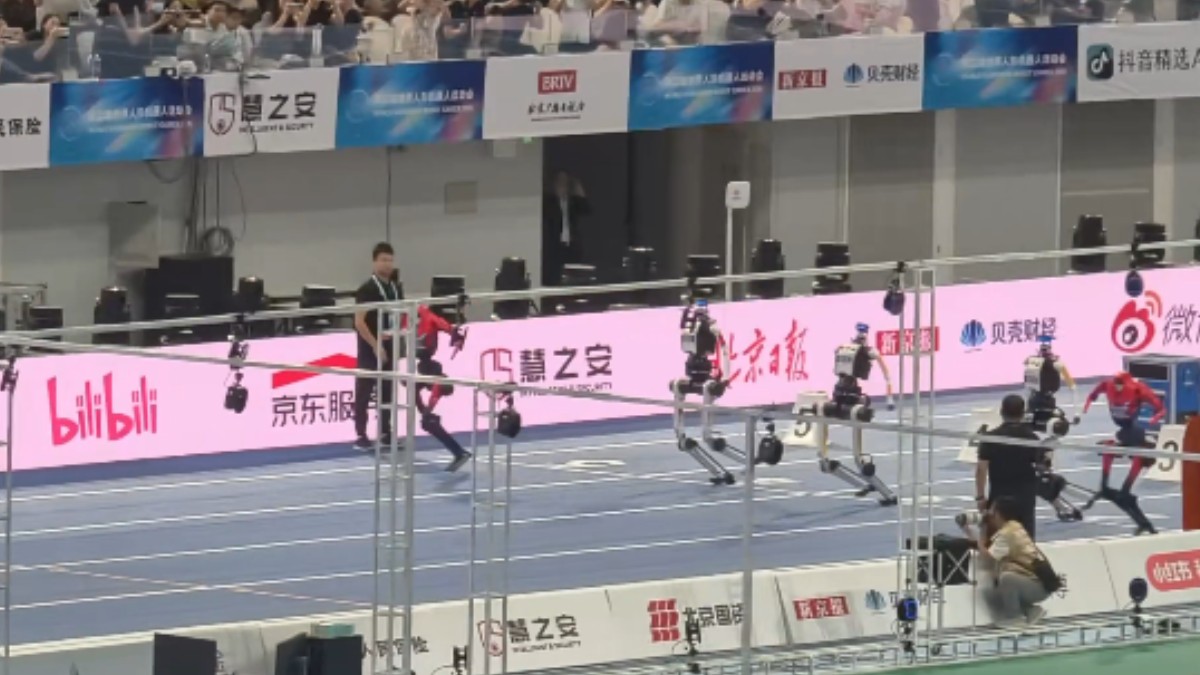
At the National Speed Skating Oval, also known as the Ice Ribbon, 2,056 robots from 666 teams from 16 countries and regions across six continents were in action in the five-day event that took place from August 22 to 26. 51 athletic competitions combined physical challenges with practical and real-world problems.
The biggest story of the Games came from Tiangong Ultra, a humanoid robot developed by Beijing-based X-Humanoid. The robot finished the 100-metre final in an extraordinary 8.64 seconds, which is a new Games record. The performance was faster than Usain Bolt's human 100-metre world record of 9.58 seconds, although robot and human performances take place under very different circumstances and should not be viewed as a direct sport comparison.
Tiangong Ultra's performance was particularly remarkable as the robot had already improved its own marks during the competition. It had 9.39 seconds earlier in the Games and then it cut to 8.86 seconds and 8.64 seconds in the final. Such a quick improvement in a matter of days showed how fast developers are improving robotic movements, control systems and mechanical skills.
But the Games were much more than speed. Organisers significantly expanded the competition from the inaugural event in 2025. This year's programme included 30 competitions and 21 scenario-based events, such as athletics, football, gymnastics, martial arts, weightlifting and dancesport. Robots were also tested in real environments such as factories, hotels, homes, logistics and emergency-response situations.
Some of the most interesting competitions were about how to develop skills that might end up being useful outside of the sport. Humanoid robots faced material handling, hotel services, maintenance, precision operations and emergency response. Other demonstrations were done to demonstrate fine motor skills, like picking up small objects and tightening screws. Real-world robotics requires so much more than running fast.
The contrast between great success and mishaps was one of the Games’ defining characteristics. The robots were experiencing trouble with balance, coordination and stopping after they reached high speeds. Some machines fell at the end of races and some in competition had mechanical problems. A weightlifting robot fell on the judges’ table and was removed from the area from which no injuries were reported.
These moments went viral online (the human-like imperfections of machines that would otherwise have nothing to do with them), and showed the human nature of humanoid robotics. The crashes also showed an important thing about humanoid robotics: the speed of the robots is only one part of the challenge. And to be useful, they also need to be able to stop, balance, be aware of what they are doing, and adapt to any situation at once.
The Games were therefore entertainment and a testing ground for embodied artificial intelligence. The technology combines AI with physical robotic systems so that machines can perceive environments, make decisions and carry out actions. Developers and researchers see this as an increasingly important aspect of future automation in manufacturing, logistics, service, and possibly homes.
China’s rapidly expanding robotics industry was especially visible throughout the event. The number of robots participating far exceeded four times the number of participants at the first Games and the number of team participants rose sharply. The competition was intended to promote technological cooperation, industrial cooperation and the development of practical robotics systems, said the competition organiser.
The 8.64-second run by Tiangong Ultra therefore is only one part of a much bigger story. The Games showed that humanoid machines are becoming faster, more coordinated and capable of handling increasingly complicated tasks. At the same time, the fantastic falls and mechanical failures showed that serious challenges remain.
the craziest moment from China’s AI robot race pic.twitter.com/Bhlgg4BG2x
— el.cine (@EHuanglu) August 26, 2026
As robotics goes on to improve, the World Humanoid Robot Games could prove a valuable benchmark for measuring progress. But the ultimate test is not just whether a robot can win a 100-metre race. Long term, its value is going to be if it can perform the right jobs in a very unpredictable reality.
The Beijing Games provided one of the first looks at that future. Tiangong Ultra’s record-breaking sprint got global attention, and the larger competition was another sign of where we are and how humanoid robots are going from demonstrations to real-life applications. The mix of impressive speed, growing intelligence and occasional spectacular crashes made the event entertaining and revealing and demonstrated how quickly humanoid robotics is evolving.