The new security arrangement between Saudi Arabia, Türkiye and Pakistan may be about to become much more relevant for West Asian geopolitics. The Mecca Joint Defence Agreement signed on 7 August by Saudi Crown Prince Mohammed bin Salman, Turkish President Recep Tayyip Erdoğan and Pakistan Prime Minister Shehbaz Sharif has already drawn comparisons with NATO. Now, a reported Iranian invitation to join the alliance might change its strategic nature.
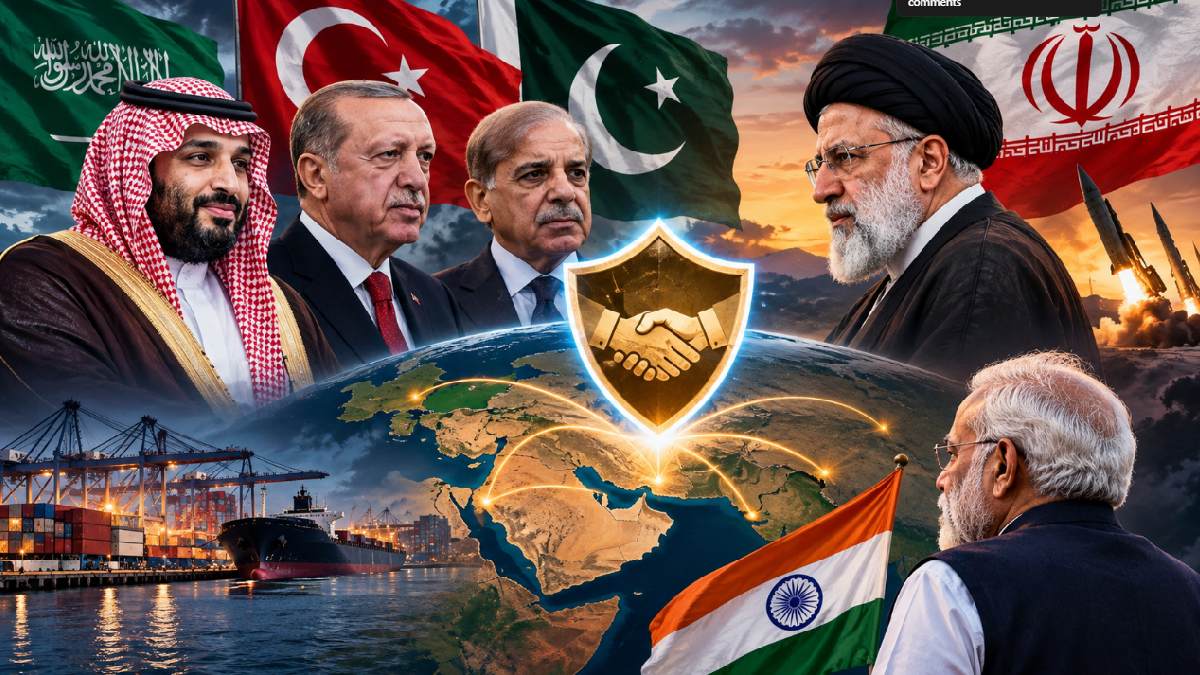
According to a senior Iranian official, Tehran has been invited to join the agreement. But the claim has not yet been officially confirmed by Iran’s Foreign Ministry or by the governments of Saudi Arabia, Türkiye or Pakistan. If the invitation is accepted and Iran eventually agrees to it, it would mark a dramatic turn in a region that has been divided by strategic rivalries for some years now.
What is the Mecca Joint Defence Agreement? It is based on a collective-security principle that an attack on one member would be considered an attack against all three. It is a joint defence and military cooperation agreement to promote military cooperation and collective deterrence between the countries in the agreement.
That provision has naturally been compared to NATO’s collective-defence principle. But, for now, describing the agreement as an “Islamic NATO” is more of a political slogan than a precise description.
Unlike NATO, the Mecca framework does not have a comparable integrated military command, institutional structure or decades-long alliance architecture. Rather, it seems to be an effort by major Muslim-majority regional powers to enhance strategic coordination and strengthen their ability to respond to security threats without solely depending on external powers.
The timing is critical. West Asia remains vulnerable to military escalation, attacks by Iran and its neighbors, energy supply disruptions and tension with the United States and Israel. Saudi Arabia has increasingly sought more strategic autonomy and better regional security capabilities.
Why will Iran be invited? Iran would be one of the most consequential potential additions to the arrangement. Tehran and Riyadh were rivals for decades and supported opposing sides in a number of conflicts in the Middle East.
That relationship started to change in 2023, when Saudi Arabia and Iran restored diplomatic relations after years of hostility and China played a big role in facilitating the rapprochement.
Although there are still substantial differences, both countries have an interest in avoiding a direct clash that could damage the Gulf and threaten energy supplies. Iranian participation in the Mecca framework would therefore be an extraordinary development - a country once seen as a potential security threat could become part of the same security architecture.
Pakistan could play a significant role in facilitating such a development. Islamabad has relationships with Tehran and Riyadh and has been increasingly becoming a diplomatic broker during regional crises.
Türkiye is trying to keep channels open with other regional actors, too. Erdoğan has frequently promoted dialogue and diplomacy as the solution to prevent further escalation. The Turkish leadership has also indicated that the defence arrangement could be open to other countries in the future.
What If Iran Joins? Iranian membership would immediately change the political character of the Mecca Pact. What began as a trio of three Sunni-majority powers would now contain the Middle East’s most influential Shia power.
That could make the arrangement less of a sectarian military bloc and more of a wider regional security mechanism. In theory, bringing rivals into a common framework could help establish channels for crisis management, confidence-building and conflict prevention.
However, membership would not automatically eliminate disagreements.
Iran and Saudi Arabia continue to have major differences on Yemen, regional armed groups, Iran’s missile capabilities, relations with Israel and the wider security architecture of the Gulf. Türkiye, Pakistan and Saudi Arabia could also have different assessments of future regional conflicts.
The biggest challenge would then be deciding how the collective-defence clause works when member states disagree on the origins of a conflict. A pact is easier to establish on paper than to operate when its members have competing strategic interests.
Why India has reasons to watch.
Developments in the Mecca Pact and the future of the Mecca Pact are important for India since New Delhi has strong relations with Saudi Arabia and Iran.
Saudi Arabia has become a key strategic and economic partner of India. Cooperation is in energy, investment, infrastructure, defence, technology and regional security. Millions of Indians are also living and working across Saudi Arabia and the Gulf, and regional stability is directly relevant to India.
Iran, on the other hand, occupies a different but equally important place in India’s strategic calculations.
The Chabahar port project is central to India’s connectivity ambitions. India signed a 10-year agreement in May 2024 for the development and operation of the Shahid-Behesti terminal in Chabahar. The port will give India its main alternative route to Afghanistan and Central Asia and reduce reliance on Pakistan.
Iran is also relevant to the International North-South Transport Corridor, which is an attempt to connect the Indian Ocean with Central Asia, Russia and Europe. Greater regional stability could make such connectivity projects easier to develop, but international sanctions, financing challenges and infrastructure constraints will continue to complicate the picture.
If Iranian participation in the Mecca Pact actually reduces tension between Tehran and Riyadh, then India could indirectly benefit. A more stable Gulf would be good for Indian energy security, shipping, trade, investment and the safety of Indian nationals living in the region.
The Pakistan Factor
At the same time, Pakistan’s role adds a complicated dimension for New Delhi.
India and Pakistan are strategic rivals, and a Pakistan-backed security alliance between Saudi Arabia and Türkiye would strengthen Pakistan’s diplomatic and military power in West Asia. Türkiye’s close defence and political relationship with Pakistan adds to India’s calculations.
However, India has an important advantage: it does not need to choose between Tehran and Riyadh.
New Delhi has consistently maintained relationships with rival powers in the region. Saudi Arabia is key to energy, investment, trade and the Indian diaspora, while Iran is important for connectivity and access to Central Asia.
The best strategy for India is likely to be strategic flexibility rather than alignment with any emerging regional bloc.
Will West Asia create a new security order? The Mecca Pact will eventually become part of a larger transformation in West Asian security. Regional powers are increasingly wanting to build mechanisms to deal with security challenges without depending on the United States or some external power.
Saudi Arabia wants more deterrence and strategic autonomy. Türkiye wants to expand its regional influence. Pakistan wants to use its military power and relations with other countries to do so. Iran has strong inducements to avoid further isolation and prevent a major regional war from breaking out. If Tehran joins, the Mecca framework could evolve from a three-country defence agreement into the nucleus of a much broader regional security arrangement.
But it is too early to declare a new “Islamic NATO.”
The Iranian invitation is still unconfirmed and even membership would not erase decades of mistrust and competing interests. The real test would be whether these countries can translate political declarations into actual military coordination, crisis management and mutual trust.
For India, at least the development is already worth watching. A more cooperative relationship between Saudi Arabia, Iran, Türkiye and Pakistan would change the strategic scene in India’s western neighbourhood. If it alleviates the conflict rather than creating another rival bloc, New Delhi can only benefit from stability while being able to retain its independent relationships with all parties.
The Mecca Pact, therefore, might be less about creating a Middle Eastern version of NATO and more about the gradual establishment of a regional security order in which West Asian powers are seeking more control over their strategic future. And India will have to remain engaged, flexible and strategically autonomous to maintain that order.