Pakistan has renewed its call for stronger military cooperation among Muslim-majority countries, with the idea of an “Islamic NATO” once again drawing attention amid growing geopolitical tensions involving India, Israel and the wider Middle East.
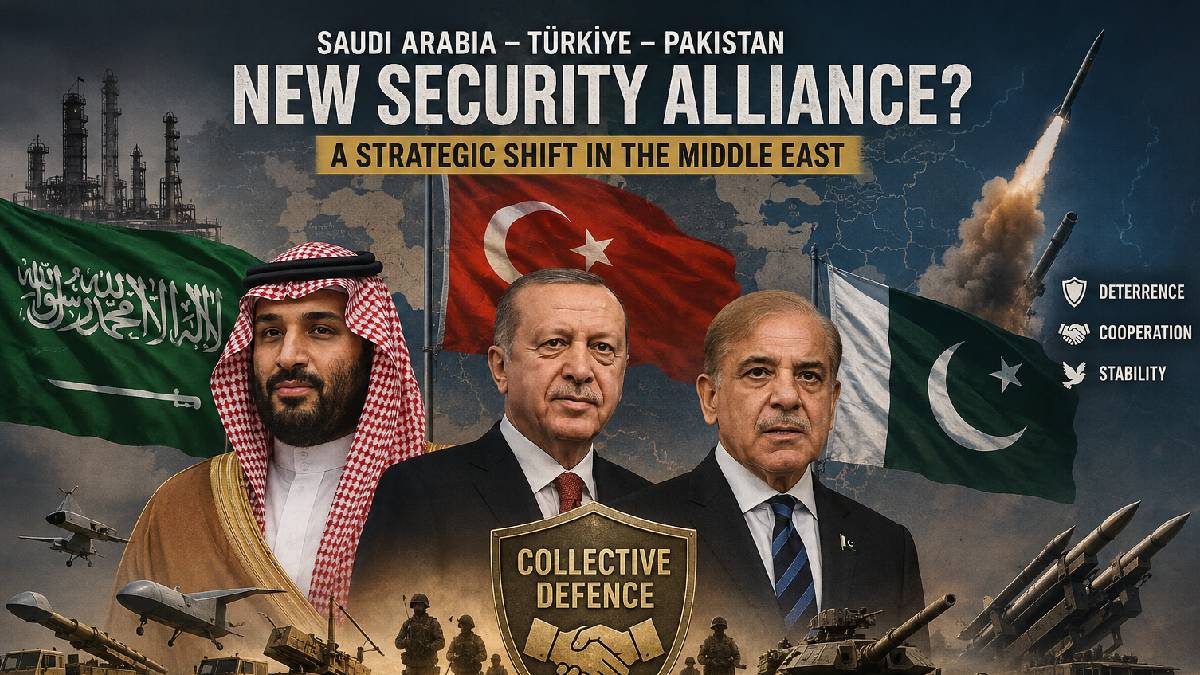
The proposal has gained fresh relevance after Saudi Arabia, Pakistan and Turkiye signed a new defence agreement in Mecca on August 7, 2026.
The agreement includes a collective-defence provision, meaning an attack on one of the participating countries would be treated as an attack on all three.
While the pact has not officially been described as an “Islamic NATO”, it has triggered discussion about whether it could eventually lead to a broader security framework.
Pakistan has supported the idea of a NATO-style alliance among Islamic countries for years. Such a grouping would seek greater coordination on defence, intelligence and regional security while giving participating nations a stronger collective voice on international security matters.
The concept is particularly significant because Pakistan has frequently framed its foreign policy around concerns involving India and Israel.
Islamabad has also called for greater unity among Muslim nations on major geopolitical issues, particularly those involving conflicts in the Middle East.
The Saudi-Pakistan-Turkiye agreement has added weight to those discussions. Saudi Arabia has considerable economic and diplomatic influence, Turkiye possesses one of the region’s largest conventional militaries and is itself a NATO member, while Pakistan is a nuclear-armed country.
Closer defence coordination among the three could therefore have wider strategic implications.
However, the latest agreement does not automatically mean that a formal “Islamic NATO” has been created. Muslim-majority countries have different foreign-policy priorities, military partnerships and relationships with major global powers.
Bringing a large number of countries under a single defence structure would therefore be a complicated diplomatic undertaking.
The development is also being closely watched in India. Pakistan’s longstanding focus on India means any expansion of its military partnerships could attract attention in New Delhi. A larger security arrangement involving Pakistan and other influential countries could potentially affect regional strategic calculations.
At the same time, analysts caution against interpreting the new agreement as an alliance specifically designed to target India or Israel. The pact has been presented as a defensive arrangement aimed at strengthening security cooperation among its signatories.
The timing is also important because the Middle East continues to experience significant security challenges, with tensions involving Iran, Israel and other regional actors reshaping diplomatic and military calculations. Several countries are reassessing their defence relationships as uncertainty increases across the region.
For Pakistan, a wider Islamic security framework could provide greater diplomatic and strategic influence. For Saudi Arabia and Turkiye, closer defence cooperation with Islamabad could also strengthen their ability to respond to future security challenges.
Whether the “Islamic NATO” concept develops beyond political rhetoric remains uncertain. For now, the Saudi-Pakistan-Turkiye defence agreement marks a notable step toward closer military coordination and adds another dimension to the rapidly changing security landscape stretching from South Asia to the Middle East.