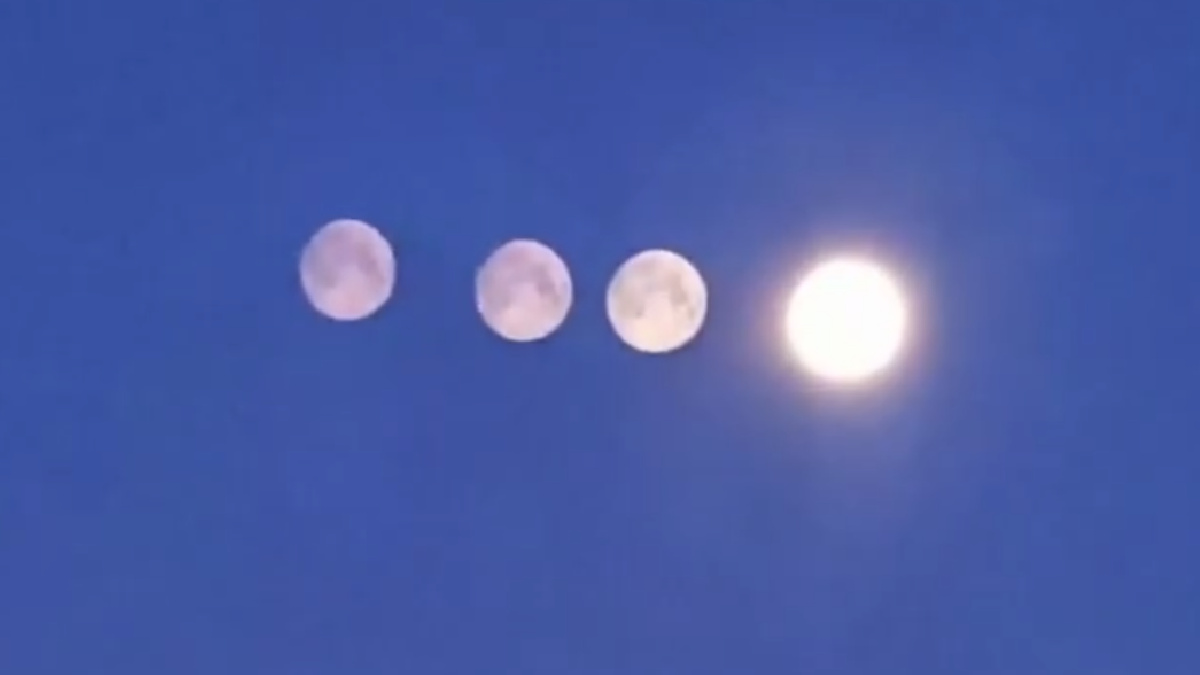
This weekend, stargazers in Russia’s cultural capital experienced a once-in-a-decade sight in the atmosphere, when the illusion of four moons hovering above the city turned into a rare optical illusion among the population of the city. It was a time of extremely cold conditions, where the night sky was turned into a mesmerizing scene and canvas by light and geometry. It was a phenomenon called Paraselene (more popularly known as “Moon Dogs”) and would leave bright, moonlike patches on either side of the actual lunar disc, suggesting that multiple satellites were orbiting the Earth.
The Science of Paraselene
As much as it looks like a mystical event, the so-called "four moons" are nothing but atmospheric optics. This illusion occurs when moonlight passes through a thin veil of cirrus clouds of high altitude. These clouds harbor millions of tiny hexagonal-shaped ice crystals. When the light of the Moon strikes these crystals, they behave like small prisms, refracting (or bending) the light.
The 22° Halo: Most of it is focused, or bent, at an angle of 22 degrees, to create a ring of light and light-filled surrounding the Moon. The Paraselenae: When these ice crystals are oriented horizontally as they are sinking through the air, the light concentrates at certain points on the left and right of the lunar halo. These bright spots are the “Mock Moons” or “Moon Dogs” that observers misinterpreted as more moons.
Perfect Storm: Why Now?
The story of Saint Petersburg was stark because of the extreme winter condition present in the region now. Temperatures in the city dropped to well below -20°C, setting the perfect "diamond dust" atmosphere - a cloud of fine ice crystals at lower elevations which allows the beam to refract light higher.
The brightness of the 2026 event was so intense that even a fourth "moon" formed atop the halo, a rare phenomenon that's called an Upper Tangent Arc; it closed out the quartet of lunar images.

A Night for the History Books
Social media were inundated with photos and videos of the event. Many residents described the experience being “alien” and “hauntingly beautiful.” It was as if one was on a different planet, said one local photographer. “The moon was in the center and these three other glowing spheres around the Moon had been perfectly aligned. It remained as such almost for 20 minutes before the clouds moved.”
Unlike a sun drill, though, “Sun Dogs” (Parhelia) survive the cold winter days because Moon Dogs are more rare here since the Moon is much less radiant than the Sun. In order for a Paraselene to be this prominent, the Moon itself needs to be near full and the atmosphere very still and cold.