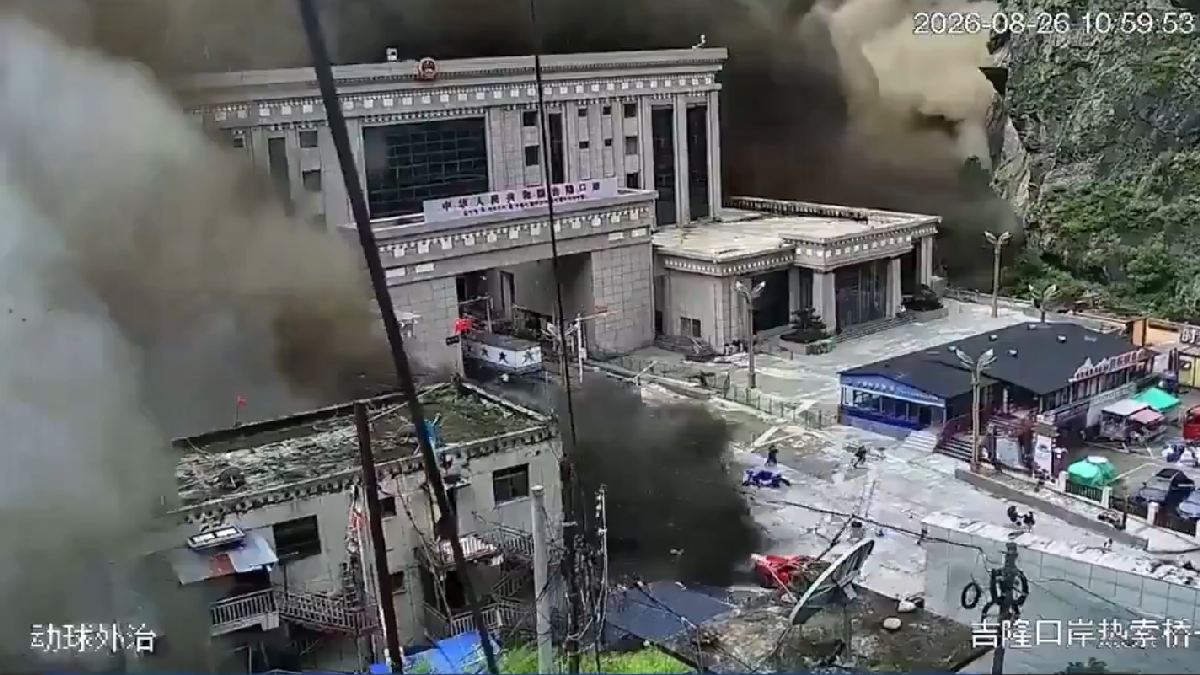
China’s disaster along the Tibet-Nepal border is getting more frightening with Chinese officials warning that a new barrier lake would pose a new threat to the rescue and the communities living in the area. An estimated hundreds of people are still missing after the mudslide and the subsequent flash floods hit areas in Tibet and Nepal.
According to Chinese state broadcaster CCTV, a total of 558 people have been reported missing from the Tibetan side in the wake of the disaster. China’s Ministry of Foreign Affairs spokesperson Lin Jian also added that more than 100 Chinese people were reported missing on the Nepal side, highlighting the cross-border scale of the disaster.
At least three people have died in Tibet after a huge mass of mud and rocks collapsed into the Lhende River near Gyirong, close to the Nepal border. The sudden release of water and debris caused severe flooding downstream, affecting areas along the Bhote Kosi and Trishuli rivers in Nepal.
At least 177 people have died in Nepal and hundreds more are still missing. Homes, roads and vital infrastructure are torn apart by powerful floodwaters. Power plants and transportation networks are also badly affected and rescue and relief efforts are far from simple.
China Issues Fresh Barrier Lake Warning
The latest concern is a barrier lake just upstream of the Himalayan border crossing. Chinese authorities are increasing monitoring of the lake because they worry that a further rise in water levels will lead to another such disaster.
The lake lies near the intersection of the Chhochen Khola and Purepu Tsangpo rivers northeast of the main disaster area. The Ministry of Water Resources in China has reportedly stepped up surveillance and assessment of the site in a bid to understand the risks and prevent more flooding.
CCTV reported that the barrier lake had more than 2 million cubic metres of water as of Thursday and is already overflowing. Water could enter the lake over the next three days. The rapid increase in water volume has raised fears that the natural barrier holding back the lake might be unstable.
A breach could result in a further sudden surge of water downstream, potentially putting rescue personnel and the communities already affected by the earlier flooding at risk.
Villages Evacuated as Rescue Efforts Continue
Chinese authorities have evacuated villages located in identified danger zones on the Tibetan side. Rescue teams have also saved two villagers, while emergency workers are searching for people who remain unaccounted for.
China has activated fire and rescue teams from Beijing and Chengdu to assist police, armed forces and local emergency workers. The teams are helping in the rescue and relief efforts as authorities work to reach isolated areas.
The disaster has also disrupted essential services. Electricity supplies and communications have been restored in central urban areas of Gyirong city, but connections with the border port are still affected.
The damaged infrastructure is expected to complicate the movement of rescue teams, emergency supplies and heavy equipment. Many roads and bridges are also damaged, and authorities will be challenged to respond to the rescue operations while preparing for the possibility of another flood event.
Himalayan Climate and Geological Risks
The latest disaster has once again highlighted the vulnerability of communities living along the Himalayan mountain system. Heavy rainfall, landslides, glacial lake outbursts and rapidly changing geological conditions are all present in the area.
Barrier lakes can form when landslides or rockfalls block natural river channels. Such lakes can be stable for a period but can become dangerous when water levels rise rapidly. If the natural barrier breaks, a large amount of water can be released suddenly, leading to destructive downstream flooding.
The latest warning is particularly concerning because the affected region has already been hit hard. If another major flood were to take place, roads, bridges, settlements and other infrastructure would be under more strain.
The Himalayan region has seen similar incidents in recent years. In August 2025, a glacial lake in Tibet overflowed due to high temperatures, killing nine people and damaging critical infrastructure, including a bridge connecting Nepal and China.
The current crisis is only one more reason to worry about the region's exposure to extreme weather and unstable mountain environments. For communities living along rivers and on mountain slopes, heavy rainfall, landslides and rapid changes in water systems can create dangerous situations with little warning.
As rescue and relief operations continue, Chinese and Nepalese authorities are currently faced with the immediate problem of finding missing people and rebuilding damaged infrastructure. At the same time, close monitoring of the barrier lake will need to be done to see if additional water entering the system could result in another major flood.
With hundreds missing and large areas impacted across the border, the Tibet-Nepal disaster is still an evolving humanitarian and environmental emergency. More careful monitoring of vulnerable river channels and mountain slopes is expected to take place to prevent the latest warning from escalating into another catastrophic disaster.