The U.S. Navy is looking into a new kind of anti-submarine weapon that could glide through the air and then enter the water to search for submarines.
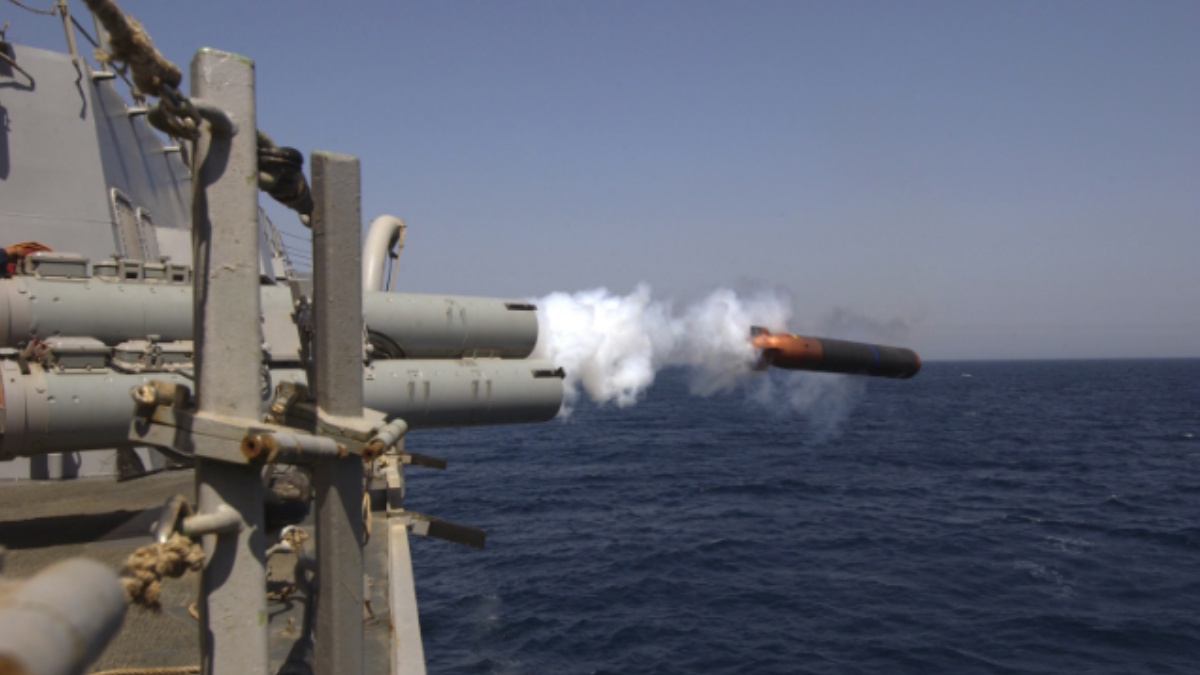
The proposed weapon, called Silent Anvil, is still in the development stage. The Navy is asking defence companies for ideas on how to build it.
The idea could give the US Navy a new way to attack submarines from longer distances and drones might be able to carry the weapon in the future.
How will the Silent Anvil Torpedo work?
Unlike a normal torpedo, Silent Anvil would spend part of its journey in the air.
So an aircraft or drone could release the weapon from a distance. It would then glide through the air before entering the water.
Once underwater, the weapon would act like a torpedo. Sensors based on sound would be used to find and track submarines.
The Navy is considering two possible designs. One is to create a completely new torpedo that can glide through the air. Another is to add a special glide kit to an existing torpedo.
The Navy wants the weapon to be small and light enough to be carried by different aircraft and drones.
The proposed weapon would weigh no more than about 268 pounds and would be about 70 inches long.
Launch scenarios ranging from extremely low altitudes to as high as 60,000 feet are also being considered by the Navy.
It is still not clear how far the weapon would glide.
Why does the US Navy want this new weapon?
The idea is that you can find the submarines from a distance, and attack at close range without even flying a single plane directly over it.
For anti-submarine missions, the US Navy already uses aircraft like the P-8A Poseidon. These aircraft can attack submarines and search over swaths of ocean.
The Navy has also previously tested a system which allows a Mark 54 torpedo to glide from high altitude before entering the water. Silent Anvil would build on this idea and could eventually be used with a wider range of aircraft and unmanned drones.
And drones are especially useful for such long flights, because they can be used in an area in which a pilot may be put in danger.
If a drone detects a submarine, a future version of Silent Anvil could be launched from the drone and sent towards the suspected location.
The Navy is also working on better tech to detect submarines. In 2026, it tested an AI-powered sonar system that can analyze underwater sounds picked up by underwater sensors and identify possible submarine targets.
That’s the US Navy working on both sides of the problem: finding submarines and developing new ways to attack them.
Silent Anvil is designed to spend as much of its journey as possible in the air and only enter the water when it needs to search for a submarine.
That would make the weapon quicker and give aircraft more flexibility during anti-submarine missions.
The project is also important because underwater warfare is becoming more and more important in the Indo-Pacific region.
China is developing its submarine capabilities, so anti-submarine warfare is a major focus for the US Navy and its allies.
But Silent Anvil is not yet an operational weapon.
The Navy is currently collecting ideas from defence companies. Companies have to respond by September 29. If the project moves forward, a prototype could be developed within about 18 months after a contract is awarded.
The final design and capabilities could still change during development.
If successful, Silent Anvil could give the US Navy another tool for hunting submarines. And drones might be used in anti-submarine missions without needing to carry traditional weapons in the same way.
At the moment, that is still to be developed, but it illustrates how modern naval warfare is combining aircraft, drones, sensors and underwater weapons to detect and target submarines more effectively.