One of Bengaluru’s automated traffic enforcement systems has resulted in a rather bizarre case after an AI-powered camera accidentally identified an acoustic guitar carried by a scooter rider as a pillion passenger who was not wearing a helmet.
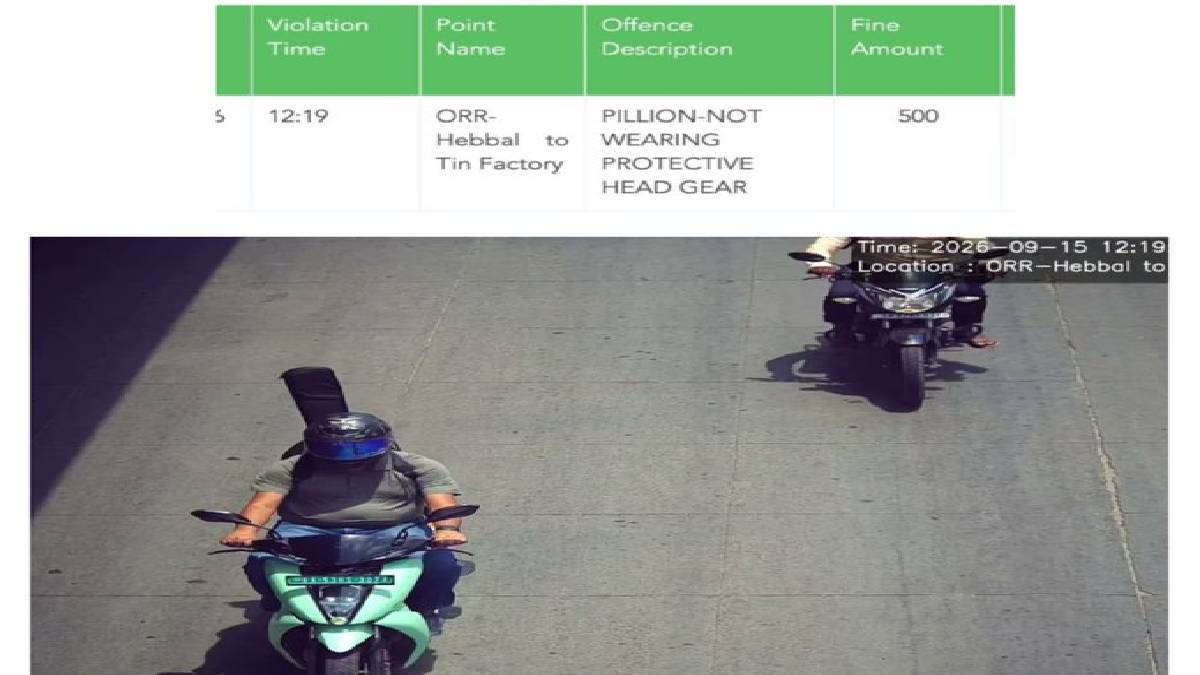
Bengaluru resident Souvik Dutta was seen riding his wife’s scooter in the city with an acoustic guitar strapped to his back, he said on social media. He had a solo ride, but the guitar was above his shoulder, and he appeared to be looking out for the traffic camera as a person sat behind him and was looking at him.
The resulting traffic notice accused the vehicle of carrying a pillion passenger without protective headgear. The challan was then sent to the registered owner of the scooter, Dutta's wife.
Dutta shared the incident online, posting the camera photo and noting that what the automated system had seen as a helmetless passenger was actually his guitar. He also appealed to the Bengaluru Traffic Police to evaluate the photographic evidence and revoke the challan if the violation had been incorrectly detected.
The incident illustrates one of the challenges of automated traffic enforcement: computer-vision systems have to interpret complex real-world scenes involving people, vehicles and objects from relatively limited camera perspectives.
Bengaluru has been increasingly relying on automated surveillance and camera-based enforcement to catch traffic violations. The city’s e-challan system already shows that automated cameras can document violations and add photographic evidence to digitally generated challans. The evidence can be reviewed when a vehicle owner checks the challan.
Helmet compliance is also an important component of Bengaluru’s automated enforcement system. Recent reports and discussions among Bengaluru riders show that cameras have been used to detect helmet-related violations of both riders and pillion passengers.
Under Section 129 of the Motor Vehicles Act, protective headgear requirements must be in place when a person is driving, riding or being carried on a motorcycle, subject to the rules and conditions. This means that identifying a pillion passenger without a helmet is a traffic offence.
In this case, however, the reported problem is that there was allegedly no passenger at all.
The episode shows how even sophisticated machine vision systems can struggle to distinguish people from objects when unusual items are carried on two-wheelers. A guitar case, big backpack, sports equipment or other elongated object could create visual patterns that differ from the situations on which an automated detection system is primarily trained.
Automated enforcement has obvious advantages for a city as big and congested as Bengaluru. Cameras can monitor intersections continuously, allow the detection of violations, and not require a police officer to be physically present at every intersection, which is already being observed. The system has become an increasingly important part of digital traffic enforcement in the city.
At the same time, cases of incorrect identification show why human review and easily accessible grievance mechanisms are still crucial. The e-challan system in Bengaluru has photographic evidence related to violations, so vehicle owners can check the basis of a notice and dispute that issue where appropriate.
The guitar incident in question is less about whether artificial intelligence can monitor traffic and more about how automated systems should handle unusual circumstances. A camera can tell that something is protruding behind a rider, but determining if that is a passenger, musical instrument, or another thing is quite a bit more complex.
For Dutta, the episode resulted in an unexpected traffic notice. For Bengaluru’s rapidly expanding automated enforcement network, it is an amusing example of what happens when machine vision encounters something outside an ordinary traffic scene.
The incident also shows the importance of checking photographic evidence in an automated challan. As traffic enforcement is increasingly dependent on cameras and AI-assisted detection, it is fundamental to check the identification and challenge the wrong identification in a system like this.