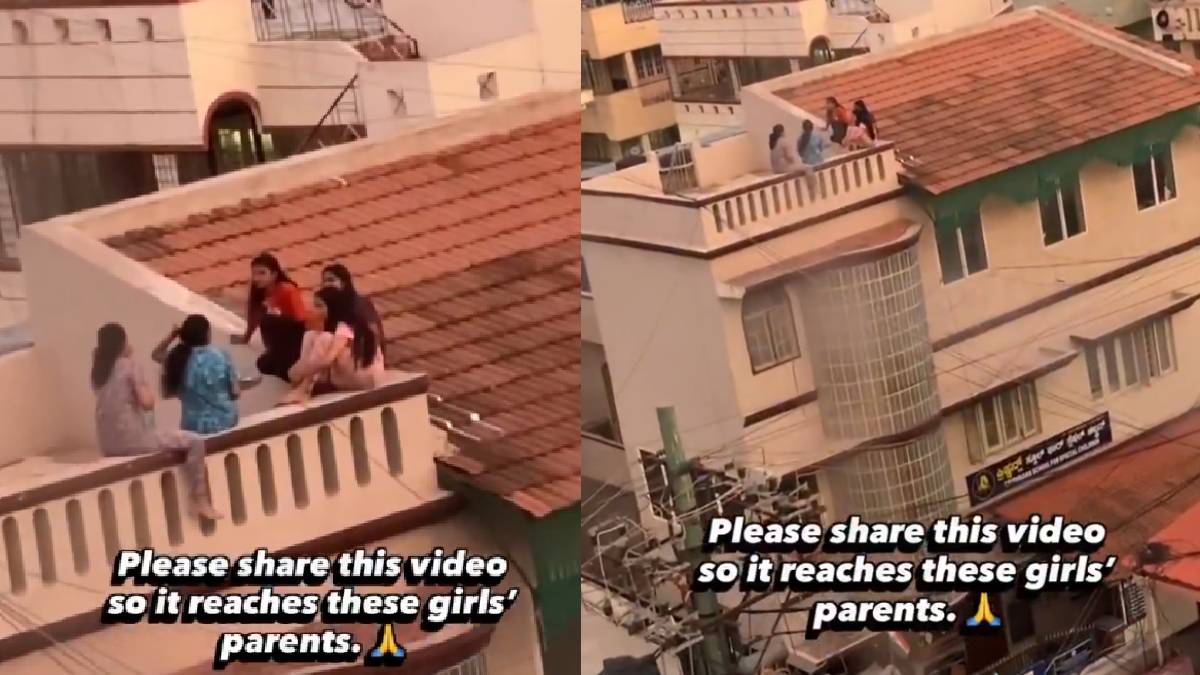
An incident at Tippasandra school in Bengaluru has raised questions about school safety and the level of supervision of students. Five girls were seen sitting casually on the rooftop of Krishna School for Special Children, apparently without visible safety measures or proper supervision.
The incident is causing concern for many who feel that the way the students were able to get into the rooftop area without adult intervention is troubling. Obviously, the facts of the incident have to be established, but it is an example to show the need for a very safe education.
School buildings are places in which safety cannot be treated casually. Safety risks of rooftops, terraces, stairways, and other potentially hazardous areas are generally restricted via access controls, barriers, and supervision, particularly if children are present.
The reported sight of five girls sitting on a rooftop has therefore raised a basic but important question: who was responsible for supervising the area at the time?
There are several possibilities to explain at least some of the students getting to the rooftop, but we are not ready to assign blame for the students’ failure to reach it without investigating the reasons for failure in terms of the students’ climb to the rooftop. What we should do now is to probe whether or not the rooftop was accessible to students, what the safety measures were in place, and whether all school protocols were followed.
Five girls casually sitting on the rooftop of Krishna School for Special Children in Tippasandra, Bengaluru apparently without any safety measures.
— ಸನಾತನ (सनातन) (@sanatan_kannada) August 17, 2026
Is this a reflection of today’s generation, a gap in parenting, or a serious lapse in supervision?
Whatever the reason, safety… pic.twitter.com/eLgeghzB1A
The incident has also triggered a wider discussion regarding student behaviour, parental responsibility, and institutional accountability. It is natural to attribute such incidents completely to changing behaviour among children or failures of parenting. But school safety is a joint responsibility shared by students, parents, teachers, school administrators, and authorities.
Children and teenagers may not always realize the danger of an imminent situation. So schools should have effective preventive measures instead of depending on students to make decisions.
If a rooftop is considered a restricted or hazardous area, physical barriers, locked access points, warning signs, and regular monitoring are all available to prevent unauthorized access. Supervision is especially important in schools where students may require more support and guidance.
The incident also raises questions about whether the school has adequate safety measures in place for terraces and rooftops. An internal review would answer whether access points were secured, staff members were watchful of students, and what was happening with existing safety protocols.
Parents assume schools will provide a secure environment while their children are in institutional care. Safety concerns can significantly affect parents’ confidence in an educational institution.
Students also need to be educated about the dangers of rooftops, high places, and restricted areas at the same time. Safety education should complement physical safeguards and adult supervision rather than replace them.
The incident should not simply be framed as whether today’s generation is more careless or whether parents are failing in their responsibilities. Such generalizations do little to address the immediate safety issue.
The more important question, of course, is whether appropriate safeguards were in place and, if not, then why.
If such situations were indeed reported, schools would have to review their safety plans and ensure that potentially dangerous areas are secure. Education and local authorities could also consider whether an inspection was necessary.
The incident serves as an example that preventing accidents is far better than responding after one occurs.
For parents, teachers, and administrators, the episode has made our vigilance very important. Students should be encouraged to enjoy their school environment, but that freedom must be within clear safety boundaries.
Accountability should be based on facts rather than assumptions. A proper analysis of the incident will reveal how the girls entered the rooftop, whether school staff knew about it, and what safety precautions were available.
When it comes to all the circumstances, it seems that there is one thing that’s clear no matter what the situation is like for students: student safety should not be taken for granted.
The Bengaluru incident should prompt schools and authorities to ask if their safety systems are strong enough to do better in the future to prevent similar situations. What appears to be an ordinary moment may be a simple accident and can easily escalate into a serious one with the least precautions taken, making safety measures essential.