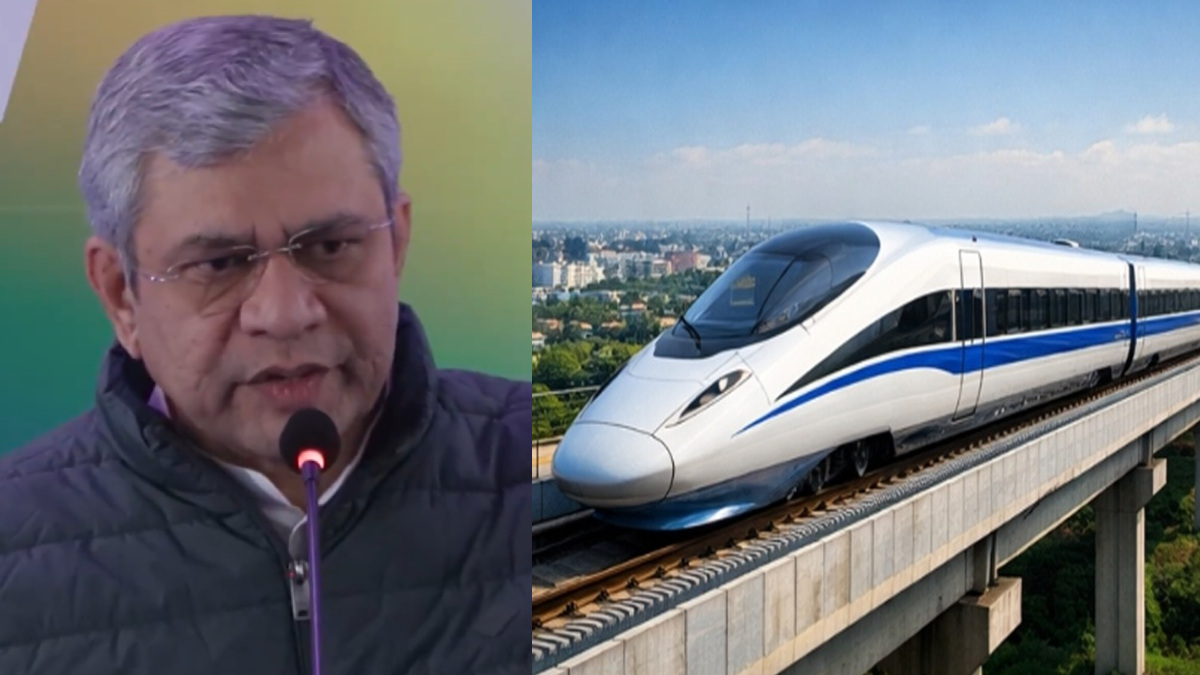
Imagine getting breakfast in Bengaluru and reaching Chennai in time for a mid-morning meeting—just over an hour. However, this futuristic vision is getting closer to reality. Union Railway Minister Ashwini Vaishnaw announced a major update on the new high-speed rail corridor, which will take 73 minutes to travel between the two southern hubs. Now even the fastest trains like Vande Bharat Express take nearly 4.5 to 5 hours to cover the 350 km distance, with road travel stretching up to 7 hours.
The Dream: A Bullet Train for South India
The planned Bengaluru–Chennai High-Speed Rail (HSR) corridor marks an ambitious development of India as it aims to connect several economic clusters via the deployment of bullet trains.
- Top Speed: The corridor will be designed for trains with speeds of up to 320–350 km/h.
- Route: The high-speed alignment will bypass the usual winding tracks, taking a straighter route to reach high velocity.
Minister Vaishnaw said the Detailed Project Report (DPR) and feasibility studies are moving quickly. That includes environmental impact assessments and finding the most effective land acquisition methods that minimize displacement.
Accessibility through Multi-Modal Transport
Central to the update is the incorporation of these high-speed stations into existing infrastructure.
- Station Locations: The government is considering "Integrated Transport Hubs" where the High-Speed Rail stations will seamlessly link to the Bengaluru Metro and Chennai Metro lines.
- Economic Impact: The project allows for a daily commute between the two cities by bringing the travel time down to 73 minutes, effectively putting the two cities into one “mega-economic zone.”
Vande Bharat vs Bullet Train
The Vande Bharat trains have completely changed the current way tracks can move in this direction, but Vaishnaw stresses that the High-Speed Rail is a whole different game of infrastructure. “We are not just focusing on improving existing tracks, our mission is to create an entirely new infrastructure for high-speed travel. The corridor between Bengaluru and Chennai has been a priority because of tremendous economic potential and a high volume of passengers on both,” the Minister said.

Challenges and Timeline
No matter how enticing a “73-minute” promise, the project would encounter considerable hurdles:
- Acquisition of Land: The purchase of a straight piece of land through the hilly terrain between the two cities is still a challenge.
- Cost: High-speed rail projects demand huge capital investment and must often rely on international coordination (the Mumbai-Ahmedabad project was a case in point).
- Construction: Developing elevated tracks and tunnels for such speeds will take years once the project is officially greenlit.