A very special display of patience, craftsmanship, and dedication has emerged from Bikaner, Rajasthan, where Mahesh Purohit, a transporter by profession, is winning admiration for engraving the Hanuman Chalisa and parts of the Ramayana on tiny rice grains.
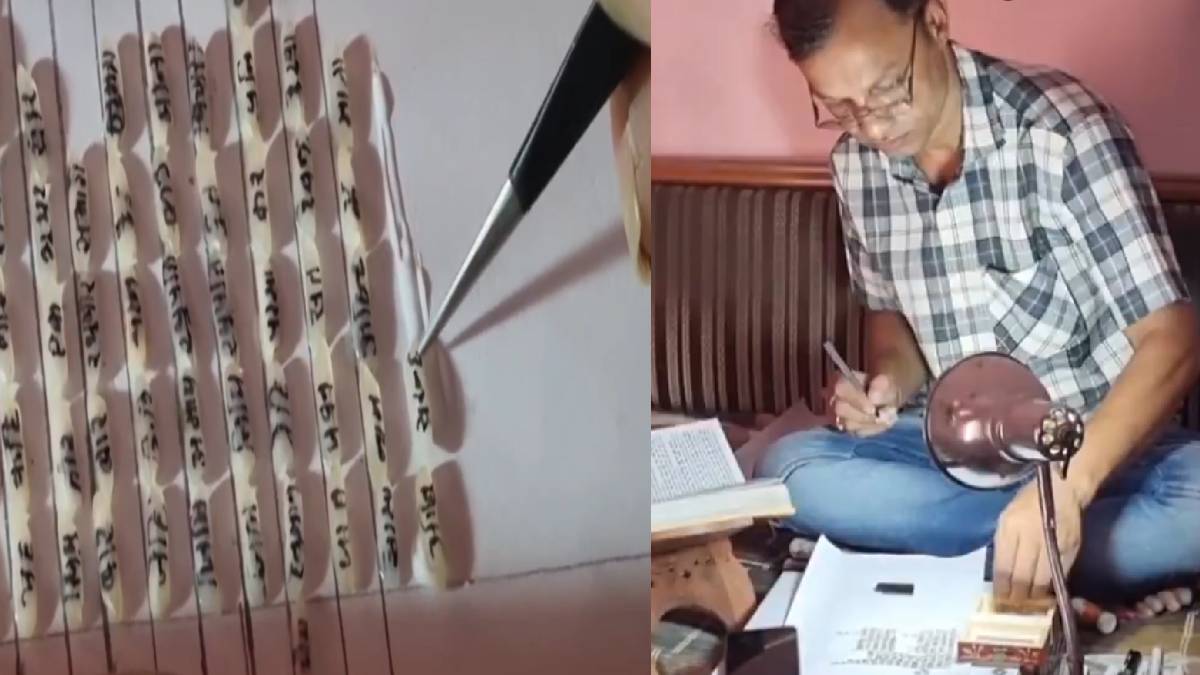
Mahesh does not make money as a professional artist. He works every day in the transportation industry but has devoted countless hours to art: miniature paintings that honour India’s rich spiritual and cultural heritage. His unique talent has made simple grains of rice into art canvases with sacred verses.
Mahesh’s crafts have left friends, family members and admirers astonished. It’s just a rare combination of great concentration, solid hands, artistic precision and profound spiritual commitment that they say his work is. Each grain has to be meticulously handled, because even a tiny move can break the delicate surface or make the tiny inscriptions unable to be read.
Mahesh believes that art can be made on the most humble of surfaces, and that creative thinking and commitment are more important than the medium. He is a good example of the way to think that some people love to work on things, but others do not, and what motivates them to do so is to create art, to work on the matter.
The engraving on rice grains is one of the most demanding forms of miniature art. To finish even a few words, artists need magnification tools, fine engraving tools, lighting control, and patience. Writing longer devotional texts like the Hanuman Chalisa or passages from the Ramayana takes a lot of precision and concentration.
Mahesh feels so much inspiration in his creation of such a big thing to do with Lord Ram, Lord Hanuman, and others from the Ramayana. The objective for Mahesh is to preserve and celebrate these ancient spiritual traditions, to share them with younger generations, and to show them how much he’d like to preserve and celebrate India’s culture and religion through his art.
And not only because of his technical power but also because of the message it conveys. Friends and well-wishers say his dedication exemplifies perseverance, discipline, and faith—things that transcend artistic boundaries. They see his projects as a testament to how dedication can be expressed through innovation and craftsmanship.
Mahesh is not done with rice grains. His next aim is to translate the Ramayana onto matchsticks. This is a more difficult artistic feat due to the narrow and fragile surface. If it is achieved, this project will be another outstanding accomplishment in Indian micro-art and will further demonstrate that he is very good at detail.
India has a long history of miniature art, from fine manuscript illustrations and ivory carvings to microscopic paintings and engravings. Artists are still inventing new ways of doing things, and new techniques are constantly in the making in the country. Mahesh’s work adds a new chapter to this long history of art with faith, craftsmanship, and innovation.
Besides its artistic value, his work serves as a reminder that exceptional talent can emerge from any profession. Even though Mahesh is a transporter, his passion and dedication can lead him to high achievement and inspire many others.
Though images of his creations remain inspiring to admire, Mahesh Purohit's micro-art continues to draw admiration and is a testament to patience, devotion, and creativity. His little rice-grain inscriptions have a message much more than their size: faith, determination, and artistic vision can lead to a visual transformation of the smallest canvas into a masterpiece.