The Centre has launched a ₹5,175 crore performance-linked incentive scheme to encourage states to accelerate the operationalisation of auctioned mines and drive governance reform in India. The scheme, launched at the level of the Scheme for Special Assistance to States for Capital Investment (SASCI) 2026-27, will strengthen India’s mining industry and alleviate the long-standing delays in mineral production.
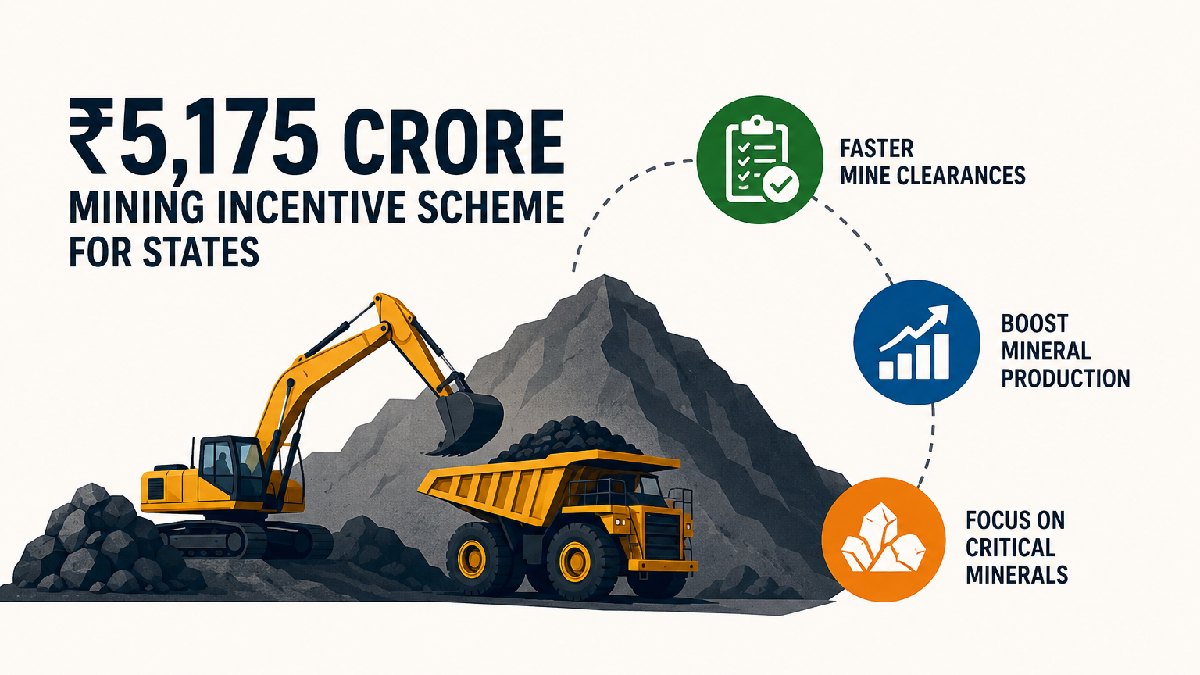
The scheme is part of India’s continued push for domestic mining supplies of essential minerals such as lithium, cobalt, nickel, graphite and rare earths that are critical for electric vehicles (EVs), renewable energy systems, battery manufacturing and advanced electronics. By linking financial incentives to actual mine production and not just auctioning mineral blocks, the government hopes to build investor confidence and create more jobs.
Tackling delays in mine operationalisation
Despite considerable resources in iron ore, bauxite, manganese, limestone, copper and other strategic minerals, India still struggles to turn these sold mining blocks into productive assets. According to government data, 684 major and critical mineral blocks have been auctioned by the Centre and various state governments up to March 31, 2026. But many of these are still under construction given the slow pace of environmental clearance, forest clearance and land acquisition.
These regulatory bottlenecks have slowed mineral production, disrupted industrial supply chains and weighed on investment in the mining industry. The new incentive framework is intended to address these problems and rewards states that have shown the ability to get projects through quicker and begin mining operations more quickly to make sure that mining operations start in a timely manner.
Three-Pillar Incentive Structure
The ₹5,175 crore incentive package has been divided into three components that will be focused on specific aspects of mining sector development.
₹2,500 Crore for Mine Operationalisation
The majority of the scheme is to bring the mineral blocks auctioned into production. States will receive ₹20 crore for every major mineral block auctioned with all necessary statutory clearances already in place before the auction. The aim is to encourage governments to complete environmental, forest and land approvals ahead of time so that the timing of the lease of mining is not affected.
Additional incentives will be available for states where auctioned mines start mining and shipping minerals by December 31, 2026. To qualify, states will have to ensure that at least 10% of their auctioned mining blocks are operational in the time frame.
₹2,000 Crore for Governance Reforms
The second pillar rewards states with improved mining governance and transparency. To access these funds, states must implement reforms such as the integration of a national digital mining portal, creation of pre-auction clearance committees, issuing of annual auction calendars, technology-based ore grade monitoring and avoiding additional state-level mineral taxes and cesses.
The incentive pool will be distributed on a first-come, first-served basis to encourage states to begin reforms at the earliest stage.
₹675 Crore Through the State Mining Readiness Index
The remaining allocation will be distributed through the State Mining Readiness Index (SMRI), which will rank states based on digital infrastructure, speed of approvals, regulatory efficiency, auction preparedness and overall operational readiness.
Boost for Resource-Rich States
States with large mineral reserves like Rajasthan, Madhya Pradesh, Odisha, Chhattisgarh, Karnataka, Gujarat and Maharashtra are expected to benefit from these projects if they achieve the programme's operational and governance milestones.
The incentive program will also enhance the availability of raw materials in steel, cement, aluminium, infrastructure and manufacturing sectors and allow for faster development of important mineral projects.
Strengthening India's Critical Mineral Strategy
One key element of the scheme is critical minerals that are now much more important for India’s clean energy transition and industrial aspirations. With the increasing demand for lithium, cobalt, nickel and rare earth elements, the government intends to reduce reliance on imports and drive production in the country at the same time, accelerating the production in the mineral blocks that are being auctioned.
The initiative will benefit the supply chains for battery manufacturing, electric mobility, renewable energy technologies and semiconductor production and would help India in the fast-growing global industry, the officials said.
Capital Investment Focus
The SASCI scheme funds can only be utilised for capital investment projects (e.g., mining districts) to promote regional development, infrastructure creation and employment generation. The scheme is available to all states and Union Territories with legislative assembly participation so that participation across India’s mineral-rich region is widespread.
A New Production-oriented Mining
While previous efforts largely rewarded states for conducting mineral auctions, the new framework directly links financial incentives to actual mine operationalisation and governance reforms. Through performance-based funding, administrative improvements and competitive benchmarking, the Centre aims to transform India's mining ecosystem into one driven by production, efficiency and long-term investment.
If implemented successfully, the ₹5,175 crore programme could significantly accelerate mineral production, improve ease of doing business in the mining sector, strengthen domestic supply chains and position India as a more competitive player in the global market for both conventional and critical minerals.