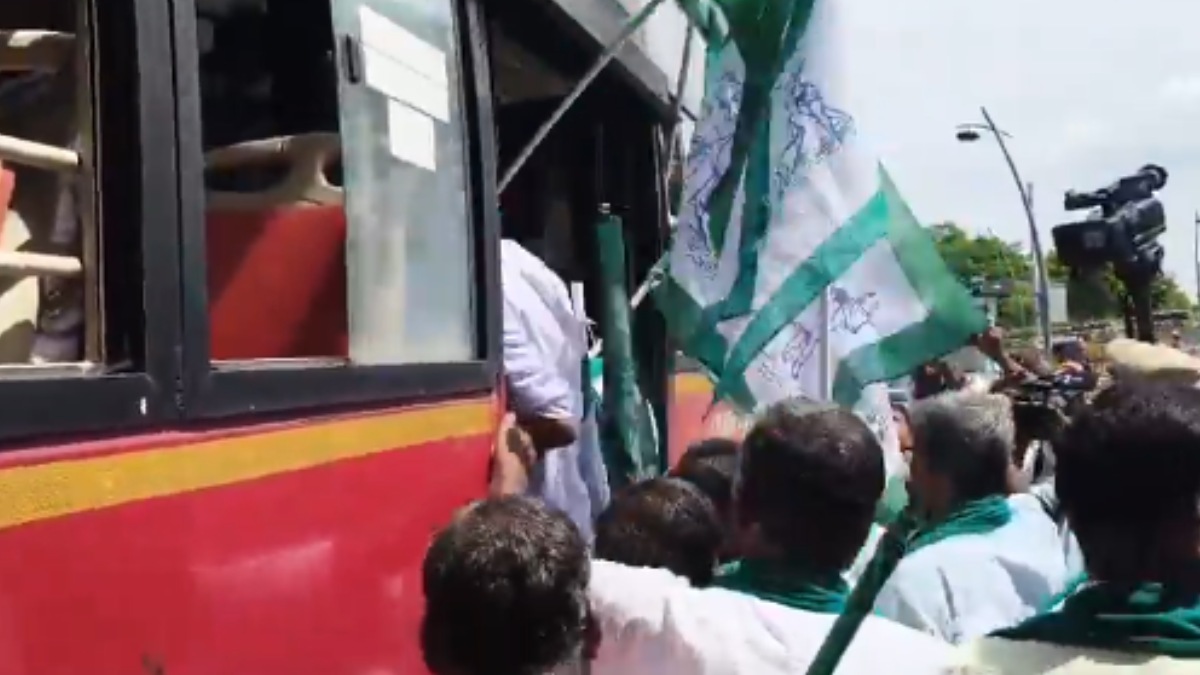
Farmers protesting in Egmore (a busy neighborhood in Chennai), who were protesting the seizure of the tractor by police, were arrested by the police at the same time they were raising a number of pressing demands to support farmers and the farming community. These dedicated people were demanding that farmers have better help to support them, and that they need tractors for farmers who don’t have one now. This is a gap in the resources that farmers rely on for their living.
The Egmore protest highlighted the perennial concerns of farmers regarding getting access to essential agricultural equipment and the high cost of farming. Farm machinery (tractors and other farm equipment) are essential tools to farm, field preparation, transport of agricultural inputs and produce, and perform various farming tasks. Unfortunately, for many small and marginal farmers, especially in the context of farming income being very variable, the cost of purchasing such equipment is often prohibitive and this only adds to the already difficult situation facing those who are trying to sustain their agricultural practice.
At the protest, the farmers made vocal proposals that were made at the protest that farmers in the farmers' request that the government supply tractors to those who needed the farmers who are presently without tractors for those farmers who lack access to tractors to farmers who are unable to get tractors to farmers who are currently without access to the government. They also asked for the government to offer tractors to the farmers who are without them. They compared the support for Members of the Legislative Assembly (MLAs) with the lack of resources for farmers who depend on agriculture to support their families and communities. They argued that the farmers asked the government to provide tractors for those who need them, and in the protest they wanted to show that this was not given to the latter.
Police took action in Egmore as it happened, and detained many protesting farmers. They’ve only exacerbated the problem that the people were already facing and have brought greater attention to their situation. When demonstrations are illegal or not in the public interest, police will arrest people; however, the specifics of this action must be contextualized within the relevant permissions and regulations that govern protests in urban areas like Chennai.
The call for tractors is emblematic of a much larger systemic issue in Indian agriculture: mechanization. Modern agricultural machinery can eliminate that labor and make farming more efficient in time-sensitive operations. But for farmers with few landholdings, the option of purchasing a tractor alone is often not feasible. So new solutions such as shared machinery services, cooperative ownership models, government subsidies, and equipment rental centers are crucial to make farming equipment more accessible to farmers that need it most.
Tamil Nadu is home to a large agricultural community, a vast farming community in many districts, and farmers grow crops that are well-suited to soil conditions, rainfall patterns, and available irrigation resources. The agricultural landscape is diverse, and farmers’ ability to thrive is greatly affected by the size of their landholdings, the crops they grow, and the availability of water and labor. Farmers’ organizations advocate for policies to alleviate both immediate financial pressure and long-term structural problems in the agricultural industry.
The difference between the facilities available to the protesters and those provided to MLAs highlights the issue of public resources in this regard. Elected representatives take a certain amount of benefit from their official role, but farmers argue that if essential agricultural equipment is not provided, they will not be able to work with the land effectively. So the discussion goes beyond tractors to include how governments can improve agricultural production and how to make it more accessible and economically viable for small-scale cultivators.
At the same time, the cost of tractors for individual farmers must be evaluated against considerations of utilization and eligibility criteria. A government-supported machinery-sharing system could potentially enable multiple farmers to access equipment without necessitating that every individual cultivator own a tractor. In this way, public investment in agricultural equipment would ensure that farmers have the farm equipment at the right time when it is most needed.
The protest also points to the importance of farmer groups having dialogue with government officials. Farmers’ organizations frequently protest as a way of drawing attention to their demands that they feel have not been taken into account through conventional channels of communication. Government authorities have to balance the right to peaceful protest with maintaining public order in densely populated urban areas such as Chennai Egmore.
The arrests resulting from the protest are likely to keep the spotlight on both the demonstration itself and the substantive demands raised by the farmers. For the agricultural community, access to machinery represents just one aspect of a much larger array of concerns that also encompasses input costs, crop pricing, irrigation practices, labor availability, market access, and overall income security.
Chennai Egmore’s protest has brought a very specific but important agricultural issue into the public consciousness. The farmers’ demand for tractor support is part of a bigger call for practical assistance that can ease the financial burden associated with cultivation. Whether this is through direct provision, subsidies, machinery rental programs, or cooperative arrangements, improving access to agricultural equipment could become a fundamental part of comprehensive farmer-support policies.
Farmers protesting in Chennai Egmore were arrested by the police while demanding various measures, including providing tractors to farmers who do not own one, similar to the provision of cars to Members of the Legislative Assembly pic.twitter.com/vLaoeZW9dk
— Vignesh Theni (@Vignesh_twitz) September 2, 2026
The protesters’ demands, together with the police response, have once again put the issues of farmer support, public spending priorities, and access to modern agricultural equipment at the heart of public debate in Chennai. We must continue to have this dialogue so that agricultural policy and support systems will benefit the farmers who are foundational to the region’s economy and food security.