External Affairs Minister Dr. S. Jaishankar will visit Ukraine and Poland from September 3 to 5 as part of a delegation. Dr. S. Jaishankar will be in Ukraine and Poland from September 3-5 on a state visit, the Ministry of External Affairs (MEA) announced on Wednesday. The visit comes at a critical time for India to visit Europe at a time of increasing geopolitical tension in Ukraine and Poland, as the situation in Ukraine and the Russia-Ukraine conflict is still very much in the news cycle.
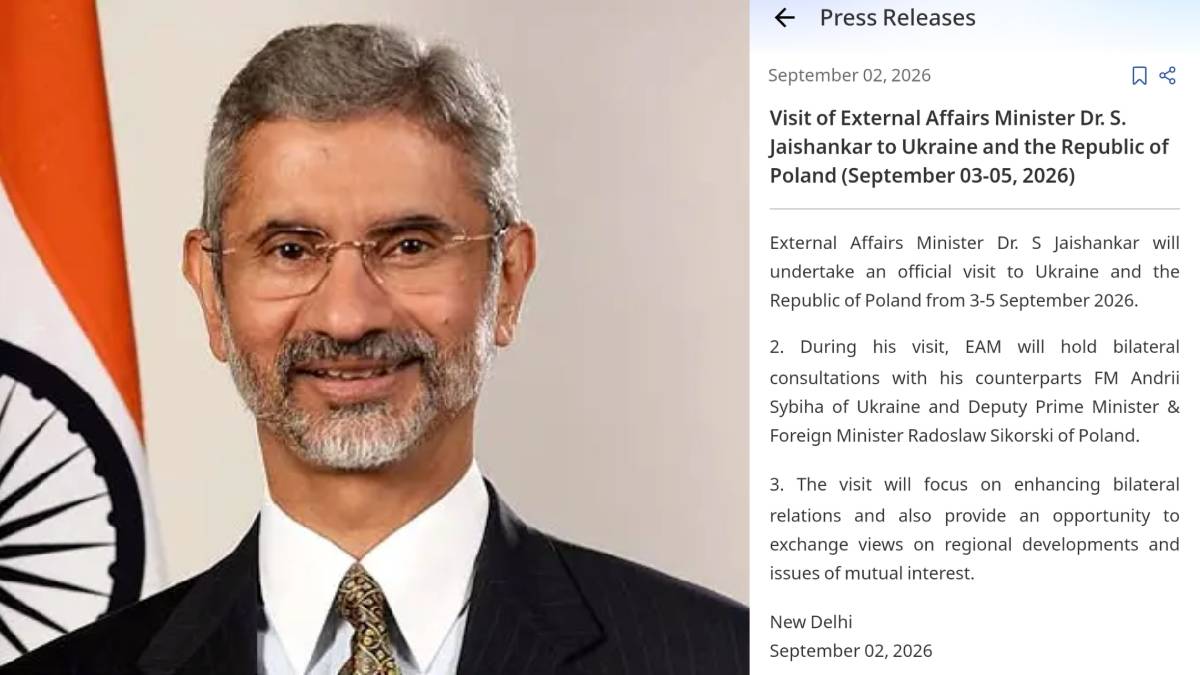
Jaishankar is expected to hold bilateral talks with Ukraine's Foreign Minister Andrii Sybiha and Poland's Deputy Prime Minister and Foreign Minister Radoslaw Sikorski. A discussion on relations between India and both countries will be aimed at developing India’s bilateral ties with both countries, and mutual views of regional developments and issues of interest between them.
The Ukraine leg of the visit is particularly important as India continues to engage in diplomatic efforts with Kyiv and has always advocated dialogue and diplomacy as the way forward to the settlement of the Russia-Ukraine conflict. New Delhi has been talking to both Moscow as well as Kyiv and has always stressed the need for a peaceful resolution of the war.
Jaishankar’s visit comes shortly after recent diplomatic exchanges between India and Ukraine. Ukraine’s First Deputy Head of the Office of the President, Sergiy Kyslytsya, recently had discussions with India’s Ambassador to Ukraine, Anjani Kumar, about the prospects of India-Ukraine relations and India’s potential role in efforts to resolve the conflict.
The Indian government also continued to engage Ukraine at the highest level. Narendra Modi visited Ukraine in August 2024 during the first visit of an Indian Prime Minister to Ukraine since Ukraine became independent. The visit also emphasized that India wants to maintain a high-level diplomatic channel between Kyiv and Russia as well as to maintain a good relationship with Ukraine.
Jaishankar's Poland visit is equally important for India's expansion of engagement with Central Europe. Poland has become an increasingly indispensable partner for India as trade, technology, investment, defence and connectivity are more and more important in recent years.
In Warsaw, Jaishankar will meet Polish Foreign Minister Radoslaw Sikorski to continue the diplomatic dialogue between New Delhi and Warsaw. The Indian Embassy in Poland has emphasized the increasing political engagement between the two countries and Prime Minister Modi’s 2024 visit to Warsaw.
The three-day diplomatic tour will therefore cover a wide range of bilateral and international issues. While strengthening economic and political cooperation will be key in the talks, the security situation in Europe is likely to be at the forefront.
India's engagement with European countries has become all the more important as New Delhi seeks to expand partnerships across the continent. The Ukraine conflict and energy security, trade, supply chains and broader geopolitical developments have all added to the strategic importance of India's ties with European countries.
Jaishankar’s visit also comes as India continues to emphasize its standing as a country where diplomacy and negotiation can work well with a variety of sides. New Delhi has for years stressed diplomacy and negotiations in the face of global challenges as a means for regional conflicts and for India’s strategic and economic interests.
The September 3-5 visit to Ukraine and Poland will therefore be closely watched for signs of how India is going to deepen its engagement with Europe and contribute to peace and stability discussions in the region.
With the foreign ministers of both countries in mind, we will be able to have meetings and review existing partnerships, identify new areas of cooperation, and share views among them on the rapidly changing geopolitical environment.