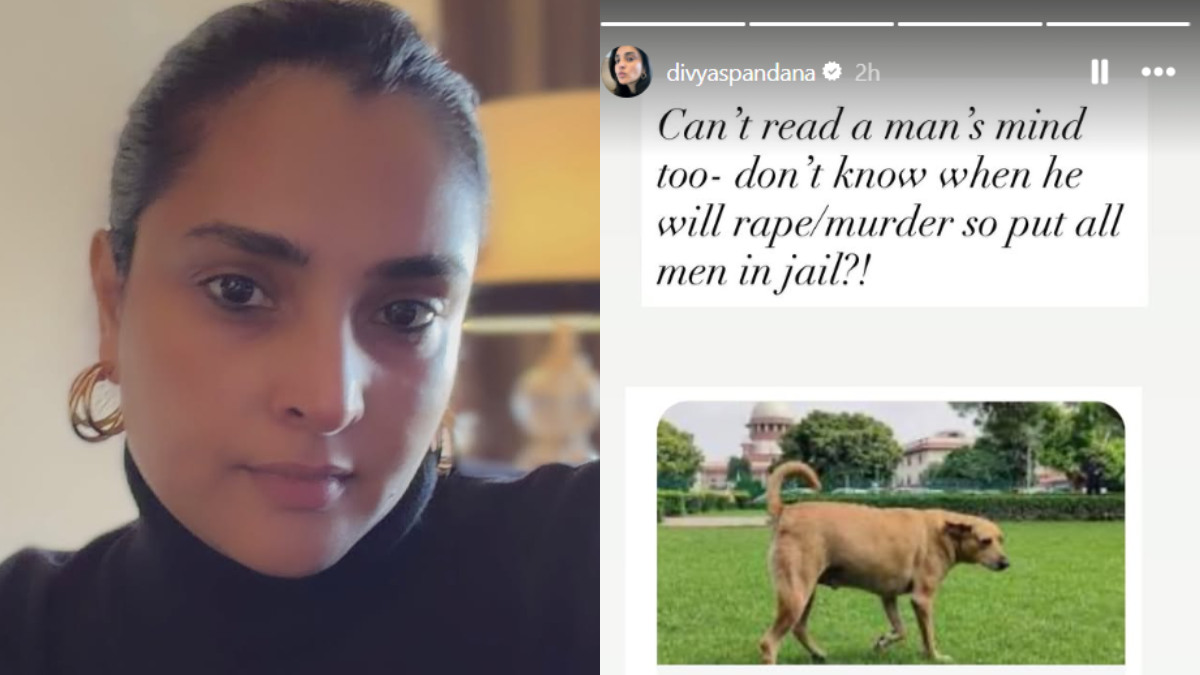
The battle of public safety against animal welfare got off to a fever pitch in January 2026 after inflammatory social media statements by the actor and former MP Divya Spandana aka Ramya. Her comments were a direct answer to comments made by the Supreme Court of India during a pivotal hearing on the “stray dog menace.”
The catalyst: “Can’t Read a Dog’s Mind.”
On 7 January 2026, in the proceedings, Supreme Court bench comprising Justices Vikram Nath, Sandeep Mehta and N.V. Anjaria expressed deep concern at increasing instances of dog bites and at stray animals wreaking havoc on the roads. Justice Vikram Nath remarked:
“It’s not just biting but that there is a danger from dogs… What do you know that dog is feeling in the morning? So you cannot read a dog’s mind when he is like, ‘I'll be biting this.’” That statement was the legal rationale for the court’s hard line on the subject: the public places like hospitals, schools and highways should be kept “clear and clean” of stray dogs for human purpose.
That Social Media Disruptor: Divya Spandana’s Social Media Status
Divya Spandana, a fierce animal rights advocate, on Instagram posted to fight against the legal logic of the court's stance and logic. She posted a status, which quickly went viral, likening the uncertainty of animals to the unpredictability of humans: “Can’t read a man’s mind too — Don’t know when he’ll rape or murder, so should we put all men in jail?” Her comment employed the rhetorical tool reductio ad absurdum, which states that if “unpredictability” is the exclusive criterion for removal or “detention,” the same reasoning applies to humans who commit violent crimes. Analyzing the Backlash. There was a firestorm of debate ignited by the post. Critics said the comparison was a “false equivalency,” observing:
Legal Agency:
Humans are subject to social contract and are accountable for those they commit through the criminal justice system. Under current laws (Article 21), the right to life and safety for humans is more important than the freedom to roam wild in public. But Spandana’s backers saw the comment as an important pushback against the “dehumanization” of animals.

That the Court’s Order — which proposed placing stray dogs in shelters instead of releasing them back to their original homes — effectively calls for permanent incarceration for animals based not on the dogs’ aggressive behavior, which has been proven and documented, but their “motivation” to stay in care, the authors said. The Way forward: Coaching on the Path to Mediating the Conflict. The Court has ordered states to adopt the Animal Birth Control (ABC) Rules more strictly and make certain that institutional areas are kept behind secured fences. The debate illuminates a widening urban schism:
Safety Advocates:
Claim that it is the state’s sole responsibility to protect the public from unnecessary harm. Animal Rights Activists: The need to forcibly remove entire animals and give them shelter with no way to go free is inhumane and against the spirit of the 2023 ABC Rules.