As cyber threats are becoming more and more sophisticated and complex, cybersecurity is now one of the top priorities for governments, businesses, and technology leaders worldwide. This very critical issue was at the FutureCrime Summit 2026 where industry experts, cybersecurity experts, policymakers, and technology professionals gathered to discuss solutions to secure India's digital ecosystem.
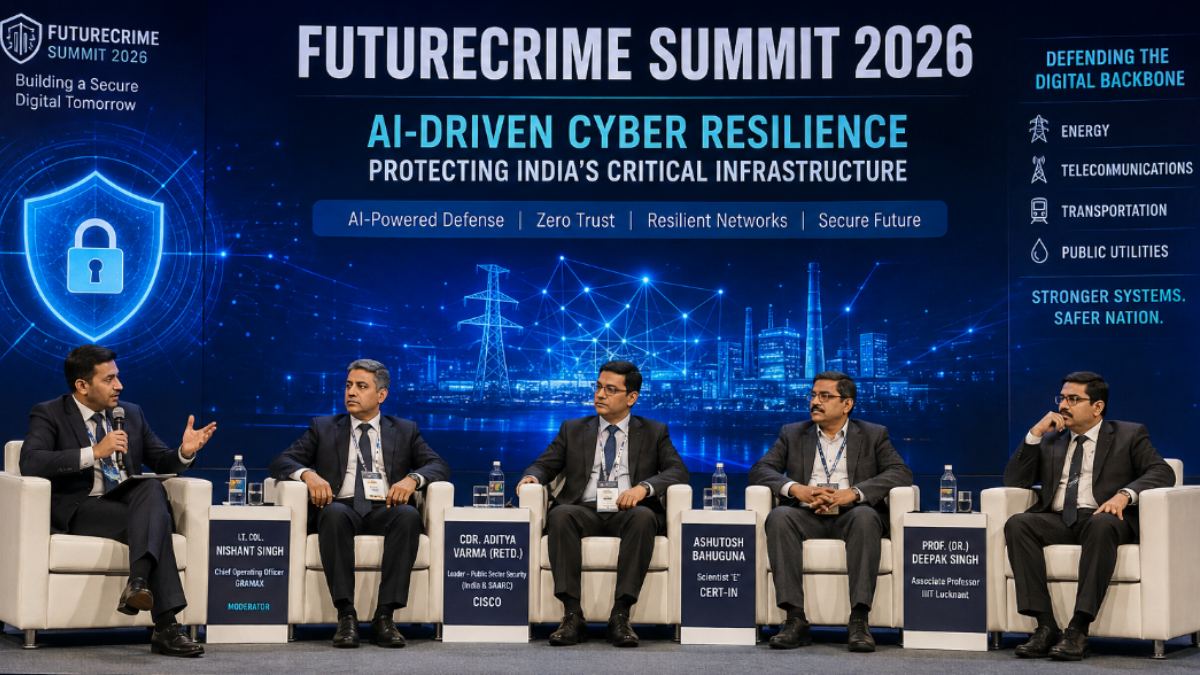
The second high-profile panel of the conference was titled “Defending the Digital Backbone: AI, Critical Infrastructure and Cyber Resilience,” where artificial intelligence, resilient security architectures, and collaborative threat intelligence were discussed to protect critical services from complex cybercrime threats.
The panel held in New Delhi was dedicated to the defense of the energy, telecommunications, transportation, healthcare, banking, water supply, and public utilities from rapidly expanding digital threats. With India's digital transformation on the rise in every corner of the country, the experts said the traditional cybersecurity methods are no longer effective to protect an infrastructure that now depends on highly interconnected networks and cloud-based technologies.
The discussion was led by Lt. Col. Nishant Singh, Chief Operating Officer at GRAMAX, who took us through the growing cyber threats to India’s critical infrastructure. He asked fundamental questions about national preparedness, which sectors are the most susceptible to technology-backed disruption, and how organizations should respond to cyber intrusions that combine cyber sabotage with physical sabotage and coordinated disinformation campaigns.
Today’s infrastructure is fundamentally different from legacy systems, experts said. The previously isolated technology networks on the ground are now much more integrated with digital platforms, cloud services, IoT devices, and AI-powered automation. While this transformation has brought about much improved efficiency, it has also widened the attack surface for cybercriminals and state-sponsored threat actors.
The panel highlighted that cyberattacks targeting critical infrastructure can have consequences far beyond data theft. Disruptions to electricity grids, telecom networks, transportation systems, healthcare facilities, or financial institutions can affect millions of people who are living in the country, and thus resilience is more than just an IT concern for the nation.
Commander Aditya Varma (Retd.), Lead Security Officer of Public Sector Security (India & SAARC) at Cisco, stressed the need for secure network architecture from scratch. He said the most effective way of protecting critical infrastructure is to implement strict network segmentation and compartmentalization.
He said physical infrastructure and digital systems need to operate in terms of a defined security boundary. By isolating network zones and limiting communication among them, organizations can prevent cyberattacks from spreading rapidly through the network’s interconnected systems. Even if attackers damage one part of the network, strong architectural controls can prevent the breach before it disrupts critical public services.
The discussion also highlighted the increasing role played by national cybersecurity agencies in strengthening India’s cyber defense capabilities. Scientist ‘E’ at CERT-In, Ashutosh Bahuguna, explained how India's national incident response framework continues to evolve through proactive vulnerability assessments, coordinated threat intelligence, and rapid response mechanisms.
As Bahuguna said, CERT-In continually monitors cyber threats affecting government departments, public sector organizations, and critical infrastructure operators. In response to growing cyber threats, the agency provides uniform guidance to national and regional Computer Emergency Response Teams to deal with them.
Artificial intelligence emerged as the central theme throughout the discussion. AI has become a game changer for efficiency across industries, yet experts in the industry said it’s also transforming cybersecurity itself.
Prof. (Dr.) Deepak Singh, Associate Professor at IIIT Lucknow, advocated for self-healing security systems built by AI to automatically identify vulnerabilities and act without human intervention.
He recalled how modern AI frameworks continuously monitor operational telemetry across digital infrastructure and detect unusual behavior that may indicate an emerging cyberattack. Instead of having to manually patch (or wait for software to update), these intelligent systems automatically deploy security patches, isolate compromised devices, and ensure that it is safe to operate at a time-critical level.
Such automated response mechanisms greatly reduce the “window of vulnerability” between identifying a security flaw and implementing corrective measures, making it much harder for attackers to exploit the newly discovered weaknesses.
Technology is not necessarily an answer to cybersecurity.
Dinesh O. Bareja, the leading cybersecurity consultant, said human awareness is still one of the best defense mechanisms against cybercrime. Despite huge investments in advanced security technologies, many successful cyberattacks start with human error (by phishing emails, fraudulent phone calls, fake login portals, or other forms of social engineering).
Bareja stressed the importance of embedding cybersecurity awareness at every level of management from senior executives to operating staff in the industrial sector. Regular employee training, simulated phishing exercises, and continual awareness campaigns can substantially reduce the likelihood that attackers gain access to sensitive infrastructure at the beginning.
He also said we need to expand public awareness on cybercriminals to ordinary citizens as entry points into more well-established organizational networks.
All of my panelists mentioned again and again that cybersecurity needs to evolve from reactive defense to proactive resilience. We need to think about systems that can survive from each of our systems and not just try and block every attack we face but do everything we can to have them continue operating.
Zero-trust architecture was featured prominently among the suggested approaches. In this approach, every user, application, and device needs to verify its identity at all times to gain access to sensitive systems, whether it’s in or outside the company’s network perimeter. Zero-trust, in combination with multi-factor authentication, continuous monitoring, endpoint detection, behavioral analytics, and AI-based threat intelligence, makes for a better security posture from a security perspective that enhances a well-established organization’s entire cybersecurity profile.
Experts also stressed the need for real-time network monitoring for India’s telecommunications backbone, transportation network, and public utility systems. Machine learning-powered traffic inspections to keep track of traffic patterns can enable security teams to identify unusual patterns quickly and respond before attacks get out of hand and go global.
The panel concluded that protecting India’s rapidly expanding digital infrastructure is a matter of close cooperation between government personnel, private businesses, technology companies, academic institutions, and cybersecurity experts. No single organization can take on the challenge of defending the ever more interconnected systems under which our lives depend.
With India's digital public infrastructure, smart cities, AI adoption, Industry 4.0 programs and nationwide connectivity, cybersecurity will be the foundation for sustained growth. At FutureCrime Summit 2026 we were encouraged that resilience is not only about preventing cyber attacks, it is also about ensuring essential services remain functional even under sustained digital assault.
Through the use of AI-based threat detection, zero-trust security, automated incident response, continuous patch management, network segmentation and comprehensive cybersecurity awareness, India is rapidly building a better digital defense system to secure the critical infrastructure against future cyber threats. The summit also reinforced to the nation that resilience, collaboration and intelligent automation would be the basis for the future of cybersecurity strategies as it prepares for an ever more connected world.