India is entering a new era of transportation with the development of its first-ever Bullet Train Corridor, the Mumbai-Ahmedabad High-Speed Rail (MAHSR) Corridor. The ambitious infrastructure project is expected to revolutionize inter-city travel by bringing world-class high-speed rail technology, dramatically reducing travel time and enhancing safety, comfort and efficiency.
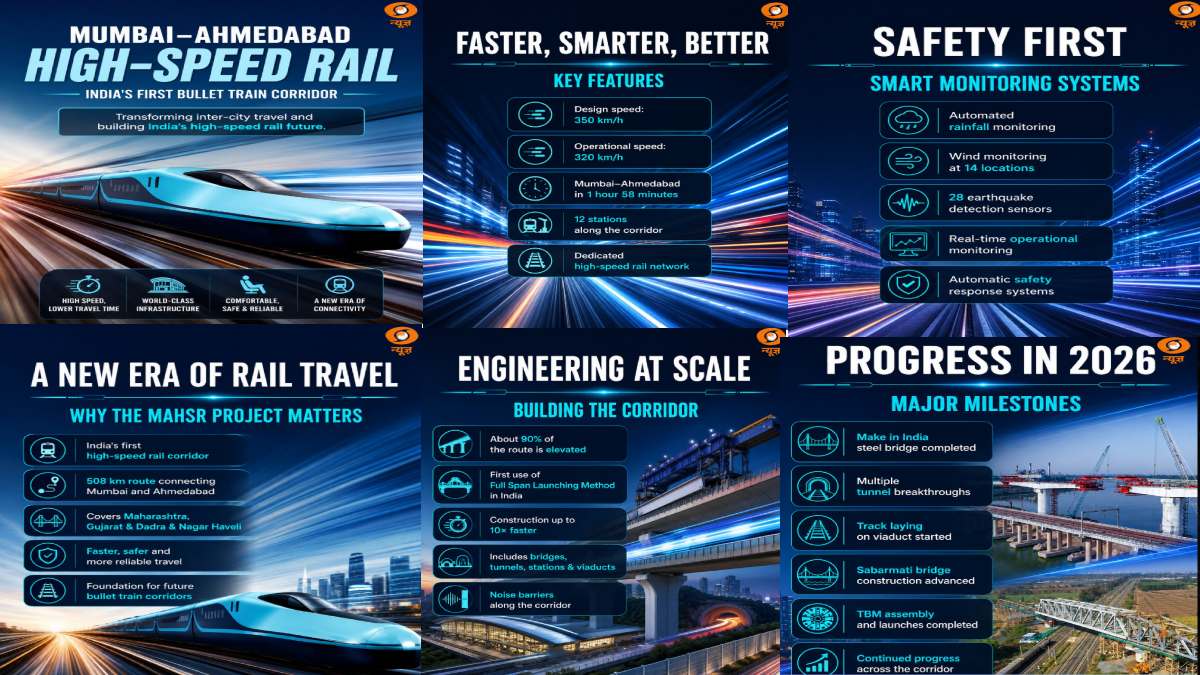
The corridor spans around 508 kilometres between Mumbai in Maharashtra and Ahmedabad in Gujarat and is among India’s largest transportation projects. There is a possibility that the high-speed rail line could cut travel time between the two major economic hubs from nearly seven hours by conventional rail to 2 to 3 hours, depending on the number of stops.
The Mumbai-Ahmedabad High-Speed Rail project is being run by the National High Speed Rail Corporation Limited (NHSRCL) with Japan's technical and financial support. The project will put the world's best Shinkansen technology and reliable service in the hands of the public.
Shinkansen is also referred to as the Bullet Train and has been operating for more than 50 years with no passenger deaths from train accidents. The state-of-the-art engineering, rail tracks and state-of-the-art operations make it the safest high-speed rail network in the world.
This project includes some emerging engineering technologies that are being introduced for the first time in India. Elevated viaducts, long-span bridges, mountain tunnels and sophisticated stations are among those built specifically for high-speed operations. The most technically challenging component will be the undersea tunnel close to Mumbai, which will contain a section under the Thane Creek, as India is better at complex infrastructure building.

Safety is still one of the key pillars of the Mumbai-Ahmedabad Bullet Train Corridor. Because of this, a railway will be operated on a completely separate track with no roads and no trains crossing over to other railway lines. There will be train control technologies that will continuously monitor train movement which will automatically control speed and prevent collisions. Modern earthquake detection systems, automatic train protection, and real-time monitoring technologies will also enhance passenger safety.
Passenger comfort will also be a priority and the bullet trains will feature comfortable seats, comfortable interiors, noise reduction technology, modern passenger information systems, accessibility features, and cleanliness will be a priority in the project. The stations are built with the highest level of luxury, fast train movement and integration into existing transport systems.
In addition to quicker travel, much more economic benefits are expected from the project. Connectivity between Mumbai and Ahmedabad is likely to promote business growth, tourism, investment and regional development. Fast transportation will also enhance industrial corridors, promote commercial growth and facilitate access to jobs in western India.
Construction has already generated thousands of jobs for engineers, technicians, construction workers and associated industries. And the transfer of advanced Japanese technology and technical expertise will enhance India's domestic capabilities in high-speed rail engineering, maintenance, and operations.
The corridor also fits in with India’s vision of modern and sustainable transport infrastructure. High-speed rail is a more eco-friendly way of transportation than road and air travel and it is less carbon-polluting than road and air travel and it reduces highway congestion and reduces energy consumption. Investment in modern rail infrastructure is expected to increase with India becoming more urbanized and needs for future mobility needs.
The Mumbai-Ahmedabad project is seen as the first step to establishing a larger network of high-speed rail corridors across the country. Some other routes have been suggested for future development which would connect large metropolitan cities and the economic centres with much faster, safer and reliable rail service.
🚄 India's First Bullet Train Corridor: A New Chapter in High-Speed Rail
— DD News (@DDNewslive) July 22, 2026
The Mumbai–Ahmedabad High-Speed Rail Corridor is laying the foundation for a new era of rail transportation in India. From world-class Shinkansen technology and advanced engineering to cutting-edge safety… pic.twitter.com/GtB5Sn1sYI
Although land acquisition problems, engineering challenges and construction timelines have been significant obstacles, progress has been seen over the past few years. Bridges, viaducts, station buildings and track infrastructure are gradually taking shape and we are getting closer to achieving India’s long-delayed bullet train dream.
As the Mumbai-Ahmedabad High-Speed Rail Corridor moves closer to completion, it represents not just a new railway line but also the future of India as a nation in which technology is being developed and transportation infrastructure is being built so that mobility is not only a good thing but also an investment to promote economic growth and regional integration. And with the country’s first bullet train almost complete, even long distance rail travel in the future is more than a national achievement for this country.