There is now a new debate surrounding historical records from Karnataka that are stored in archives in neighbouring Maharashtra. There is a demand by historians, researchers and history lovers to locate them all, digitise them and return the documents, for which legal and administrative means are available to Karnataka.
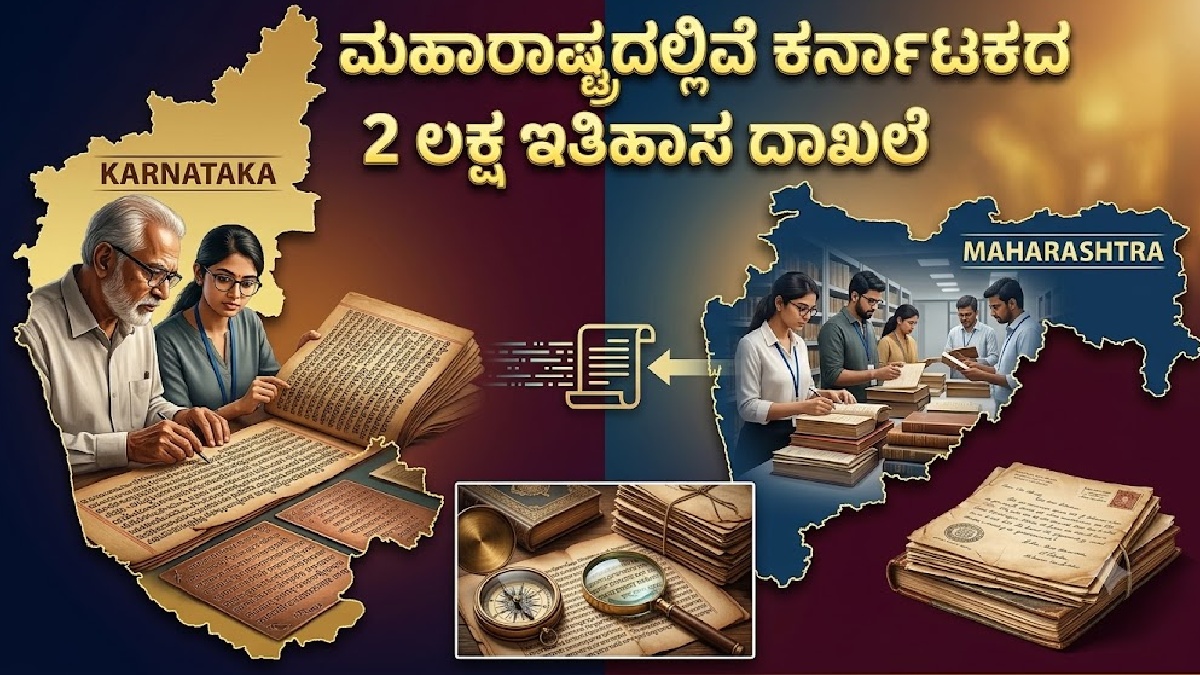
The issue is particularly significant because historical material related to Karnataka’s political, cultural, social and administrative past might be scattered across archival institutions that are based on earlier administrative boundaries rather than the borders of the present states.
Among the materials that have attracted particular interest are records that might be related to Kittur Rani Chennamma and Sangolli Rayanna (Karnataka's two most prominent historical figures).
Why are Karnataka Records in Maharashtra?
The presence of Karnataka-related records in Maharashtra can be understood in the context of centuries of political and administrative connections between the two regions.
Before modern states were formed, territories were governed by kingdoms, princely states and administrative systems. Records were often kept in administrative divisions that did not correspond to today’s state boundaries during the British period.
As administrative centres changed, documents related to regions that are now part of Karnataka could therefore be transferred to repositories outside the present state.
Consequently, the existence of Karnataka-related records in Maharashtra does not necessarily mean that they were deliberately dropped from Karnataka. Rather, historical administrative arrangements may explain why documents about Karnataka are now in archives elsewhere.
What Could These Records Contain?
The historical archive is much bigger than the documents related only to kings, wars and political events.
They can contain land records, tax documents, government orders, correspondence between princely states, reports prepared by British officials, court records, administrative communications and documents related to social and economic developments.
Such material can be useful to understand how people lived, how territories were administered, how taxes were collected, how land ownership was organized and how political decisions made in the community affected local communities.
Original archival documents are especially valuable for researchers because they offer the primary evidence for comparison of historical accounts and oral traditions.
What is the significance of Chennamma and Rayanna Records?
Kittur Rani Chennamma and Sangolli Rayanna are significant in Karnataka’s resistance to British rule.
Chennamma’s resistance and subsequent battle with Kittur are often discussed in writings, oral traditions and popular accounts. But original administrative correspondence, official reports, court documents and communications from the period can provide additional evidence about the political circumstances surrounding the conflict.
In the same way, Sangolli Rayanna records might help researchers understand the organization of resistance, colonial authorities' response to it, and the social conditions of this time period.
As historical figures cannot be understood through folklore or later stories alone, primary documents can also help historians distinguish between documented histories, later interpretation, and popular accounts.
Concerns Over Preservation
Another major issue is the physical preservation of old records.
If not preserved in the right temperature, humidity, and conservation conditions, paper documents, manuscripts, and other archival material may deteriorate.
When a historical document is destroyed, damaged beyond its ability to recover, or permanently lost, reproducing the same source may be impossible.
This is why historians and researchers are now focusing on digitisation more and more.
It would be possible to create high-quality digital versions of papers so scholars could study the documents without having to handle the fragile originals repeatedly.
Could Digitisation be the first step?
Moving hundreds of thousands of documents from one state to another could present significant administrative, legal and conservation challenges.
A more practical first step might be to create a detailed inventory of Karnataka-related material held in Maharashtra's archival institutions.
Karnataka and Maharashtra could jointly identify documents based on location, period, subject and historical significance.
The identified records could then be professionally scanned and digitised.
Digital copies could then be made available to Karnataka's universities, research institutions, libraries and historians.
This would allow researchers in Karnataka to access important historical material while the original documents are kept safely in professionally maintained archival facilities.
Need for Cooperation Between Two States
The issue could be tackled through cooperation between the Karnataka and Maharashtra governments and their respective archives departments.
A joint archival survey could identify:
Documents related to Karnataka, records connected with princely states and local administrations, British-era correspondence concerning Karnataka regions, material relating to Kittur and its historical figures, land, revenue and judicial records, political and administrative correspondence, documents requiring urgent conservation.
Once identified, the two states could decide whether the originals can be legally and practically transferred, or if authenticated digital copies should be made and shared.
Historical Records Are More Than Old Documents
Historical records are not simply old pieces of paper. They are evidence of the political, economic, social and cultural life of previous generations.
Documents can contain information on agriculture, trade, education, local administration, communities, social movements and political developments that are not adequately documented elsewhere.
For future generations, such material can also help prevent historical narratives from becoming dependent entirely on incomplete or secondary sources.
Will the Records Return To Karnataka?
Whether original Karnataka-related documents still held in Maharashtra can be physically returned would require detailed examination of ownership, archival law, provenance and administrative arrangements.
Before any demand for repatriation can be acted upon, authorities would need to establish precisely which documents exist, where they are located, their historical significance and the legal status of each collection.
If physical transfer is not possible, official digitisation and wider research access would provide an effective alternative.
A Responsibility For Future Generations
The preservation of Karnataka’s historical heritage is a collective responsibility of governments, historians, universities, archives professionals and the public.
A comprehensive survey of Karnataka-related records in Maharashtra could be an important starting point.
The priority should then be to identify the documents, to preserve them scientifically, to digitise them and to make them available to genuine researchers.
Records connected with Kittur Rani Chennamma, Sangolli Rayanna and other important chapters in Karnataka’s history could potentially add valuable primary evidence to existing scholarship.
Whether these documents eventually return physically to Karnataka or remain preserved in Maharashtra with authenticated digital copies available in Karnataka, ensuring their survival and accessibility should remain the central objective. In the case of a state wanting to preserve and understand its history, these archival records are not just relics of the past; as such, they are not merely a product of the past. They are evidence; they are evidence to be used further down the road to tell us where Karnataka came from and how its society, politics and culture have evolved.