A tiger from Karnataka’s Nagarahole National Park has reached Ankola in Uttara Kannada district after a journey of more than 350 kilometers. This is now believed to be the longest tiger migration in Karnataka, and the success of forest conservation programs has been proven; connected wildlife habitats do not get neglected.
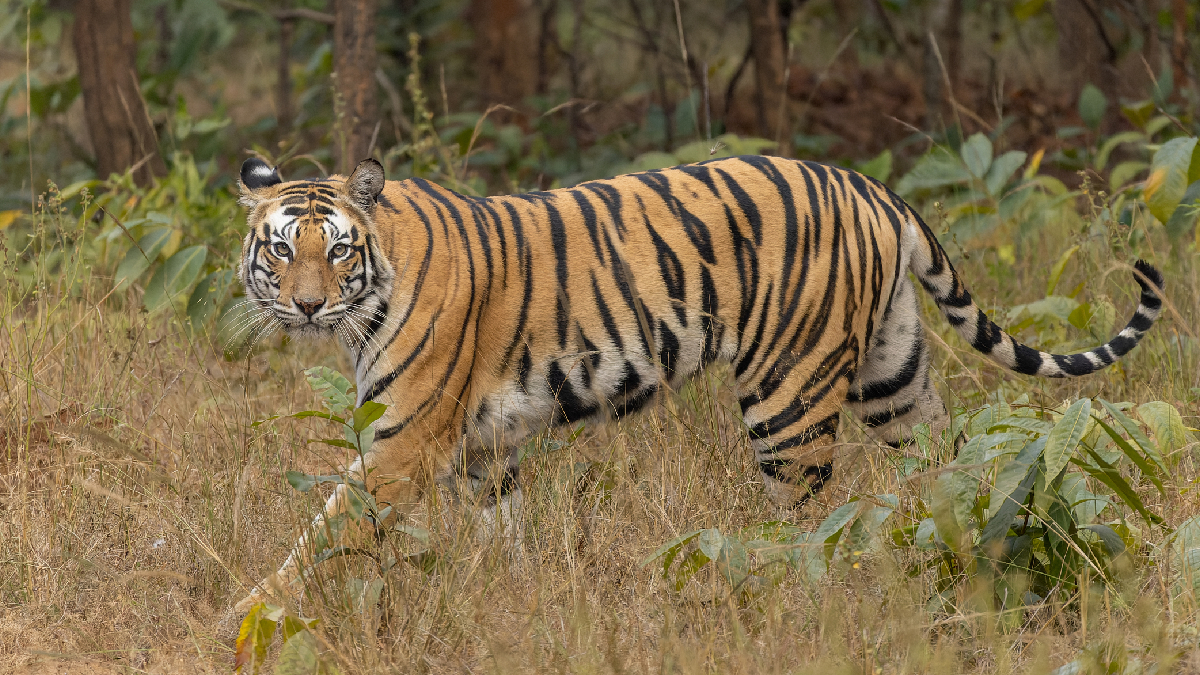
The discovery came during the recent tiger census in the Canara Circle conducted by the Karnataka Forest Department. Government officials were reviewing thousands of images recorded by camera traps when they noticed something unusual. For the first time in Ankola's wildlife history, camera traps captured photographs and footprints of two tigers roaming through the dense forests of Gule and Kotibavi ranges.
At first sight, the big cats were quite exciting. But the real surprise came when the tiger stripe patterns were evaluated by wildlife experts with advanced identification software. Since every tiger has a unique stripe pattern, much like a human fingerprint, researchers could trace their origin accurately.
The analysis revealed that neither tiger was originally from Ankola. One had dispersed from the nearby Kali Tiger Reserve, and the other made a wonderful journey from Nagarahole National Park to Ankola by traveling more than 350 km across various landscapes before he settled in Ankola. The route probably included hills, rivers, valleys, agricultural fields, and even human settlements, so survival was a remarkable task.
Wildlife experts say that tigers are generally territorial animals. Adult males usually establish territories ranging from six to 12 square kilometers and aggressively defend them from competitors. But young male tigers often leave their birthplace in search of new territories where they can establish dominance and find mates.
Kumar Pushkar, Principal Chief Conservator of Forests and Chief Wildlife Warden of Karnataka, said long-distance tiger dispersal had become more visible in recent years because of camera trap technology. These monitoring systems have changed wildlife research; scientists can monitor animals with remarkable accuracy.
The Ankola and Karwar forests are the best destinations for tigers because of their rich biodiversity and extensive forest cover. The Karwar forest has more than 118,000 hectares and is a continuous landscape with the Kali Tiger Reserve. Evergreen forests, moist deciduous forests, dry deciduous forests, and scrub vegetation are found throughout, and this gives the perfect habitat to large carnivores.
The Ankola sub-division itself covers nearly 24,800 hectares over seven forest areas. But more importantly, the area provides abundant prey, including gaur (Indian bison), sambar deer, spotted deer, barking deer, wild boar, and porcupines. Such prey abundance makes the area an ideal habitat for newly arrived tigers looking to establish territories.
This remarkable migration is also part of a growing list of long-distance tiger dispersal events in Karnataka. From 2006 to 2008, a tiger cub first photographed in Bhadra Tiger Reserve was later found to be nearly 270 kilometers away in Kali Tiger Reserve. One tiger that attacked a person in Shivamogga's Shikaripura was traced back to Bandipur National Park after traveling about 280 kilometers. A tiger from Maharashtra also spread around 250 kilometers before settling into the Kali Tiger Reserve permanently.
The Nagarahole-to-Ankola journey has surpassed all the previous records and is the longest tiger movement in the state’s history.
The Kali Tiger Reserve has been regarded as a 'sink' habitat, and so dispersing tigers will be attracted to it because it is a large, well-connected forest. And Chief Conservator of Forests Vasant Reddy says: “The reserve is completely connected to the Goa forests and Bhimgad Wildlife Sanctuary.” With abundant prey and minimal habitat fragmentation, these corridors are safe for wildlife.
Dr. K. Ullas Karanth, wildlife biologist of the field, says that long-distance movements are most frequent in young male tigers looking for territory of their own. He also advises that further scientific research is needed in order to better understand dispersal patterns and to plan for the long term.
The arrival of the Nagarahole tiger in Ankola is more than an isolated wildlife event. And it is evidence that Karnataka’s forest corridors are still in operation and conservation efforts over the past decades are helping wildlife move around in the broad landscape. The roaring presence of this great traveler serves as proof that nature is flourishing in the face of increasing human pressure.