Nepal's Foreign Minister Shisir Khanal has rejected the notion of Kathmandu choosing between India and China, saying both neighbouring countries are important to Nepal for different reasons. He told NDTV at a Kathmandu news conference that Nepal does not consider its relationships with the two countries as alternatives and does not want one relationship to replace the other.
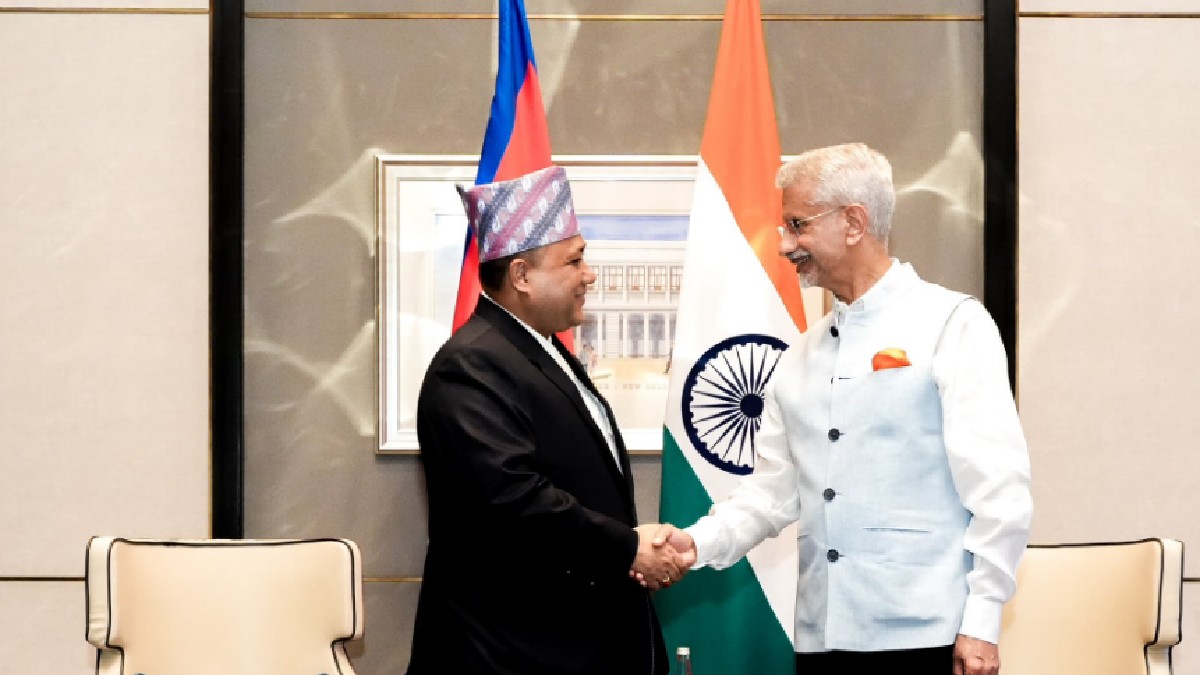
Khanal said in his family analogy, he would not wish to tell his father that he would replace him with his mother or vice versa. His comments are a reflection of Nepal’s approach of the country’s desire to keep ties with India and China close in the name of the country’s national interests and to maintain good relations with both.
Khanal said Nepal has an emotional connection with its neighbours but its foreign policy is driven more by rational considerations of its interests. He described India and China as important neighbours and noted that Kathmandu would rather have a harmonious relationship than to play between them in the larger strategic battle of the two Asian powers.
The foreign minister was also asked about China's expanding economic presence in Nepal. He said India's economic relationship with Nepal was important because almost two-thirds of Nepal's total trade is with India. India still has an important role in Nepal's economy, despite the fact that China has been building more infrastructure and investment in Nepal.
Nepal has long-standing cultural, economic and people-to-people ties with India. The two countries also have an unusually open border which allows citizens to travel across much of the frontier with little to no documentation that’s usually required at international borders. At the same time, China has become an even more important economic and strategic partner for Nepal, particularly in infrastructure and connectivity efforts.
Nepal plays down border dispute with India
Khanal also attempted to play down the significance of Nepal’s border disputes with India during the same conversation. He said, “It’s not as big as it is made out to be,” as the India-Nepal border is open.
Khanal states that boundary disputes are a natural challenge among neighbouring countries. He said the large movement of people across the India-Nepal border makes the relationship distinctive and such disagreements should be considered in a broader context.
But territorial disputes have remained a sensitive part of India-Nepal relations. Nepal continues to assert its claim over the Lipulekh area in Uttarakhand, a disputed region located close to the India-Nepal-China trijunction.
Earlier this year, Nepal objected to India and China's plan to transport Kailash Mansarovar Yatra through the Lipulekh Pass. Nepal has insisted that the land claimed by Nepal should not be used for deals with India and China without addressing its concerns.
The Lipulekh Pass is strategic because it is the junction of India, Nepal and China. It is also the one line of pilgrimage to Mount Kailash and Lake Mansarovar in Tibet.
Nepal faces a flood crisis
Khanal’s remarks on Nepal’s foreign relations come as the country is coping with the aftermath of devastating flash floods affecting the Bhote Koshi and Trishuli river systems. The disaster has caused extensive loss of life and property; more than 300 people are reported dead and many others are missing.
The floods also affected areas on the Chinese side of the border. China has been in touch with Nepal on the search and rescue and has been in contact with relevant diplomatic missions to keep an eye on the situation.
The disaster has also affected Indian nationals. The search and rescue teams have found about 100 missing Indians, while hundreds of others were still unaccounted for, according to Indian media.
The situation has added another layer of conflict to Nepal’s relationship with its two big neighbours. India and China are competing for influence in South Asia, but Nepal has always tried to keep room for manoeuvre with both countries.
Khanal’s recent comments further support Kathmandu’s stated interest in a balanced foreign policy. Rather than seeing India and China as enemies, Nepal appears to be in favour of keeping trade, geography, connectivity, security and national interests in mind; that is, relations with India and China as competitive.